Forex Trading Plan: How to Write One, With a Template
A forex trading plan is a written set of rules that defines which markets you trade, under what conditions you enter and exit, and how much you risk per trade and in total. A typical plan covers the pairs and hours traded, entry and exit rules, risk per trade, daily and weekly loss limits, and how results are recorded and reviewed. A plan does not guarantee profits; it sets decisions in advance to reduce impulsive trading.
Key takeaways
- A trading plan puts the decisions that should be made before a trade into writing.
- A plan typically covers: pairs and trading hours, entry and exit rules, risk per trade, and daily and weekly loss limits.
- In many plans, the risk per trade is capped at a fixed percentage of the account, and the lot size is calculated from that risk and the stop loss distance.
- A plan can be tried on a demo account or with low risk first, and assessed with a trading journal.
- Rules are usually changed at a scheduled review after enough trades, not during a trade or after a single loss.
At a glance
- Strategy
- How trades are found and managed
- Plan adds
- Risk, markets, hours, records
- Risk rules
- Per trade, daily, open trades
- Rule changes
- Usually at scheduled reviews
Why use a forex trading plan?
A trading plan puts the decisions that should be made before a trade into writing: which pair, under what conditions, with how much risk, and when to exit. The decisions are made in advance and calmly, not in front of a moving price while a gain or loss is on screen.
Three common benefits are:
- Consistency: when every trade follows the same rules, results can be measured and the method can be assessed.
- Risk control: limits set in advance can help prevent a single trade or a bad day from causing disproportionate damage to the account.
- Fewer impulsive trades: unplanned, over-leveraged trades and chasing losses can make trading resemble gambling.
What is the difference between a trading plan and a trading strategy?
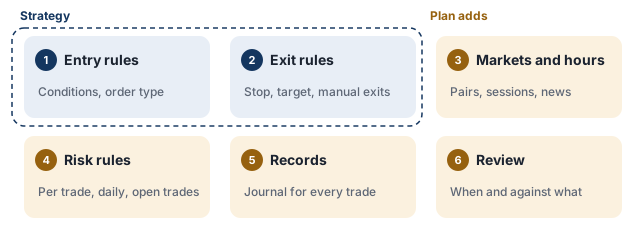
A trading strategy defines how trades are identified and managed; a trading plan adds risk limits, markets, hours, record-keeping and review rules. In other words, the plan contains the strategy and the rules around it: which pairs and hours are traded, how much is risked per trade and in total, how trades are recorded and how results are reviewed. A sound strategy used without risk rules can still leave the account exposed to large losses.
What should a forex trading plan include?
Markets and trading hours
The plan states which pairs are traded and at what times. Some plans limit the number of pairs so that behaviour, costs and execution conditions can be tracked more consistently. Because spreads can widen and prices move quickly around major data releases, the plan also states whether trading is allowed at those times: forex market hours.
Entry rules
The conditions for entering a trade are written clearly enough that someone else could follow them. “Price looks like it will rise” is not a rule; the timeframe, indicators or price levels and the order type are defined: forex order types.
Exit rules
The plan states where the stop loss is placed, how the take profit is chosen and when a position may be closed manually. The stop loss is commonly based on the level at which the setup would be considered invalid, and the target on a level the price could reasonably reach rather than on a preferred ratio: stop loss, risk-reward ratio.
How is risk management defined in a trading plan?
Risk rules are a central part of many plans:
- Risk per trade: the amount lost if the stop loss is hit, in many plans capped at a fixed percentage of the account: 1% rule.
- Daily and weekly loss limits: a plan may specify that no new trades are opened once the daily or weekly loss limit is reached, which also limits how far a short-term drawdown can run within that period, gaps and slippage aside.
- Open position limits: the number of positions open at the same time, and the combined risk of positions with overlapping or correlated exposure, are capped.
- Leverage: in risk-based planning, the lot size is calculated from the risk amount, and the leverage used follows from it: what is leverage in forex.
Risk rules in numbers
The percentages below are example values chosen to show the calculation, not recommendations.
Account $10,000, risk 1% per trade, EUR/USD with a 25-pip stop loss, USD account:
- Risk per trade: 10,000 × 1% = $100
- Pip value per standard lot on EUR/USD: about $10
- Lot size: 100 ÷ (25 × 10) = 0.40 lots
- With a daily loss limit of 3%, no new trades are opened that day once losses reach $300.
The lot size calculation step by step: position sizing, position size calculator.
Record-keeping and review rules
How each trade is recorded and how often results are reviewed are also part of the plan. Win rate, average win, average loss and costs can only be measured if trades are recorded: trading journal.
Forex trading plan template
The template below can be filled in to create a personal plan:
| Section | What to fill in |
|---|---|
| Goal and period | The period over which the plan is assessed (for example 3 months or 50 trades) |
| Pairs | The pairs traded |
| Trading hours | Which sessions are traded; what happens around data releases |
| Timeframes | The chart timeframes used for analysis and entry |
| Entry rules | The conditions required to enter, and the order type |
| Exit rules | How the stop loss and take profit are set; when to close manually |
| Risk per trade | The percentage of the account |
| Loss limits | Maximum daily and weekly loss; what happens when a limit is reached |
| Open positions | Maximum number of positions at the same time |
| Records | What is recorded for each trade |
| Review | When and against which measures results are reviewed |
Forex trading plan example
The plan below is illustrative only. It shows how the template can be filled in and is not a strategy or a trade recommendation. All values, including the trading hours, risk percentages, loss limits, risk-reward ratio and weekend rule, are examples; each trader sets their own according to their circumstances.
Example plan
- Goal and period: apply the plan on a demo account for 3 months and assess it after at least 50 trades.
- Pairs: EUR/USD and GBP/USD.
- Trading hours: the London session and the London and New York overlap; no new trades from 15 minutes before to 15 minutes after a major data release.
- Timeframes: 4-hour chart for direction, 1-hour chart for entry.
- Entry rules: entry with a pending order when the written conditions are met.
- Exit rules: stop loss at the level where the setup is invalid; take profit at a plausible target level that, in this example, also produces at least a 1:1.5 risk-reward ratio. No positions held over the weekend.
- Risk per trade: 1% of the account.
- Loss limits: 3% daily, 6% weekly; when a limit is reached, no new trades for the rest of that period.
- Open positions: at most 2.
- Records: every trade is logged in the journal with the reason for entry and a screenshot.
- Review: at the end of each month, win rate, average risk-reward ratio and rule compliance are reviewed.
How do you test a forex trading plan?
- Demo or low risk first: a new plan can be tried on a demo account or with low risk first: forex demo account.
- Enough trades: a small sample of trades may not be statistically representative, so the plan is assessed after a set number of trades.
- Rule compliance: if results are poor, the first check is whether the rules were followed. Trades that broke the rules are less useful for evaluating the plan’s rules, though they remain relevant for measuring rule compliance.
When should a trading plan be updated?
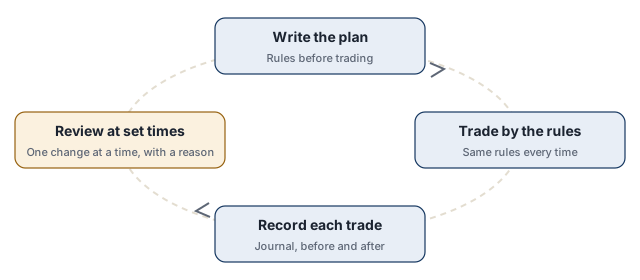
Rules are usually updated at the scheduled review, with the reason for each change written down, rather than during a trade or after a single loss. Changing several rules at once makes it hard to tell which change affected the results.
Why do traders not follow their trading plan?
Writing a plan is easier than following it. Common reasons are:
- Rushing after a loss: opening trades outside the plan, or larger trades, to win the loss back quickly.
- Overconfidence after gains: loosening the risk rules after a few winning trades.
- Moving the stop loss: waiting for the price to come back instead of accepting the loss.
- Vague rules: rules that are open to interpretation are applied differently on each trade.
Clear rules, loss limits set in advance and a record of every trade make it easier to measure and improve compliance with the plan.
Free email course
Forex Risk Management in 5 Days
A free five-day email course: risk per trade, stop losses, position sizing, risk-reward and drawdowns, with a worked example each day.
Frequently asked questions
What is a trading plan in forex?
A written set of rules that defines which pairs and hours are traded, when trades are entered and exited, and how much is risked per trade and in total. It is used to make trading decisions consistent and measurable.
What should be in a trading plan?
Typically the markets and trading hours, entry rules, exit rules (stop loss and take profit), risk per trade, daily or weekly loss limits, a maximum number of open positions, and rules for recording and reviewing trades.
How long should a trading plan be?
There is no set length. A plan short enough to check before each trade, often one or two pages, is easier to follow consistently than a long document.
Is a trading plan the same as a trading strategy?
No; the strategy is one part of the trading plan. The difference is explained in the article.
Does a trading plan guarantee profits?
No; a plan sets decisions in advance and is designed to reduce impulsive decision-making, but it does not change the result if the method itself is not profitable.
How often should a trading plan be updated?
At a scheduled review or after a set number of trades, not during a trade or after a single loss.
Related articles
- Position Sizing in Forex: How Many Lots Should You Trade?
How to calculate position size in forex from your risk amount, stop loss distance and pip value, with worked examples for EUR/USD and USD/JPY.
- Risk-Reward Ratio in Forex: How to Calculate It, With Examples
What the risk-reward ratio is, how to calculate it for long and short trades, the break-even win rate for each ratio, and why a high ratio alone is not enough.
- The 1% Rule in Trading: How Much to Risk Per Trade
What the 1% rule in trading means, how to apply it with a worked example, how it differs from position value, and its limits for small accounts.
- Forex Demo Account: What It Is and How to Use It Properly
What is a forex demo account? How demo trading works, how to use a demo account properly, demo vs live differences and when to move to a live account.
- Support and Resistance in Forex: How to Find and Use Levels
Support and resistance in forex explained: how to find levels on a chart, why they are zones, breakouts and false breakouts, and placing a stop with an example.
- Moving Averages in Forex: SMA vs EMA, Periods and Crossovers
Moving averages in forex explained: how SMA and EMA are calculated, worked examples, common periods (20, 50, 200), crossovers, golden cross and their limits.
- RSI Indicator Explained: Formula, 70 and 30 Levels, Divergence
The RSI indicator explained: how the Relative Strength Index is calculated step by step, what 70 and 30 mean, the 14-period setting, divergence and its limits.
- Candlestick Patterns: How to Read Forex Candlestick Charts
Candlestick patterns explained: how to read a candle (open, high, low, close), doji, hammer, shooting star and engulfing patterns, confirmation and limits.
Glossary terms
- Stop loss
A stop loss is an order that closes a position automatically if the price moves against you to a set level. It is designed to limit the loss on a trade, but it does not guarantee the exit price.
- Take profit
A take profit is an order that closes a position automatically when the price reaches a set profit target.
- Drawdown
A drawdown is the decline in an account's value from a peak to a subsequent low, usually expressed as a percentage of the peak.
First published 1 October 2026. Last fact-checked 4 October 2026.This article is for educational purposes only and is not investment advice.