Risk-Reward Ratio in Forex: How to Calculate It, With Examples
The risk-reward ratio in forex compares the amount you could lose on a trade if the stop loss is hit with the amount you could gain if the take profit is reached. A 25-pip stop with a 50-pip target is a 1:2 risk-reward ratio. The ratio alone does not show whether a strategy is profitable; it has to be read together with how often targets are reached, the win rate.
Key takeaways
- Risk-reward ratio = stop loss distance : take profit distance; a 25-pip stop with a 50-pip target is 1:2.
- A higher ratio does not show profitability on its own; other things being equal, targets placed further away may be reached less often in many strategies.
- If wins reach the target and losses the stop, the break-even win rate before costs = 1 ÷ (1 + reward ÷ risk); at 1:2 it is about 33.3%.
- Stop and target levels are usually based on the market's structure rather than chosen to reach a preferred ratio.
- Costs (spread, commission, swap) and execution differences (slippage, early or partial exits) make the realised ratio differ from the planned one.
Watch: the short version
Risk-Reward Ratio: Why 1:2 Can Still Lose Money
Narration: AI voice. Educational only, not investment advice.
At a glance
- Ratio
- Stop distance : target distance
- 1:2 example
- 25-pip stop, 50-pip target
- Break-even at 1:2
- 33.3% wins, before costs
- Result depends on
- Win rate, ratio and costs
How does the risk-reward ratio work?
The risk-reward ratio compares the possible loss on a trade with the possible gain. The possible loss comes from the distance between the entry price and the stop loss; the possible gain from the distance between the entry price and the take profit. This article uses the risk:reward convention, so 1:2 means risking 1 to target 2; some sources write the same trade the other way round, as a reward-to-risk ratio of 2. How the two orders work: stop loss, take profit.
How to calculate the risk-reward ratio in forex
risk-reward ratio = stop loss distance : take profit distance
The distances can be measured in pips or in money; for the same position size and before costs, both give the same ratio. Once spread, commission and swap are included, the realised ratio in money can differ. To set a 1:2 risk-reward ratio, the take profit distance is twice the stop loss distance: with a 25-pip stop, the target is 50 pips.
How to calculate risk-reward on a long trade
Long EUR/USD
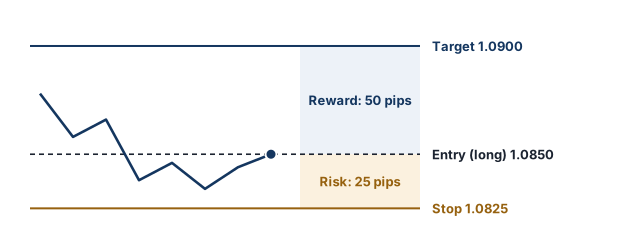
Assumptions: buy EUR/USD at 1.0850, stop loss at 1.0825, take profit at 1.0900.
- Risk: 1.0850 − 1.0825 = 25 pips
- Reward: 1.0900 − 1.0850 = 50 pips
- Risk-reward ratio: 25 : 50 = 1:2
How to calculate risk-reward on a short trade
Short GBP/USD
Assumptions: sell GBP/USD at 1.2700, stop loss at 1.2740, take profit at 1.2580.
- Risk: 1.2740 − 1.2700 = 40 pips
- Reward: 1.2700 − 1.2580 = 120 pips
- Risk-reward ratio: 40 : 120 = 1:3
How are the risk-reward ratio and the win rate related?
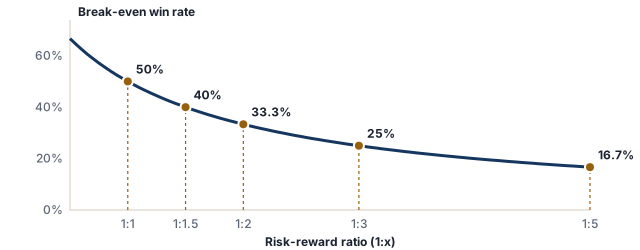
If wins reach the planned target and losses reach the planned stop, the risk-reward ratio determines the theoretical break-even win rate.
What is the break-even win rate?
The break-even win rate is the theoretical win rate required to break even when average wins and losses match the stated risk-reward ratio, before costs:
break-even win rate = 1 ÷ (1 + reward ÷ risk)
| Risk-reward ratio | Break-even win rate (before costs) |
|---|---|
| 1:1 | 50% |
| 1:1.5 | 40% |
| 1:2 | 33.3% |
| 1:3 | 25% |
So a strategy using a 1:2 ratio breaks even at approximately 33.3% before costs. Spread and commission raise this threshold.
Is a higher risk-reward ratio always better?
Not necessarily. Other things being equal, targets placed further away may be reached less often in many strategies. Assuming losses reach the planned stop and ignoring costs, a 1:5 strategy that reaches its target only 10% of the time loses money, while a 1:1 strategy that wins 60% of the time is profitable. What decides the result is the win rate, average win, average loss and costs taken together. This combined average outcome per trade is often called expectancy.
Why can the same risk-reward ratio give different results?
Because the result also depends on the win rate and on costs:
Same ratio, different win rates
Assumptions: 100 trades, $50 risk per trade, 1:2 risk-reward ratio ($100 target), $5 costs per trade.
- 40% win rate: (40 × 100) − (60 × 50) − (100 × 5) = +$500
- 30% win rate: (30 × 100) − (70 × 50) − (100 × 5) = −$1,000
How do you choose a risk-reward ratio?
- Levels from market structure. The stop is commonly based on the level at which the setup would be considered invalid, and the target on a level the price could reasonably reach: stop loss. Moving the target to an unrealistic level to reach a preferred ratio improves the ratio on paper, not the expected result.
- Costs. Because of the bid-ask spread, long trades open at the ask and close at the bid, so the spread slightly worsens the realised ratio; the effect is larger on trades with short targets: spread.
- Position size from the risk amount. The risk-reward ratio shapes the trade; the position size decides how much money is at risk: position sizing.
- Recording the realised ratio. Slippage, swap on positions held overnight, early exits and partial closes can make the realised ratio differ from the planned one. Recording both in a trading journal, together with the break-even win rate for the ratio used, shows how a strategy actually performs.
The position size calculator works out the lot size once the stop distance is set.
Free email course
Forex Risk Management in 5 Days
A free five-day email course: risk per trade, stop losses, position sizing, risk-reward and drawdowns, with a worked example each day.
Frequently asked questions
What is a good risk-reward ratio?
There is no single good ratio; what matters is whether the ratio and the win rate together give a positive average result after costs. Traders may use ratios such as 1:1.5 or 1:2, but no ratio is universally optimal.
What does a 1:2 risk-reward ratio mean?
It means targeting 2 units of gain for every 1 unit of risk, for example a 25-pip stop loss with a 50-pip take profit.
How do you calculate the risk-reward ratio?
Divide the stop loss distance by the take profit distance, both measured from the entry price. A 30-pip stop with a 90-pip target is 30 : 90, or 1:3.
What does a 1:3 risk-reward ratio mean?
Targeting 3 units of gain for every 1 unit of risk, for example a 20-pip stop loss with a 60-pip take profit. Before costs, it breaks even at a 25% win rate if wins and losses match the plan.
Is a 1:1 risk-reward ratio good?
Before costs, a 1:1 ratio breaks even at a 50% win rate if wins and losses match the plan. Spread and commission raise the win rate it needs, so it is profitable only with a win rate high enough above 50% to cover them.
How are the risk-reward ratio and the win rate related?
Assuming wins and losses match the planned target and stop, the higher the risk-reward ratio, the lower the win rate needed to break even. Before costs, a 1:1 ratio breaks even at a 50% win rate, 1:2 at about 33.3% and 1:3 at 25%.
Related articles
- Position Sizing in Forex: How Many Lots Should You Trade?
How to calculate position size in forex from your risk amount, stop loss distance and pip value, with worked examples for EUR/USD and USD/JPY.
- Stop Loss in Forex: How to Set One and Where to Place It
How a stop loss works in forex, how to set one step by step, common ways to choose the stop level, and why a stop can close at a worse price.
- Is Forex Trading Profitable? What the Evidence Says
Is forex trading profitable? What regulators' data says about how many retail traders lose money, what contributes to losses and how expectancy works.
- Forex Order Types: Market, Limit, Stop and More Explained
Forex order types explained: market order, buy limit vs buy stop, sell limit vs sell stop, stop-limit, stop loss, take profit, trailing stop, OCO and GTC.
- Support and Resistance in Forex: How to Find and Use Levels
Support and resistance in forex explained: how to find levels on a chart, why they are zones, breakouts and false breakouts, and placing a stop with an example.
Glossary terms
- Stop loss
A stop loss is an order that closes a position automatically if the price moves against you to a set level. It is designed to limit the loss on a trade, but it does not guarantee the exit price.
- Take profit
A take profit is an order that closes a position automatically when the price reaches a set profit target.
First published 1 October 2026. Last fact-checked 4 October 2026.This article is for educational purposes only and is not investment advice.