Stop Loss in Forex: How to Set One and Where to Place It
A stop loss in forex is an order that closes a position automatically if the price reaches a level you set, to limit the loss on a trade. In risk-based trading it is usually set first, at the level where the trade setup would be considered invalid, and the position size is then calculated from its distance. A standard stop loss does not guarantee the exit price.
Key takeaways
- A stop loss closes a position automatically at a set level; on long positions it is usually triggered by the bid, on short positions by the ask.
- In risk-based trading the stop level is chosen first and the position size is calculated from the stop distance.
- Common ways to choose the level: beyond recent price structure, as a multiple of volatility, or a fixed distance.
- Once triggered, a standard stop usually becomes a market order, so gaps, spread widening and slippage can close the trade at a worse price.
- If the position size is unchanged, widening a stop after entry increases the risk beyond what was planned when the position was sized.
Watch: the short version
Where Should Your Stop Loss Go? A Worked EUR/USD Example
Narration: AI voice. Educational only, not investment advice.
At a glance
- Purpose
- Sets the planned loss
- Placement
- Structure, volatility or fixed distance
- Position size
- From the stop distance
- Exit price
- Not guaranteed: gaps, slippage
How does a stop loss work in forex?
A stop loss is an order attached to a position that closes it automatically if the price moves against you to a level you set. On a long position the stop sits below the entry price; on a short position it sits above it. On many retail FX platforms, including MetaTrader, a stop on a long position is triggered by the bid and a stop on a short position by the ask, which is why a short can be stopped out even when the bid chart never touched the stop level: bid and ask.
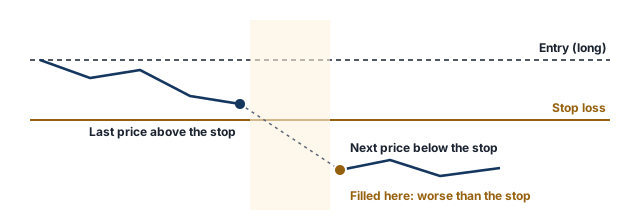
Once triggered, a standard stop loss usually becomes a market order and is filled at the next available price. In normal conditions that is at or close to the stop level; in a fast market it can be worse. A short definition with an example is in the glossary: stop loss meaning.
How to set a stop loss in forex
A common sequence in risk-based trading is:
- Choose the stop level. A common approach is to place the stop near the level where the trade setup would be considered invalid.
- Measure the distance between the entry price and the stop level in pips.
- Calculate the position size from the amount you are willing to risk and that distance: position sizing.
- Place the order with the stop attached, either when opening the trade or straight after, and check the level on the platform.
Doing it in this order keeps the amount at risk the same from trade to trade while the stop distance varies.
EUR/USD stop loss example
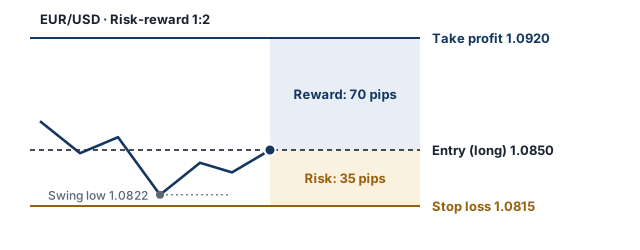
Assumptions: long EUR/USD at 1.0850 (ask), $50 risk on a USD account, pip value $10 per standard lot.
The entry is at 1.0850. The most recent swing low on the bid chart is 1.0822, and the setup would be considered invalid below it. The stop is placed a few pips lower, at 1.0815, so that ordinary fluctuation around the swing low is less likely to trigger it. Because a long stop is triggered by the bid, the spread does not move it closer; for a short, the stop would be placed above a swing high with extra room for the spread, since it is triggered by the ask.
- Stop distance: 1.0850 − 1.0815 = 35 pips
- Risk amount: $50 on a USD account, pip value $10 per standard lot
- Position size: 50 ÷ (35 × 10) ≈ 0.143 → 0.14 lots (rounded down)
If the stop is hit, the loss is about $49 before spread, commission and slippage.
Where should you place a stop loss?
There is no single correct level. Commonly used approaches are:
- Price structure: beyond a recent swing low (for a long) or swing high (for a short), or beyond a support or resistance level, on the reasoning that a move past it would invalidate the setup.
- Volatility: a multiple of a volatility measure such as the Average True Range (ATR), so the stop is wider when the market moves more and tighter when it moves less. For example, with an ATR of 18 pips, a stop at 1.5 × ATR is 27 pips from the entry.
- Fixed distance: the same number of pips on every trade. It is simple, but it ignores how much the pair is moving at the time.
Whichever approach is used, a stop placed within the pair’s normal short-term fluctuation or within the spread may be more likely to be triggered by ordinary short-term volatility rather than by a move that invalidates the setup. A wider stop is not safer in itself: it needs a smaller position for the same risk amount.
Stop loss and take profit: what is the relationship?
The stop loss defines the planned risk and the take profit the planned target; together they set the trade’s risk-reward ratio. A 35-pip stop with a 70-pip target is a 1:2 ratio: risk-reward ratio. Take-profit orders are explained in take profit.
Why can a stop loss close at a worse price?
- Stop loss slippage: in a fast market the next available price after the trigger can be beyond the stop level: slippage.
- Gap risk: when the market reopens after the weekend or reacts to major news, the price can jump past the stop without trading at it, and the order is filled at the first available price.
- Spread widening: around news, the daily rollover or in thin markets the spread can widen, which can trigger stops on short positions earlier than the bid chart suggests.
Some brokers offer a guaranteed stop-loss order (GSLO), which closes the position at exactly the stop price even if the market gaps past it. Guaranteed stop loss orders are not available at every broker, are often limited to certain products and usually carry a fee.
Can you move a stop loss?
Stops can be modified after entry, and how they are moved changes the risk:
- Trailing stop: the stop follows the price at a set distance as the trade moves in your favour: trailing stop. In MetaTrader, the trailing stop runs in the trading platform rather than on the broker’s server, so it stops moving while the platform is closed.
- Moving to breakeven: some traders move the stop to the entry price after a certain gain. This reduces or may eliminate the original price risk, but it does not necessarily guarantee a zero-cost exit: spread, commission, swap or slippage can still leave a small loss. It also makes it more likely the trade is closed by a normal pullback.
- Widening the stop: if the position size is unchanged, moving the stop further away after entry increases the risk beyond what was planned when the position was sized.
What are common stop loss mistakes?
- Choosing the lot size first and then fitting the stop to it, instead of the other way round.
- Placing the stop inside normal fluctuation or the spread, so ordinary price movement closes the trade.
- Widening or removing the stop after entry to avoid taking the loss.
- Moving the stop to breakeven too early without a rule, so trades are closed by ordinary pullbacks before the setup has played out.
- Assuming the stop guarantees the exit price, and sizing positions with no allowance for slippage or gaps.
- Forgetting that short stops use the ask, which matters most around news and in thin markets.
Free email course
Forex Risk Management in 5 Days
A free five-day email course: risk per trade, stop losses, position sizing, risk-reward and drawdowns, with a worked example each day.
Frequently asked questions
What is a stop loss in forex?
An order that closes a position automatically if the price reaches a level set by the trader, to limit the loss on that trade. On a long position it sits below the entry price, on a short position above it.
What is the difference between a stop loss and a take profit?
A stop loss closes a trade at a planned loss level; a take profit closes it at a planned target. Together they define the trade's risk-reward ratio, for example a 25-pip stop with a 50-pip target is 1:2.
Should I move my stop loss to breakeven?
It is a choice with a trade-off. Moving the stop to the entry price reduces or removes the original price risk, but it makes it more likely that a normal pullback closes the trade, and costs or slippage can still leave a small loss.
Is a stop loss guaranteed?
No. A standard stop loss usually becomes a market order once triggered, so in a fast market or a price gap it can close at a worse price. Some brokers offer guaranteed stops, usually for a fee and on selected products.
How many pips should a stop loss be?
There is no fixed number. The distance depends on the pair's volatility, the timeframe and where the trade idea would be invalid; the position size is then adjusted so the amount at risk stays the same.
Can I trade without a stop loss?
It is possible, but then losses may continue until the position is closed manually, closed out automatically by the broker, or otherwise limited by broker and jurisdiction rules such as negative balance protection. A stop loss sets the planned loss in advance, although not the exact exit price.
Sources
- MetaTrader 5 Help: General Principles of Trading, MetaQuotes
- Customer Advisory: Eight Things You Should Know Before Trading Forex, U.S. Commodity Futures Trading Commission
Related articles
- Position Sizing in Forex: How Many Lots Should You Trade?
How to calculate position size in forex from your risk amount, stop loss distance and pip value, with worked examples for EUR/USD and USD/JPY.
- Forex Order Types: Market, Limit, Stop and More Explained
Forex order types explained: market order, buy limit vs buy stop, sell limit vs sell stop, stop-limit, stop loss, take profit, trailing stop, OCO and GTC.
- Bid and Ask Price in Forex: What They Mean and Which You Pay
What is the bid and ask price in forex? Which price you buy and sell at, how to read a quote, the spread, the mid price and why charts show the bid.
- What Is a Spread in Forex? How Spreads Work and What They Cost
What is a spread in forex? The gap between bid and ask, how to calculate spread cost per lot, fixed vs variable spreads, commission and why spreads widen.
- Support and Resistance in Forex: How to Find and Use Levels
Support and resistance in forex explained: how to find levels on a chart, why they are zones, breakouts and false breakouts, and placing a stop with an example.
Glossary terms
- Stop loss
A stop loss is an order that closes a position automatically if the price moves against you to a set level. It is designed to limit the loss on a trade, but it does not guarantee the exit price.
- Take profit
A take profit is an order that closes a position automatically when the price reaches a set profit target.
- Trailing stop
A trailing stop is a stop loss that moves with the price as a trade goes in your favour. It keeps a set distance from the price and does not move back.
- Slippage
Slippage is the difference between the price you expect when placing an order and the price at which it is actually filled. It can work against you (negative slippage) or in your favour (positive slippage).
First published 1 October 2026. Last fact-checked 4 October 2026.This article is for educational purposes only and is not investment advice.