Position Sizing in Forex: How Many Lots Should You Trade?
Position sizing in forex is deciding how many lots to open on a trade, and the position size largely determines how much you risk if your stop loss is hit. It is calculated from three numbers: the amount you are willing to risk, the stop loss distance in pips and the pip value. Formula: lots = risk amount ÷ (stop distance in pips × pip value per standard lot).
Key takeaways
- Position size largely determines how much you risk if a stop loss is hit; spread, commission and slippage can make the actual loss differ.
- Formula: lots = risk amount ÷ (stop loss distance in pips × pip value per standard lot).
- In risk-based sizing, the position is calculated from the amount you are willing to risk per trade, not from the free margin or the maximum leverage available.
- For the same risk amount, a wider stop loss means a smaller position.
- Calculated sizes are usually rounded down to the broker's lot step, leaving room for costs and slippage.
Watch: the short version
How Many Lots Should You Trade? Position Sizing in 3 Numbers
Narration: AI voice. Educational only, not investment advice.
At a glance
- Formula
- Risk ÷ (stop pips × pip value)
- Order
- Stop first, then size
- Wider stop
- Smaller position, same risk
- Leverage
- Mainly sets the margin
How does position size affect forex risk?
Position size is the amount you trade, usually expressed in lots. The same price move gives very different results depending on it: on EUR/USD, 30 pips is worth about $300 on 1 standard lot and about $3 on 0.01 lots (assuming a pip value of $10 per standard lot on a USD account). That is why position size is one of the main settings that determine the risk on a trade. Lot units are explained in what is a lot in forex.
How to calculate forex position size
A risk-based position size is worked out backwards from the amount you are willing to risk. It needs three numbers:
- Risk amount: the money you are willing to lose if the stop loss is hit, often set as a percentage of the account.
- Stop loss distance: the distance between the entry price and the stop loss, in pips. How stop orders work: stop loss.
- Pip value: what one pip is worth per standard lot on that pair, in your account currency: pip value.
lots = risk amount ÷ (stop loss distance in pips × pip value per standard lot)
In this method the stop loss is determined first, from the level at which the trade setup would be considered invalid, and the position size is then calculated from that distance. Moving the stop closer so that a preferred lot size fits can place the stop at a level that has no technical meaning.
Position size example: EUR/USD
EUR/USD position size
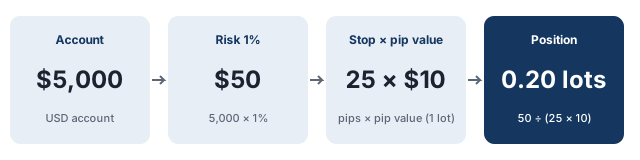
Assumptions: account $5,000, risk 1% per trade ($50), EUR/USD with a 25-pip stop loss, pip value $10 per standard lot on a USD account.
50 ÷ (25 × 10) = 0.20 lots
If the stop is hit, the loss is about $50 before spread, commission and slippage.
How do you size a trade on a JPY pair?
On pairs where the US dollar is not the quote currency, the pip value per standard lot on a USD account is not $10, so it is worked out first.
USD/JPY position size calculation example
Assumptions: account $10,000, risk 1% ($100), USD/JPY at 150.00 with a 40-pip stop loss, USD account.
- Pip value per standard lot: 0.01 × 100,000 ÷ 150.00 ≈ $6.67
- Position size: 100 ÷ (40 × 6.67) ≈ 0.375 → 0.37 lots (rounded down)
Because pip values can change with exchange rates, the calculation should use the current exchange rate.
How does the stop loss distance change the position size?
Stop distance and position size
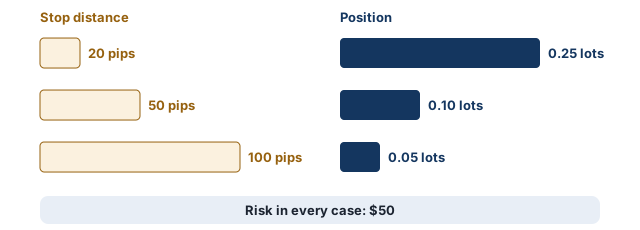
Assumptions: the same $5,000 account and $50 risk on EUR/USD, pip value $10 per standard lot.
- 20-pip stop: 50 ÷ (20 × 10) = 0.25 lots
- 50-pip stop: 50 ÷ (50 × 10) = 0.10 lots
- 100-pip stop: 50 ÷ (100 × 10) = 0.05 lots
For the same risk amount, the wider the stop, the smaller the position; the loss if the stop is hit stays at about $50 in all three cases.
The forex position size calculator does this for any pair and account currency.
What percentage of your account should you risk per trade?
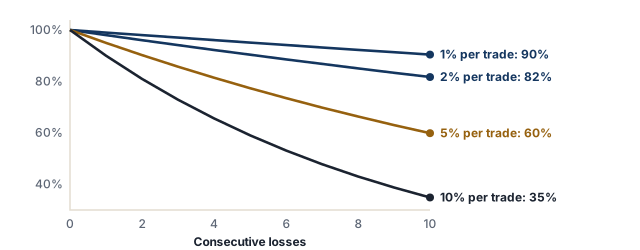
There is no single correct figure. Some traders use fixed-percentage approaches such as 0.5%, 1% or 2% of the account per trade; the 1% rule is one well-known version. Whatever the figure, it helps to see how a losing streak would affect the account, because losing streaks can occur even in profitable strategies.
The table assumes the same percentage of the remaining balance is risked on each trade and every stop is hit at the planned loss:
| Risk per trade | Account after 10 consecutive losses (approx.) |
|---|---|
| 1% | 90% |
| 2% | 82% |
| 5% | 60% |
| 10% | 35% |
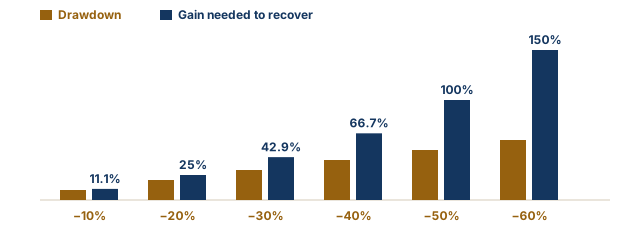
A higher percentage risk causes drawdowns to compound more rapidly, and a deeper drawdown requires a larger percentage gain to recover: after falling to 60% of its starting value, an account needs a gain of about 67% to get back to where it started. Besides the risk per trade, the distance to the target also shapes results: risk-reward ratio.
What are common position sizing mistakes?
- Sizing from free margin. Free margin shows the largest position you can open, not one sized to your risk: margin.
- Using the same lot size on every trade. When stop distances or pip values vary, a fixed lot size means a different amount at risk on each trade.
- Assuming the wrong pip value. $10 per standard lot only applies on a USD account to pairs quoted in US dollars, such as EUR/USD or GBP/USD; JPY pairs and other account currencies differ.
- Leaving out costs. Spread, commission and slippage can increase the actual loss; calculated sizes are usually rounded down to the broker’s lot step.
- Counting correlated positions separately. Positions such as long EUR/USD and long GBP/USD may create overlapping USD exposure, so their combined risk can be larger than each position suggests. Correlations between pairs also change over time.
How do position size and leverage relate?
Leverage primarily determines the margin required once the position size has been chosen; the risk on the trade is driven mainly by position size and stop distance. For example, 0.20 lots of EUR/USD at 1.0850 is a position of about $21,700. At 30:1 leverage it needs about $723 of margin. On a $5,000 account, the effective leverage is about 4.3:1. More on leverage, and the margin calculator works out the margin for any pair.
Free email course
Forex Risk Management in 5 Days
A free five-day email course: risk per trade, stop losses, position sizing, risk-reward and drawdowns, with a worked example each day.
Frequently asked questions
How many lots should I trade?
Divide the amount you are willing to risk by the stop loss distance multiplied by the pip value. With $50 at risk, a 25-pip stop and a pip value of $10 per standard lot, that is 50 ÷ (25 × 10) = 0.20 lots.
What is position sizing in forex?
Deciding how many lots to trade so that the loss at the stop loss equals a planned amount. The size follows from the risk amount, the stop distance in pips and the pip value.
What lot size for a $1,000 account?
It depends on the risk per trade and the stop distance. Risking 1% ($10) with a 20-pip stop on EUR/USD (pip value $10 per standard lot, USD account) gives 10 ÷ (20 × 10) = 0.05 lots.
Does position size depend on the currency pair?
Yes, through the pip value. On a USD account a standard lot of EUR/USD is worth about $10 per pip, but USD/JPY at 150.00 about $6.67, so the same risk and stop give a larger position on USD/JPY.
Does leverage decide my position size?
Not directly in a risk-based sizing method. Leverage sets the largest position you are allowed to open and the margin it needs; the risk amount and stop loss distance determine the size.
Should I use the same lot size on every trade?
A fixed lot size produces the same nominal risk only when the stop distance and the pip value are also unchanged. When either varies, the amount at risk varies too.
Related articles
- What Is a Lot in Forex? Standard, Mini and Micro Lots
What is a lot in forex? Standard, mini, micro and nano lot sizes, what 0.01 lot means, pip value and margin per lot, and how to calculate lot size.
- What Is a Pip in Forex? Meaning, Pip Value & Examples
What is a pip in forex? Pip meaning, how to count pips, pip value per lot, pips on JPY pairs, pipettes and pip vs point, with worked examples.
- What Is Leverage in Forex? How It Works, Ratios and Limits
What is leverage in forex? How leverage ratios such as 1:30, 1:100 and 1:500 work, how margin is calculated, effective leverage and retail limits.
- Forex Order Types: Market, Limit, Stop and More Explained
Forex order types explained: market order, buy limit vs buy stop, sell limit vs sell stop, stop-limit, stop loss, take profit, trailing stop, OCO and GTC.
Glossary terms
- Fixed fractional position sizing
Fixed fractional position sizing risks a fixed percentage of the current account balance on each trade, so the amount at risk is recalculated as the balance changes.
- Drawdown
A drawdown is the decline in an account's value from a peak to a subsequent low, usually expressed as a percentage of the peak.
- Lot
A lot is a standardised trade size in forex. A standard lot is 100,000 units of the base currency, a mini lot 10,000 units and a micro lot 1,000 units.
- Pip
A pip is the standard unit for measuring price changes in a currency pair: 0.0001 for most pairs and 0.01 for pairs quoted in Japanese yen.
- Stop loss
A stop loss is an order that closes a position automatically if the price moves against you to a set level. It is designed to limit the loss on a trade, but it does not guarantee the exit price.
First published 1 October 2026. Last fact-checked 4 October 2026.This article is for educational purposes only and is not investment advice.