Trading Journal: How to Keep a Forex Trading Journal
A trading journal in forex is a personal record of every trade: the reason for entering, entry and exit, size, risk, result and whether the trading plan was followed. It makes it possible to measure the win rate, average win and loss, average result per trade and rule compliance. A platform's account history records the numbers, but not why a trade was taken or whether it followed the plan.
Key takeaways
- A trading journal records each trade with its reason, risk, result and compliance with the plan.
- The platform's account history records the numbers; it does not record the reasoning or rule compliance.
- A journal makes it possible to calculate the win rate, average win and loss, average result per trade and rule compliance rate.
- Recording results in units of risk (R) makes trades of different sizes comparable.
- Conclusions from a few trades can mislead; how many trades are enough depends on trading frequency and the variability of results.
At a glance
- Record before entry
- Reason, stop, target, risk
- R
- Amount risked on a trade
- Review
- Win rate, averages, expectancy
- Judge trades by
- Rule compliance first
What is a forex trading journal used for?
A trading journal is a personal record of trades. Its main purpose is to show which decisions led to which results:
- Measuring the method: the win rate and the average win and loss can only be calculated if trades are recorded. Without them, it is not possible to tell whether a method works.
- Checking compliance with the plan: it shows whether poor results come from the method or from rules not being followed: trading plan.
- Finding repeated mistakes: trades taken at certain times, on certain pairs or after losses can be examined separately.
What is the difference between a trading journal and account history?
The account history in platforms such as MetaTrader automatically records entry and exit prices, size, costs and the result of each trade. It does not record why the trade was taken, why the stop was placed where it was, or whether the trade followed the plan. A trading journal fills that gap. In short, a trading journal and the account history do not replace each other: the account history for the numbers, the journal for the reasoning and the review.
What should a forex trading journal record?
| Field | Example |
|---|---|
| Date and time | 2026-10-14, 11:20 |
| Pair and direction | EUR/USD, buy (long) |
| Strategy or setup | Which entry rule in the plan; for example “pullback in the trend direction” |
| Reason for entry | The written entry condition in the plan was met |
| Entry price and size | 1.08500, 0.40 lots |
| Stop loss and take profit | 1.08250 and 1.09000 |
| Risk | $100 (1% of the account) |
| Exit price and reason | 1.09000, take profit hit |
| Result | +$200, +2R |
| Costs | Spread, commission, swap |
| Plan compliance | Yes or no; if no, why |
| Screenshots | The chart before the trade, at entry and at exit |
| Notes | Thoughts and state of mind during the trade |
How the risk and lot size are calculated: position sizing.
What is R in a trading journal?
R is the amount risked on a trade. A trade opened with $100 at risk that gains $200 is recorded as +2R; if the stop loss is hit, it is −1R. Recording results in R makes trades on different account sizes, or with different risk amounts, comparable on the same scale. Why planned and realised R can differ: risk-reward ratio.
How do you keep a forex trading journal?
- Tool: a spreadsheet, a notebook or a trading journal app can be used. What matters is using it consistently, not which tool it is.
- Fixed fields: the fields in the table above are chosen once and the same information is recorded for every trade.
- Before the trade: the reason for entry, the stop loss, the take profit and the risk are written down before entering; reasons written afterwards can be shaped by the result.
- After the close: the exit price and reason, the result and plan compliance are added once the trade is closed. The figures can be checked against the platform’s account history.
- Regular review: the records are reviewed at set intervals, for example monthly or after a set number of trades.
Forex trading journal example
Three journal entries
Assumptions: risk on every trade is $100 (1R).
| # | Pair and direction | Size | Stop / target | Exit reason | Result | Plan followed |
|---|---|---|---|---|---|---|
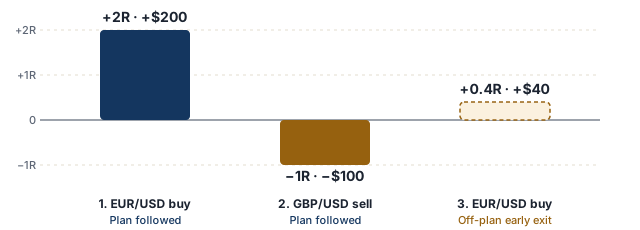
| 1 | EUR/USD buy | 0.40 lots | 25 pips / 50 pips | Take profit | +$200 (+2R) | Yes |
| 2 | GBP/USD sell | 0.25 lots | 40 pips / 80 pips | Stop loss | −$100 (−1R) | Yes |
| 3 | EUR/USD buy | 0.40 lots | 25 pips / 50 pips | Closed early by hand (+10 pips) | +$40 (+0.4R) | No: exited outside the plan for fear of a loss |
The third trade closed in profit but did not follow the plan. If early exits like this repeat, the gap between planned and realised results is worth measuring separately.
How do you analyse a forex trading journal?
At each review, the journal can be used to calculate:
- Win rate: the share of trades that were profitable.
- Average win and average loss: the average result of winning and losing trades, in money or in R.
- Average result per trade: the total net result divided by the number of trades, often called expectancy. If it is negative after costs, the method as applied is losing money.
- Rule compliance rate: the share of trades that followed the plan, and the difference in results between trades that did and did not.
- Maximum drawdown: the largest fall in the account from a peak; it shows the largest capital decline the strategy has experienced: maximum drawdown.
Reviewing 20 trades
A 20-trade review period, including costs:
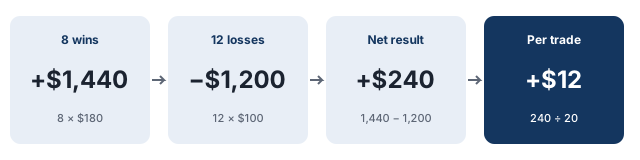
- 8 winning trades averaging +$180; 12 losing trades averaging −$100
- Win rate: 8 ÷ 20 = 40%
- Net result: (8 × 180) − (12 × 100) = 1,440 − 1,200 = +$240
- Average result per trade: 240 ÷ 20 = +$12
Twenty trades is generally a limited sample for drawing a statistically robust conclusion; these figures do not prove that the method is profitable, they only give a starting point for continued tracking.
What are common trading journal mistakes?
- Recording only winners: leaving out losing or off-plan trades makes results look better than they are.
- Writing the reason afterwards: a reason written after the trade closed can be shaped to explain the result.
- Leaving out costs: without spread, commission and swap, the average result per trade looks higher than it is: spread.
- Irregular records: recording for a few days and then stopping leaves too little data to review.
- Judging by outcome: counting a profitable off-plan trade as a “good trade” and a losing on-plan trade as a “bad trade”. Trades are first judged by rule compliance; results are judged over a sufficient number of trades.
- Recording without reviewing: a journal that is never reviewed becomes an archive.
Trying a new method or plan on a demo account together with a journal gathers data without risking real money: forex demo account.
Free email course
Forex Risk Management in 5 Days
A free five-day email course: risk per trade, stop losses, position sizing, risk-reward and drawdowns, with a worked example each day.
Frequently asked questions
What is a trading journal?
A personal record of every trade with the reason for entering, entry and exit prices, size, risk, result and whether the trading plan was followed. It is used to measure results and find recurring mistakes.
What should I write in a trading journal?
At least the date, pair, direction, entry, stop loss, take profit, exit, position size, risk amount, result including costs, the setup used and whether the plan was followed. A short note on the reason for any deviation makes the review more useful.
Is there a simple trading journal template?
A spreadsheet with one row per trade and the columns listed above is enough to start. The example journal on this page shows the layout and how results in R are calculated.
Can a trading journal be kept in Excel?
Yes; a spreadsheet such as Excel or Google Sheets, or a note-taking app such as Notion, is enough. What matters is recording the same information for every trade, consistently.
Does the MT4 account history replace a trading journal?
Not fully; the account history records entry, exit and result figures, but not the reason for the trade or whether the plan was followed.
How long before a trading journal gives meaningful results?
There is no fixed number; it depends on how often you trade and how variable the results are. Because a few trades can be down to chance, results are reviewed after a set number of trades.
Related articles
- Forex Trading Plan: How to Write One, With a Template
What a forex trading plan is and how to write one: what it should include, risk rules, a fill-in template, an example plan and how to test and update it.
- Risk-Reward Ratio in Forex: How to Calculate It, With Examples
What the risk-reward ratio is, how to calculate it for long and short trades, the break-even win rate for each ratio, and why a high ratio alone is not enough.
- Position Sizing in Forex: How Many Lots Should You Trade?
How to calculate position size in forex from your risk amount, stop loss distance and pip value, with worked examples for EUR/USD and USD/JPY.
- Is Forex Trading Profitable? What the Evidence Says
Is forex trading profitable? What regulators' data says about how many retail traders lose money, what contributes to losses and how expectancy works.
Glossary terms
- Drawdown
A drawdown is the decline in an account's value from a peak to a subsequent low, usually expressed as a percentage of the peak.
- Stop loss
A stop loss is an order that closes a position automatically if the price moves against you to a set level. It is designed to limit the loss on a trade, but it does not guarantee the exit price.
- Take profit
A take profit is an order that closes a position automatically when the price reaches a set profit target.
First published 1 October 2026. Last fact-checked 4 October 2026.This article is for educational purposes only and is not investment advice.