What Is a Prop Firm? How Prop Trading Firms Work
A retail prop firm is a company that sells trading evaluations, commonly called challenges, and offers successful traders access to a funded or simulated funded account under predefined risk rules. Traders who pass receive a profit split, a percentage of eligible profits. Retail prop firms differ from traditional proprietary trading firms, which trade their own capital through employed traders.
Key takeaways
- A retail prop firm sells evaluations (challenges); traders who pass get a funded or simulated funded account and a profit split.
- Whether a funded account trades real capital or is simulated depends on the firm's model and terms.
- Challenges combine a profit target with loss limits such as a daily drawdown and a maximum drawdown; breaking a limit ends the challenge.
- The challenge fee is the amount at risk for the trader; most firms do not require a trading deposit.
- Regulatory treatment depends on the jurisdiction and business model; regulators in Italy, Spain and Belgium have issued consumer warnings.
At a glance
- Trader pays
- A challenge fee, not a deposit
- To pass
- Hit the target within loss limits
- Funded account
- Often simulated
- Trader receives
- A profit split of eligible profits
How does a prop firm challenge work?
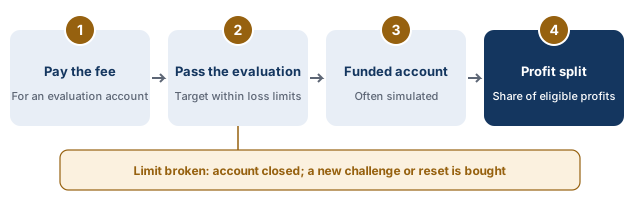
A prop trading firm in the retail sense sells a prop firm evaluation and funds traders who pass it. Most follow the same steps:
- Pay for a prop firm challenge or evaluation. The trader pays a one-off fee for an evaluation account of a chosen size, for example $100,000: prop firm challenge.
- Pass the evaluation. The trader must reach a profit target without breaking the loss limits, sometimes in two stages and sometimes within a minimum number of trading days.
- Get a funded trading account. A trader who passes receives a funded trading account under similar rules. Whether that account trades real capital or is a simulated funded account depends on the firm’s model and terms.
- Receive a profit split. The trader receives a prop firm profit split, an agreed percentage of eligible profits; the percentage varies by firm and programme.
The trader’s money at risk is the challenge fee rather than a trading deposit. If a loss limit is broken, the account is closed and a new challenge, or a reset, has to be bought.
Retail prop firms vs traditional proprietary trading
| Traditional proprietary trading firm | Retail prop firm (funded trader programme) | |
|---|---|---|
| Whose capital | The firm’s own capital | The firm’s capital or, often, a simulated trading account |
| Traders | Employees or contracted traders selected by the firm | Members of the public who pay for an evaluation |
| Main revenue | Trading profits | Commonly challenge and reset fees; models vary |
| Trader’s cost | None to join | Challenge fee per attempt |
In traditional proprietary trading, a bank or trading firm trades its own money through its own traders. A retail prop firm, also called a funded trader programme, sells evaluations online and pays successful traders a share of the profits. Many run the challenge, and often the funded stage, on a simulated trading account; some copy the trades of funded traders to real markets.
Common prop firm challenge rules
Rules vary by firm and programme, but most combine:
- Profit target: the gain, as a percentage of the account, needed to pass a stage.
- Daily drawdown: the most the account may lose in one day.
- Maximum drawdown: the most the account may fall in total. It can be static (measured from the starting balance) or a trailing drawdown that moves up with the account’s high: prop firm drawdown rules.
- Minimum trading days: the number of days on which the trader must place trades before passing.
- Consistency rule: a limit on how much of the total profit may come from a single day or trade.
- News trading rules and weekend holding rules: restrictions on trading around major releases or holding positions over the weekend.
Prop firm challenge example: $100,000 account (illustrative only)
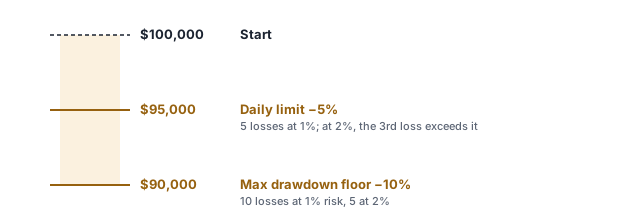
Assumptions: $100,000 account, a 5% daily drawdown limit and a 10% static maximum drawdown (example figures; actual limits vary by programme), a fixed risk of 1% of the starting balance ($1,000) per trade, every losing trade closed at its stop loss, and no spread, commission or slippage.
- Daily drawdown limit: $5,000, reached after five losing trades in one day.
- Maximum drawdown: the account must stay above $90,000, reached after ten losing trades in total.
- At 2% risk per trade ($2,000), the same limits are reached after half as many losing trades.
In practice, costs, slippage and the way a firm measures drawdown (balance or equity, static or trailing) change these numbers.
Because breaking a limit ends the challenge, risk per trade and position size matter more than usual: 1% rule, position sizing.
Are prop firms regulated?
Many retail prop firms operate outside the conventional broker and investment-firm licensing model, particularly where trading is simulated; regulatory treatment depends on the jurisdiction and the business model. Several regulators have warned consumers about these offers:
- Italy (Consob, 8 July 2024): described them as a kind of online trading “video game” and reported complaints about the difficulty of the tests and about profits not being paid.
- Spain (CNMV, 6 June 2019): warned about “financed trading accounts” linked with paid training courses, including the risk of fraud, and noted that providing these courses and accounts is outside its remit.
- Belgium (FSMA, 7 March 2024): issued a warning about the “shadow investment game”.
More on prop firm regulation and how to check a firm: are prop firms legit.
Are prop firms legal?
The legal position depends on the jurisdiction and on what the firm actually does, and the regulators above have warned about these offers rather than describing them as authorised activities. A firm that holds client money for trading, or executes client orders in real markets, may need a licence in the countries it serves.
Do prop firms need a licence?
It depends on the business model and the country. Firms that only sell evaluations on simulated accounts often operate without a financial licence; firms that provide investment services may need one. Several European regulators have stated that these offers fall outside their supervision or are not authorised.
What are the advantages and risks of prop firms?
Advantages: the possible loss is limited to the challenge fee, there is no trading deposit, and a passed challenge gives access to a larger account size than many traders could fund themselves.
Prop firm risks:
- Challenge fee: lost if a rule is broken or the target is not reached; resets cost extra.
- Simulated funded account: profits may be paid from the firm’s own income rather than from market gains, depending on the model.
- Payout risk and counterparty risk: payouts depend on the firm’s willingness and ability to pay; some firms have closed or refused payouts.
- Rule changes: firms can change rules or terms, sometimes for existing accounts.
Before paying for a challenge, traders can compare the programme rules, payout terms, account type and historical complaints, and test the same rules on a demo account: forex demo account, trading plan.
Free email course
Forex Risk Management in 5 Days
A free five-day email course: risk per trade, stop losses, position sizing, risk-reward and drawdowns, with a worked example each day.
Frequently asked questions
Are prop firm accounts real or simulated?
It depends on the firm. Many retail prop firms run the challenge on a simulated account, and some also run the funded stage on a simulated funded account; the firm's terms state which.
What is a prop firm challenge?
A paid evaluation in which a trader must reach a profit target without breaking the firm's loss limits, often in one or two stages, to qualify for a funded account.
What happens if you fail a prop firm challenge?
The account is closed and the challenge fee is not refunded; the trader can usually buy a new challenge or a reset.
How does a prop firm profit split work?
The firm pays the trader an agreed percentage of eligible profits on the funded account and keeps the rest; the percentage and payout conditions vary by firm and programme.
Can you lose money with a prop firm?
You can lose the challenge fee. Most prop firms do not ask traders to cover trading losses beyond that fee.
How do prop firms make money?
Revenue models vary; challenge and reset fees are common, while some firms may also make money from successful traders' activity or from copying their trades to real markets.
Sources
Related articles
- The 1% Rule in Trading: How Much to Risk Per Trade
What the 1% rule in trading means, how to apply it with a worked example, how it differs from position value, and its limits for small accounts.
- Position Sizing in Forex: How Many Lots Should You Trade?
How to calculate position size in forex from your risk amount, stop loss distance and pip value, with worked examples for EUR/USD and USD/JPY.
- Forex Trading Plan: How to Write One, With a Template
What a forex trading plan is and how to write one: what it should include, risk rules, a fill-in template, an example plan and how to test and update it.
Glossary terms
- Drawdown
A drawdown is the decline in an account's value from a peak to a subsequent low, usually expressed as a percentage of the peak.
- Daily drawdown
Daily drawdown, also called the daily loss limit, is the most an account may lose within one trading day under a prop firm's rules; the limit is recalculated at a reset time set by the firm.
- Static drawdown
Static drawdown is a maximum loss limit fixed at a set level below an account's initial balance; unlike trailing drawdown, it does not rise when the account makes money.
- Trailing drawdown
Trailing drawdown is a maximum loss limit that rises as an account reaches new highs, staying a fixed distance below the highest balance or equity reached, and never falls.
- Funded account
A funded account is the prop firm account a trader receives after passing a challenge, or directly through instant funding, on which profits are shared under the firm's profit split.
- Profit split
A profit split is the percentage of eligible profits on a funded prop firm account that the firm pays to the trader; the firm keeps the rest.
- Consistency rule
A consistency rule is a prop firm condition that limits how much of a trader's total profit may come from a single day or trade, so that results are not driven by one outsized gain.
- Payout
A prop firm payout is the payment of a funded trader's share of eligible profits, made by the firm under its profit split and payout rules.
- Profit target
A profit target is the gain, usually a percentage of the initial account size, that a trader must reach to pass a stage of a prop firm challenge.
- Instant funding
Instant funding is a prop firm programme in which a trader pays a fee and receives a funded account straight away, without passing an evaluation.
- Simulated account
A simulated account is a trading account that uses fictitious capital and does not execute trades in the real market; many prop firms use simulated accounts for challenges and for funded accounts, and pay real payouts from their own revenue.
- Challenge fee
A challenge fee is the price a trader pays a prop firm to take an evaluation (a challenge) with a profit target and loss limits; it pays for a service, is kept by the firm if the challenge fails, and some programmes refund it after a qualifying payout.
- Stop loss
A stop loss is an order that closes a position automatically if the price moves against you to a set level. It is designed to limit the loss on a trade, but it does not guarantee the exit price.
First published 3 October 2026. Last fact-checked 3 October 2026.This article is for educational purposes only and is not investment advice.