Are Prop Firms Legit? Regulation, Risks and How to Check
Prop firms are not automatically legitimate or illegitimate as a category; legitimacy has to be assessed firm by firm. Some prop firms are legitimate operating businesses, while others have failed to pay, closed suddenly or operated fraudulently, and the industry is lightly regulated. Checking a prop firm means looking at its legal entity, operating history, payout record, rules, account type and complaints.
Key takeaways
- Prop firms are not legitimate or illegitimate as a category; each firm has to be assessed on its own record.
- Prop firm regulation depends on the country and business model; several European regulators have warned consumers about these offers.
- A prop firm challenge fee is usually not protected like money held in a regulated brokerage account.
- Checking a prop firm means looking at its legal entity, operating history, independently verifiable payout history, rule changes and complaints.
- Guaranteed funding, retroactive rule changes and unverifiable payout claims are prop firm red flags.
At a glance
- Assess
- Firm by firm
- Key check
- Independently verifiable payouts
- Fee protection
- Usually none
- Regulator warnings
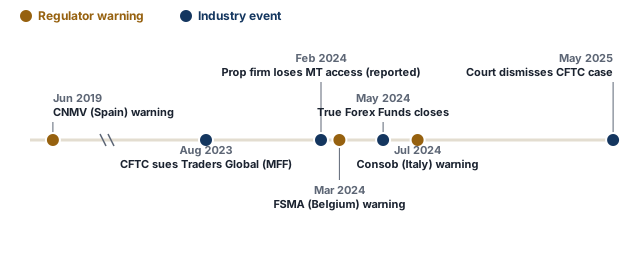
- CNMV 2019, FSMA 2024, Consob 2024
Are prop firms legit or scams?
Prop firms are not automatically legitimate or illegitimate as a category; legitimacy has to be assessed firm by firm. A legit prop firm sells trading evaluations and pays a profit split to traders who pass; a prop firm scam takes fees with no intention or ability to pay. Some prop firms are legitimate operating businesses, while others may fail to pay, close suddenly or operate fraudulently.
So the answer to “are prop firms legit?” depends on the firm, and starts with how its prop firm challenge and funded trading account actually work: what is a prop firm.
Are prop firms regulated?
Prop firm regulation depends on the country and the business model. Many retail prop firms operate outside the conventional broker and investment-firm licensing model, particularly where trading is simulated. Do prop firms need a licence? A firm that only sells evaluations on simulated accounts often operates without a financial licence, while one that holds client money or provides investment services may need one in the countries it serves. Several European regulators have warned consumers:
| Country | Regulator | Date | Main warning |
|---|---|---|---|
| Italy | Consob | 8 July 2024 | Compared these offers to an online trading “video game”; reported complaints about test difficulty and unpaid profits |
| Spain | CNMV | 6 June 2019 | Warned about “financed trading accounts” linked with paid courses, including the risk of fraud; outside its remit |
| Belgium | FSMA | 7 March 2024 | Warned consumers about the “shadow investment game” |
Prop firm risks and past industry problems
The main prop firm risks are counterparty risk (the firm’s ability to pay), payout risk, rule changes and the risk of a prop firm shutdown. Examples of prop firm closures and regulatory disputes:
| Date | Event | What it shows |
|---|---|---|
| February 2024 | A broker reportedly had to stop providing MetaTrader to the prop firm Funding Pips at MetaQuotes’ request; the firm’s CEO linked it to active US accounts, according to Finance Magnates | Firms can lose their trading platform at short notice |
| May 2024 | True Forex Funds, which had reportedly lost its MetaTrader licences earlier in 2024, closed citing its financial situation; traders reported blocked payouts | A prop firm shutdown can leave fees and payouts unpaid |
| August 2023 to May 2025 | The US CFTC sued Traders Global Group (My Forex Funds), alleging fraud; in May 2025 a federal court dismissed the case with prejudice and sanctioned the CFTC | Regulatory disputes can disrupt a firm for years, whatever their outcome |
Prop firm red flags: warning signs to check
- Guaranteed funding or payouts, or unrealistic income claims.
- Unclear legal entity: no company name, registration or address in the terms.
- Retroactive rule changes: drawdown, consistency or payout rules changed for existing accounts.
- Unverifiable payout claims: screenshots and testimonials without any independent record.
- Withdrawal restrictions: vague payout conditions, long delays or new requirements added before a payout.
- Unclear simulated account terms: no statement of whether funded accounts are real or simulated.
- Pressure to buy quickly, such as countdown discounts on every visit.
- Copied branding: a name or design close to a known firm with a different web address: clone firm.
- Untraceable payment requests, such as personal accounts: forex scams.
How to check if a prop firm is legit
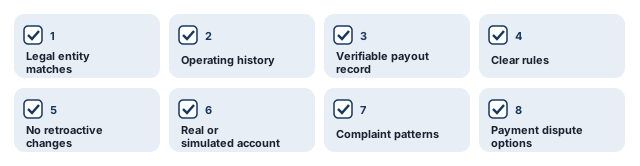
A checklist for how to check if a prop firm is legit before paying for a challenge:
- Legal entity: the legal company name, registration and address in the terms, and whether they match the website.
- Operating history: how long the firm has run its current programmes.
- Payout record: an independently verifiable payout history, not only payout screenshots published by the firm: prop firm payout.
- Rules: clear drawdown, consistency and payout rules: prop firm drawdown rules.
- Terms history: whether the firm has changed payout or drawdown rules retroactively, for example by comparing archived versions of its rules page.
- Account type: is the funded account real or simulated?
- Complaints: patterns in reviews and forums about refused or delayed payouts, rather than single cases.
- Payment and chargeback options: card and platform payments may offer dispute options that bank transfers and crypto do not.
Is my money protected with a prop firm?
Usually, a prop firm challenge fee is not protected in the same way as money held in a regulated brokerage account. The fee is a purchase of an evaluation, not a deposit held for the trader, so client money protection rules and investor compensation schemes generally do not apply, and there is no challenge fee protection if the firm closes. With a regulated broker, the trader’s deposit can be protected by segregation and, in some countries, an investor compensation scheme: how to choose a forex broker.
Free email course
Forex Risk Management in 5 Days
A free five-day email course: risk per trade, stop losses, position sizing, risk-reward and drawdowns, with a worked example each day.
Frequently asked questions
Are prop firms legit?
Some are legitimate operating businesses that pay traders who pass their evaluations; others have failed to pay, closed suddenly or operated fraudulently. Legitimacy has to be assessed firm by firm.
Are prop firms scams?
No, not all prop firms are scams; however, the model carries counterparty, payout and business-closure risk, and fraudulent operators also use the prop firm label.
Are prop firms safe?
A challenge fee is usually not protected by client money rules or compensation schemes, and payouts depend on the firm's ability and willingness to pay, so the risk depends on the firm.
Are prop firms regulated?
Many retail prop firms operate outside broker and investment-firm licensing, particularly where trading is simulated; treatment depends on the country and business model.
Are funded prop firm accounts real or simulated?
It depends on the firm. Some funded accounts trade real capital; many are simulated funded accounts on which the firm pays a share of the simulated profits.
How do I know if a prop firm will pay out?
No check guarantees it, but an independently verifiable payout history, clear payout rules, a long operating history and few complaints about refused payouts are positive signs.
What should I check before paying for a prop firm challenge?
The legal entity, operating history, payout record, rules and rule-change history, whether the funded account is real or simulated, complaints and the payment and chargeback options.
How can I check if a prop firm is legit?
Check its legal entity, operating history, payout record, rules, account type and complaints, using the checklist in this article.
What happens if a prop firm shuts down?
Challenge fees and pending payouts may be lost, because the fee is a purchase rather than a protected deposit; recovery depends on the firm's insolvency process and the payment method used.
Sources
Regulatory and official sources
- Beware of online trading "video games" (press release, 8 July 2024), Consob (Italy)
- The CNMV warns about websites of financed trading accounts linked with training courses (6 June 2019), CNMV (Spain)
- The FSMA warns consumers against shadow investment game (7 March 2024), FSMA (Belgium)
- CFTC v. Traders Global Group Inc. et al., complaint (August 2023), Commodity Futures Trading Commission
Industry and news sources
Related articles
- What Is a Prop Firm? How Prop Trading Firms Work
What a prop firm is and how prop trading firms work: challenge fees, prop firm evaluations, funded and simulated accounts, profit splits, rules and risks.
- Prop Firm Challenge Explained: One-Step, Two-Step and Instant Funding
How a prop firm challenge works: one-step vs two-step evaluations, instant funding, profit targets, drawdown limits, trading days, fees and refunds.
- Prop Firm Drawdown Rules: Static vs Trailing Drawdown Explained
Prop firm drawdown rules explained: daily drawdown, maximum drawdown, static vs trailing and end-of-day trailing, balance vs equity, with worked examples.
- Forex Scams: How to Spot Them and What to Do
How forex scams work, the warning signs, signal and trading bot scams, clone firms, withdrawal blocks, recovery scams and what to do after losing money.
Glossary terms
- Funded account
A funded account is the prop firm account a trader receives after passing a challenge, or directly through instant funding, on which profits are shared under the firm's profit split.
- Payout
A prop firm payout is the payment of a funded trader's share of eligible profits, made by the firm under its profit split and payout rules.
- Profit split
A profit split is the percentage of eligible profits on a funded prop firm account that the firm pays to the trader; the firm keeps the rest.
- Clone firm
A clone firm is a fraudulent operation that copies the name, registration number, address or other details of a genuine authorised firm to make itself look legitimate.
First published 3 October 2026. Last fact-checked 3 October 2026.This article is for educational purposes only and is not investment advice.