Prop Firm Drawdown Rules: Static vs Trailing Drawdown Explained
Prop firm drawdown rules set how much a challenge or funded account may lose before it is closed. Most firms combine a prop firm daily drawdown limit, which resets each day, with a prop firm maximum drawdown limit. The key difference is that static drawdown stays fixed, while trailing drawdown rises as the account reaches new highs. Many firms measure both against equity, including open trades.
Key takeaways
- Prop firm daily drawdown limits losses within one day; prop firm maximum drawdown limits the total loss on the account.
- Static drawdown stays fixed below the starting balance; trailing drawdown rises as the account reaches new highs.
- End-of-day trailing drawdown updates once a day from the closing balance; intraday trailing drawdown can move with every new equity high.
- Equity-based drawdown counts floating P&L on open trades, so a limit can be breached before a trade is closed.
- Position size can be set from the remaining drawdown, the distance to each limit, rather than from the account size alone.
Watch: the short version
Prop Firm Drawdown Rules: Static vs Trailing Drawdown
Narration: AI voice. Educational only, not investment advice.
At a glance
- Daily drawdown
- Most the account may lose in a day
- Maximum drawdown
- Static or trailing
- Measured on
- Balance or equity, by firm
- Floating losses
- Count on equity-based limits
What is prop firm drawdown?
Prop firm drawdown is the loss an account may take before it breaks the firm’s rules. In general, drawdown is the fall from an account’s peak; prop firm drawdown rules turn it into hard limits, and an account that falls below a limit is closed. Most prop firm challenge rules include two:
- Prop firm daily drawdown: the most the account may lose within one trading day: daily drawdown.
- Prop firm maximum drawdown: the most the account may lose in total, measured from a fixed level (static drawdown) or from the account’s high (trailing drawdown).
The key difference is that static drawdown stays fixed, while trailing drawdown rises as the account reaches new highs. The limits are usually a percentage of the initial account size and vary by firm and programme: what is a prop firm.
How is prop firm daily drawdown calculated?
The daily drawdown floor is recalculated at a fixed prop firm daily reset time, set by the firm:
daily drawdown floor = balance (or equity) at the daily reset − daily loss allowance
Whether the firm uses balance or equity at the reset, and whether the floor is checked against balance or equity during the day, depends on its rules. At many firms the check is against equity, so a large open loss can breach the limit even if no trade has been closed.
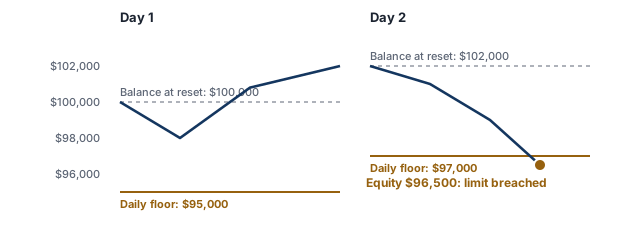
Prop firm daily drawdown example: $100,000 account (illustrative only)
Assumptions: $100,000 initial account, daily loss allowance of 5% of the initial account ($5,000), floor calculated from the balance at the daily reset and checked against equity.
- Day 1: balance at reset $100,000, so equity must stay above $95,000.
- Day 2: balance at reset $102,000 after a winning day, so equity must stay above $97,000.
- If an open trade on day 2 shows a floating loss of $5,500 and no other trades are open, equity falls to $96,500 and the daily limit is breached before the trade is closed.
What is static drawdown?
Static drawdown is a maximum loss limit fixed at a set level below the initial balance that does not move when the account makes money. On a $100,000 account with a 10% static maximum drawdown, the account must stay above $90,000 for the life of the challenge; after a $6,000 gain, the distance to max drawdown is $16,000: static drawdown.
What is trailing drawdown?
Trailing drawdown is a maximum loss limit that rises as the account reaches new highs, staying a fixed distance below the highest balance or equity reached, and never falls. Some firms stop the trailing floor once it reaches the initial balance, so it cannot rise above the starting capital: trailing drawdown.
End-of-day trailing drawdown
An end-of-day trailing drawdown updates once a day, from the highest closing balance at the daily reset. Profits made and given back within the same day do not raise the floor.
Intraday trailing drawdown
An intraday trailing drawdown can move with every new equity high during the day, including unrealised profit and loss on open trades. A trade that shows a large open profit and then reverses can raise the floor before it is closed.
The static vs trailing drawdown example below shows how the two floors move on the same account.
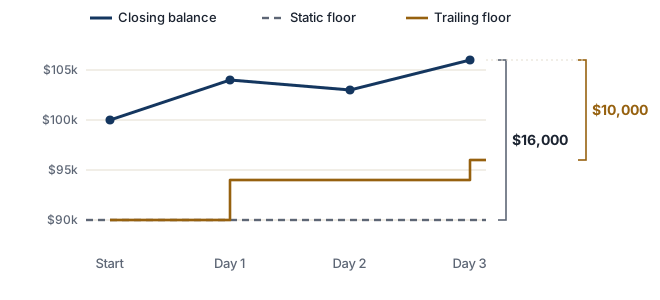
Static vs end-of-day trailing drawdown on a $100,000 account (illustrative only)
Assumptions: $100,000 initial account, maximum drawdown of 10% ($10,000), trailing floor updated from the closing balance each day.
| Day | Closing balance | Static floor | Trailing floor |
|---|---|---|---|
| Start | $100,000 | $90,000 | $90,000 |
| 1 | $104,000 | $90,000 | $94,000 |
| 2 | $103,000 | $90,000 | $94,000 |
| 3 | $106,000 | $90,000 | $96,000 |
After day 3, the room to the floor is $16,000 under the static rule but $10,000 under the trailing rule.
Static vs trailing drawdown: which is easier?
Static drawdown generally leaves more room after profits because the floor does not rise. Trailing drawdown raises the floor with the account’s gains, so less of those gains can be given back. Which is easier to trade under depends on the firm’s other rules and on the strategy, for example how far trades swing before they close.
| Static drawdown | Trailing drawdown | |
|---|---|---|
| Floor after profits | Stays where it started | Rises with the account’s high |
| Room after a winning run | Grows | Stays at most the drawdown allowance |
| Effect of a large open profit | None | Intraday versions can raise the floor before the profit is closed |
| Main risk | The same total room, whatever the gains | Giving back recent profits can breach the limit |
Balance-based vs equity-based prop firm drawdown
Balance-based drawdown counts only closed trades. Equity-based drawdown also counts floating P&L, the unrealised profit and loss on open trades, plus swaps and commissions, so open trade drawdown can breach a limit while the trade is still running. A firm’s rules page states which it uses: equity drawdown.
Prop firm drawdown rules comparison: FTMO vs FundedNext
As of October 2026, from the firms’ own rules pages. Rules change, so check the current terms before buying a challenge.
| Firm and programme | Daily drawdown | Maximum drawdown | Static or trailing | Measured against | Daily reset time |
|---|---|---|---|---|---|
| FTMO Challenge 2-Step | 5% of initial capital | 10% of initial capital | Static | Equity | Midnight CE(S)T |
| FTMO Challenge 1-Step | 3% of initial capital | 10% of initial capital | End-of-day trailing (can rise, never falls) | Equity | Midnight CE(S)T |
| FundedNext Stellar 2-Step | 5% of initial balance | 10% of initial balance | Static (account must stay above 90% of the initial balance) | Balance or equity | Not stated on the programme page |
How to manage risk with prop firm drawdown limits
- Size positions from the remaining drawdown. The distance to max drawdown and to the daily floor sets how much a trade can lose; if $3,000 of daily loss buffer remains, a trade risking $1,000 uses a third of it: position sizing.
- Keep a drawdown buffer. Spread, slippage and swaps count against equity-based limits, so a stop placed exactly at a limit can still breach it.
- Count open trades together. Several open positions in correlated pairs can reach the daily floor at the same time.
- Use a consistent risk-per-trade framework that leaves sufficient room before the daily and maximum drawdown limits for a run of losing trades: 1% rule.
Use the prop firm drawdown calculator to calculate the remaining daily drawdown, maximum drawdown and trailing drawdown room from the current balance and equity.
Free email course
Forex Risk Management in 5 Days
A free five-day email course: risk per trade, stop losses, position sizing, risk-reward and drawdowns, with a worked example each day.
Frequently asked questions
How is prop firm drawdown calculated?
Each limit is a floor: for daily drawdown, the balance or equity at the daily reset minus the daily loss allowance; for maximum drawdown, the starting balance (static) or the highest balance reached (trailing) minus the maximum loss allowance. The firm's rules state which values it uses.
What is the difference between daily drawdown and maximum drawdown?
Daily drawdown limits how much the account may lose within one day and resets each day; maximum drawdown limits the total loss over the life of the account and does not reset.
What is trailing drawdown in a prop firm?
A maximum loss limit that rises as the account reaches new highs and never falls; firms differ on whether it updates intraday or at the end of the day and whether it stops at the starting balance.
Is static or trailing drawdown better?
Static drawdown leaves more room after profits because the floor does not rise; trailing drawdown raises the floor with the account's gains, so less of those gains can be given back.
Does prop firm drawdown include open trades?
At many firms, yes. The limits are measured against equity, which includes floating P&L on open positions, swaps and commissions.
When does the daily drawdown reset?
At a reset time set by the firm, often midnight in a stated time zone; the new daily limit is based on the balance or equity at that moment.
What happens if you hit the maximum drawdown?
Hitting a limit is a rule violation, or breach, and leads to account termination for that challenge or funded account; the trader can usually buy a new challenge or a reset.
Sources
- Trading Objectives, FTMO
- Stellar 2-Step Challenge, FundedNext
Related articles
- What Is a Prop Firm? How Prop Trading Firms Work
What a prop firm is and how prop trading firms work: challenge fees, prop firm evaluations, funded and simulated accounts, profit splits, rules and risks.
- The 1% Rule in Trading: How Much to Risk Per Trade
What the 1% rule in trading means, how to apply it with a worked example, how it differs from position value, and its limits for small accounts.
- Position Sizing in Forex: How Many Lots Should You Trade?
How to calculate position size in forex from your risk amount, stop loss distance and pip value, with worked examples for EUR/USD and USD/JPY.
Glossary terms
- Drawdown
A drawdown is the decline in an account's value from a peak to a subsequent low, usually expressed as a percentage of the peak.
- Static drawdown
Static drawdown is a maximum loss limit fixed at a set level below an account's initial balance; unlike trailing drawdown, it does not rise when the account makes money.
- Trailing drawdown
Trailing drawdown is a maximum loss limit that rises as an account reaches new highs, staying a fixed distance below the highest balance or equity reached, and never falls.
- Daily drawdown
Daily drawdown, also called the daily loss limit, is the most an account may lose within one trading day under a prop firm's rules; the limit is recalculated at a reset time set by the firm.
- Equity drawdown
Equity drawdown is the fall in an account's equity, its balance plus floating profit and loss on open trades, from a reference level such as the starting balance or a previous high.
First published 3 October 2026. Last fact-checked 3 October 2026.This article is for educational purposes only and is not investment advice.