Prop Firm Challenge Explained: One-Step, Two-Step and Instant Funding
A prop firm challenge is a paid evaluation in which a trader must reach a profit target without breaking the firm's drawdown limits to qualify for a funded account. The main difference is the number of evaluation stages: a one-step prop firm challenge has one, a two-step prop firm challenge has two, while instant funding skips the evaluation. Rules, fees and refund terms vary by firm and programme.
Key takeaways
- A prop firm challenge is a paid prop firm evaluation; passing it gives access to a funded trading account, which may be real capital or a simulated funded account.
- The main difference between formats is the number of stages: one-step has one, two-step has two, and instant funding skips the evaluation.
- Every challenge combines a profit target with daily and maximum drawdown limits; some add minimum trading days and consistency rules.
- Prop firm challenge fees vary by account size and programme; the fee is lost if the challenge is failed.
- Some firms refund the challenge fee with the first payout, and most sell resets.
At a glance
- Formats
- One-step, two-step, instant funding
- Usual rules
- Target, daily and max drawdown
- Fee
- Paid per attempt
- Refund
- Only under the firm's terms
What is a prop firm challenge?
A prop firm challenge is a paid prop firm evaluation in which a trader must reach a profit target without breaking the firm’s drawdown limits to qualify for a funded trading account. Depending on the firm, the funded account trades real capital or is a simulated funded account on which the firm pays a share of the simulated profits: what is a prop firm.
The main difference between formats is the number of evaluation stages: a one-step prop firm challenge has one, a two-step prop firm challenge has two, while an instant funding prop firm account skips the evaluation.
How does a prop firm challenge work?
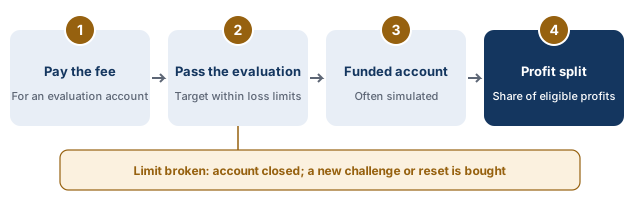
The prop firm challenge process usually has four steps:
- Choose a programme and account size and pay the prop firm challenge fee.
- Trade the evaluation account under the programme’s rules: a profit target, a daily drawdown limit, a maximum drawdown limit and any other conditions.
- Pass or fail. Reaching the profit target with every rule respected passes the stage; breaking any limit ends the prop firm evaluation.
- Receive the funded account after the last stage, usually once identity checks are complete. Payouts then follow the firm’s prop firm profit split.
One-step vs two-step prop firm challenge: what’s the difference?
A one-step prop firm challenge has a single evaluation stage: one profit target, then the funded account. A two-step prop firm challenge has two stages, often called the challenge and the verification, each with its own profit target; the second target is usually lower.
| One-step challenge | Two-step challenge | |
|---|---|---|
| Number of stages before funding | One | Two |
| Profit targets | One | Two, usually a lower one in the second stage |
| Drawdown limits | Can be tighter, or trailing | Can be static, sometimes wider |
| Evaluation fee structure | One fee for one stage; pricing differs by programme | One fee covering both stages; pricing differs by programme |
| Time to funded account | Can be shorter | Usually longer |
A one-step challenge has fewer stages, while a two-step challenge may offer different drawdown or profit-target conditions. Which suits a trader depends on the programme’s drawdown limits, targets and consistency rules rather than on the number of stages alone.
Prop firm challenge rules comparison: FTMO vs FundedNext
As of October 2026, from the firms’ own rules pages. Rules change, so check the current terms before paying for a challenge.
| Programme | Profit target | Daily drawdown | Maximum drawdown | Time limit | Fee refund | Account after passing | Other conditions |
|---|---|---|---|---|---|---|---|
| FTMO Challenge 2-Step | 10% (stage 1), 5% (verification) | 5% | 10%, static | Not stated on the rules page | Not stated on the rules page | FTMO Account; rules expressed in “Initial Simulated Capital” | At least 4 trading days in each stage |
| FTMO Challenge 1-Step | 10% | 3% | 10%, end-of-day trailing | Not stated on the rules page | Not stated on the rules page | FTMO Account; rules expressed in “Initial Simulated Capital” | Consistency rule: the best day may not exceed 50% of total profit (positive days’ profit on accounts from orders before 12 October 2026) |
| FundedNext Stellar 2-Step | 8% (phase 1), 5% (phase 2) | 5% | 10% | None | Refunded with the first payout on the funded account | FundedNext Account; type not stated on the programme page | Maximum risk of 3% at any time on the funded account |
How the drawdown limits are calculated, static or trailing, balance or equity: prop firm drawdown rules.
What is an instant funding prop firm?
An instant funding prop firm gives an instant funding account without an evaluation: the trader pays a fee and starts on the funded account directly, so it is a funded account without a challenge. No evaluation prop firm programmes have their own drawdown, consistency and payout rules, and fees are often higher than for a challenge of the same account size, so the terms need the same checks as any prop firm challenge: instant funding.
Other prop firm challenge rules: minimum days, consistency and trading restrictions
- Minimum trading days: the number of days on which a trade must be opened before a stage can be passed.
- Consistency rule: a limit on how much of the total profit may come from one day or trade, such as FTMO’s 1-Step consistency rule: consistency rule, prop firm consistency rule.
- Time limit: some programmes set a period in which the target must be reached; others have none.
- Trading restrictions: some firms limit trading around major news releases, holding positions over the weekend, or strategies such as copy trading; others allow them.
Prop firm challenge fees, resets and refunds
The prop firm challenge fee is paid once per attempt; fees typically vary by account size and programme. A prop firm reset fee restarts a failed or ongoing challenge on the same account, at a price set by the firm.
Is a prop firm challenge fee refundable? Only under the firm’s refund terms. Some firms offer a prop firm refund of the challenge fee with the first payout on the funded account, as FundedNext does on its Stellar 2-Step programme. When a prop firm challenge is failed, the fee is not refunded, and the trader can buy a reset or a new challenge.
Two-step prop firm challenge example: $100,000 account (illustrative only)
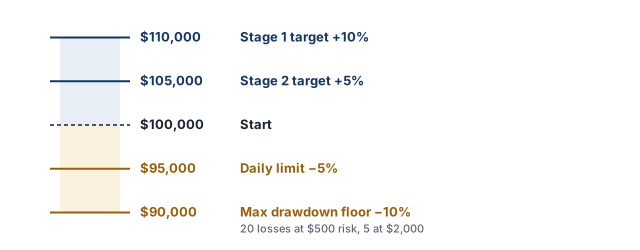
Assumptions: two-step challenge on a $100,000 account, 10% profit target in stage 1 and 5% in stage 2, 5% daily drawdown, 10% static maximum drawdown, each stage starting again at $100,000. For the losing-trade counts: identical fixed risk per trade, no costs or slippage, and losses spread across days so the daily limit is not breached.
- Stage 1 passes when the balance reaches $110,000 with all positions closed, without equity falling below $90,000 or losing more than $5,000 in a day.
- Stage 2 passes at $105,000 under the same loss limits.
- At $500 risk per trade (0.5% of the account), the $10,000 maximum drawdown is reached after 20 losing trades; at $2,000 per trade, after 5.
Rules, fees and refund terms vary by firm and programme; this example only shows how the targets and limits fit together.
How to prepare for a prop firm challenge
A prop firm challenge checklist before paying the fee:
- Rules: profit target, minimum trading days and time limit for each stage.
- Drawdown: daily and maximum limits, static or trailing, balance or equity.
- Consistency: any best-day or similar rule.
- Trading restrictions: news trading, weekend holding, expert advisors, copy trading.
- Payout terms: profit split, payout frequency and conditions.
- Refund and reset terms: whether the fee is refunded and what a reset costs.
- Account type: real capital or simulated funded account.
Testing the same rules on a demo account and setting a position size that leaves room before the limits helps show whether a strategy fits the programme: position sizing, forex demo account, trading plan.
Free email course
Forex Risk Management in 5 Days
A free five-day email course: risk per trade, stop losses, position sizing, risk-reward and drawdowns, with a worked example each day.
Frequently asked questions
What is a prop firm challenge?
A paid evaluation in which a trader must reach a profit target without breaking the firm's drawdown limits, in one or two stages, to qualify for a funded account.
How many stages does a prop firm challenge have?
One in a one-step challenge and two in a two-step challenge; instant funding programmes have no evaluation stage.
Is a one-step or two-step prop firm challenge easier?
One-step has fewer stages; two-step has two separate targets. Difficulty depends on the drawdown limits, profit targets and consistency rules of each programme.
What is the difference between a prop firm challenge and instant funding?
A challenge requires passing an evaluation before funding; instant funding gives a funded account straight away, usually for a different fee and under its own rules.
Do prop firms use real or simulated accounts after you pass?
It depends on the firm. Some funded accounts trade real capital, many are simulated funded accounts on which profits are paid by the firm; the terms state which.
Is the prop firm challenge fee refundable?
Only under the firm's refund terms. Some firms refund the fee with the first payout on the funded account; the fee is not refunded if the challenge is failed.
How long does a prop firm challenge take?
It depends on the programme. Some have no time limit, others a set period; many require a minimum number of trading days before the challenge can be passed.
What happens if you fail a prop firm challenge?
A failed prop firm challenge is closed for breaking a rule and the fee is not refunded; the trader can usually buy a reset of the same account or a new challenge.
Sources
- Trading Objectives, FTMO
- Stellar 2-Step Challenge, FundedNext
Related articles
- What Is a Prop Firm? How Prop Trading Firms Work
What a prop firm is and how prop trading firms work: challenge fees, prop firm evaluations, funded and simulated accounts, profit splits, rules and risks.
- Prop Firm Drawdown Rules: Static vs Trailing Drawdown Explained
Prop firm drawdown rules explained: daily drawdown, maximum drawdown, static vs trailing and end-of-day trailing, balance vs equity, with worked examples.
- Position Sizing in Forex: How Many Lots Should You Trade?
How to calculate position size in forex from your risk amount, stop loss distance and pip value, with worked examples for EUR/USD and USD/JPY.
Glossary terms
- Profit target
A profit target is the gain, usually a percentage of the initial account size, that a trader must reach to pass a stage of a prop firm challenge.
- Consistency rule
A consistency rule is a prop firm condition that limits how much of a trader's total profit may come from a single day or trade, so that results are not driven by one outsized gain.
- Instant funding
Instant funding is a prop firm programme in which a trader pays a fee and receives a funded account straight away, without passing an evaluation.
- Profit split
A profit split is the percentage of eligible profits on a funded prop firm account that the firm pays to the trader; the firm keeps the rest.
- Funded account
A funded account is the prop firm account a trader receives after passing a challenge, or directly through instant funding, on which profits are shared under the firm's profit split.
- Daily drawdown
Daily drawdown, also called the daily loss limit, is the most an account may lose within one trading day under a prop firm's rules; the limit is recalculated at a reset time set by the firm.
- Challenge fee
A challenge fee is the price a trader pays a prop firm to take an evaluation (a challenge) with a profit target and loss limits; it pays for a service, is kept by the firm if the challenge fails, and some programmes refund it after a qualifying payout.
First published 3 October 2026. Last fact-checked 18 October 2026.This article is for educational purposes only and is not investment advice.