Prop Firm Consistency Rule: How It Works, With Examples
A prop firm consistency rule limits how much of a trader's profit may come from a single day. The core idea is simple: one trading day must not account for too large a share of the trader's total profit. A common formula is best-day profit divided by total profit, although some firms use different definitions. Exceeding the threshold usually means trading on until the share falls, rather than failing the account.
Key takeaways
- The core idea of a prop firm consistency rule: one trading day must not account for too large a share of total profit.
- A common formula is best-day profit divided by total profit; some firms divide by the profit target or count only positive days.
- At many firms, exceeding the threshold does not fail the account; the trader keeps trading, or the profit target rises.
- Some programmes apply the rule during the challenge, some only to payout eligibility on the funded account, and some have none.
- More stable position sizing can reduce the chance that one day dominates total profit.
Watch: the short version
Prop Firm Consistency Rule Explained, With Numbers
Narration: AI voice. Educational only, not investment advice.
At a glance
- Compares
- Best day with a profit base (varies)
- Example threshold
- 50% (varies by firm)
- If above it
- Keep trading, or a higher target
- May help
- More stable position sizes
What is a prop firm consistency rule?
A prop firm consistency rule, also called a best day rule or consistency target, limits how much of a trader’s profit may come from a single day. The core idea is simple: one trading day must not account for too large a share of the trader’s total profit: consistency rule. It sits alongside the profit target and drawdown limits among the prop firm challenge rules, and on many programmes it also works as a prop firm payout consistency rule on the funded account.
Firms use two main methods:
| Method | Formula | What happens if exceeded |
|---|---|---|
| Share of total profit | best day profit ÷ total profit (or positive days’ profit) | Keep trading until the share falls within the limit |
| Share of the profit target | best day profit ÷ profit target | The profit target rises, so more profit is needed to pass |
How is the consistency rule calculated?
best-day consistency % = best day profit ÷ relevant profit base × 100
The relevant profit base differs by firm: net profit over the period, the sum of positive days’ profit only, or the profit target. The consistency rule is met when the percentage is at or below the firm’s threshold. A common formula is best-day profit divided by total profit, although some firms use different definitions.
50% prop firm consistency rule example (illustrative only)
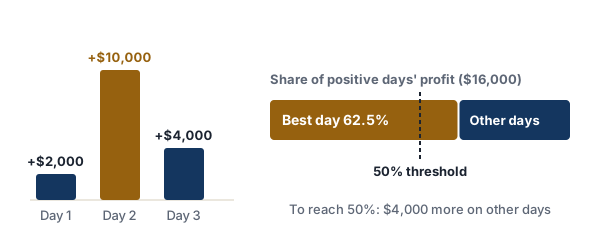
Assumptions: a 50% threshold measured against the sum of positive days’ profit; all figures are closed profit; the best day remains $10,000.
- Day 1: +$2,000, Day 2: +$10,000, Day 3: +$4,000. Positive days’ profit is $16,000.
- Best day share: $10,000 ÷ $16,000 = 62.5%, above the 50% threshold.
- For $10,000 to be 50% or less, positive days’ profit must reach at least $20,000, so another $4,000 is needed on other days.
What happens if you break the consistency rule?
At many firms, exceeding the threshold does not immediately fail the account. When traders exceed the consistency threshold:
- They keep trading until other profitable days bring the best day’s share within the limit, before passing the stage or gaining payout eligibility: prop firm payout.
- Or the profit target rises, where the rule compares the best day with the target, so more profit is needed to pass.
More trading days also mean more exposure to the daily and maximum drawdown limits: prop firm drawdown rules.
Prop firm consistency rules compared: FTMO vs FundedNext vs Topstep
As of October 2026, from the firms’ own rules and help pages. Rules change, so check the current terms.
| Programme | Stage or account type | Threshold | Calculation formula | Payout impact | If exceeded |
|---|---|---|---|---|---|
| FTMO 1-Step (consistency rule) | Challenge and funded account | 50% | Best day ÷ total profit (closed trades), for accounts from orders created, or accounts merged, on or after 12 October 2026; best day ÷ positive days’ profit (legacy Best Day rule) on accounts opened directly from earlier orders | Reward eligibility on the FTMO Account requires it | Not a breach; keep trading until 50% or less |
| FundedNext Futures Rapid | Funded account only; at least 3 days | 40% | Highest profit day ÷ total profit | Payout eligibility requires it | Keep trading until 40% or less |
| Topstep Trading Combine (consistency target) | Evaluation | 55% | Best day ÷ profit target | Not a payout rule | Profit target increases |
| Topstep Express Funded Account (consistency path) | Funded account; at least 3 trading days | 40% | Largest single day ÷ total net profit | Payout eligibility requires it | No payout until met |
Why do prop firms use consistency rules?
These rules are intended to reduce dependence on a single outsized winning day and to make performance more distributed across the evaluation period. A result reached over several days with similar position sizes shows more about how a trader manages risk than one reached with a single large position. The rules also make challenges take longer to pass for traders whose profits come in bursts.
How to manage a prop firm consistency rule
- Track the best day’s share as well as the distance to the profit target, so the required additional profit is known in advance.
- Keep a consistency buffer: a best day well below the threshold leaves room for one strong day without delaying payout eligibility.
- Position size: more stable position sizing can reduce the chance that one day dominates total profit: position sizing.
- Plan for extra days if a large winning day pushes the share above the threshold, while staying inside the drawdown limits.
Use the prop firm consistency calculator to calculate the best-day percentage and the additional profit required to meet a 40%, 50% or other consistency limit.
Free email course
Forex Risk Management in 5 Days
A free five-day email course: risk per trade, stop losses, position sizing, risk-reward and drawdowns, with a worked example each day.
Frequently asked questions
What is a consistency rule in a prop firm?
A rule that limits how much of a trader's profit may come from one day, usually expressed as a maximum percentage of total profit or of the profit target.
How is the prop firm consistency rule calculated?
Commonly as best-day profit divided by a profit base times 100; the base is total profit, positive days' profit or the profit target, depending on the firm.
What is a 50% consistency rule in prop firms?
A rule under which the most profitable day may account for at most 50% of the relevant profit, as in FTMO's 1-Step consistency rule, which uses total profit on accounts from orders created, or accounts merged, on or after 12 October 2026, and positive days' profit (the legacy Best Day rule) on accounts opened directly from earlier orders.
What is a 40% consistency rule?
A rule under which the largest single day may account for at most 40% of total profit, used for example on some funded futures accounts at FundedNext and Topstep.
Does a consistency rule apply to the challenge or the payout?
It depends on the programme. Some apply it during the evaluation, some only to payout eligibility on the funded account, and some to both.
Can you fail a prop firm because of the consistency rule?
At many firms, no; exceeding the threshold delays passing or payout eligibility, or raises the profit target, rather than closing the account. The programme rules state how it is treated.
What happens if you exceed the consistency threshold?
Usually the trader must keep trading until the best day's share falls within the limit, or must reach a higher profit target, before passing or requesting a payout.
How can I meet a consistency rule faster?
It depends on how the firm calculates the rule; under total-profit formulas, additional profit on other days lowers the best-day share, while under profit-target formulas the higher target has to be reached.
Sources
Related articles
- Prop Firm Challenge Explained: One-Step, Two-Step and Instant Funding
How a prop firm challenge works: one-step vs two-step evaluations, instant funding, profit targets, drawdown limits, trading days, fees and refunds.
- Prop Firm Drawdown Rules: Static vs Trailing Drawdown Explained
Prop firm drawdown rules explained: daily drawdown, maximum drawdown, static vs trailing and end-of-day trailing, balance vs equity, with worked examples.
- Position Sizing in Forex: How Many Lots Should You Trade?
How to calculate position size in forex from your risk amount, stop loss distance and pip value, with worked examples for EUR/USD and USD/JPY.
Glossary terms
- Consistency rule
A consistency rule is a prop firm condition that limits how much of a trader's total profit may come from a single day or trade, so that results are not driven by one outsized gain.
- Payout
A prop firm payout is the payment of a funded trader's share of eligible profits, made by the firm under its profit split and payout rules.
- Profit target
A profit target is the gain, usually a percentage of the initial account size, that a trader must reach to pass a stage of a prop firm challenge.
First published 3 October 2026. Last fact-checked 18 October 2026.This article is for educational purposes only and is not investment advice.