Forex Scams: How to Spot Them and What to Do
A forex scam is a fraudulent scheme that uses forex or leveraged trading to obtain money or account access from victims, for example by misappropriating funds, fabricating trading activity or obstructing withdrawals. Common warning signs are guaranteed or unusually high returns, unsolicited contact and pressure to act quickly, payment routes that cannot be verified, and unauthorised offers to trade on the client's behalf.
Key takeaways
- Guaranteed or unusually high returns are among the most common warning signs of a forex scam.
- Funding instructions should be verifiable as belonging to, or officially authorised by, the regulated entity.
- Requests for a "tax", "fee" or "unlock payment" before a withdrawal is released are a typical sign of fraud.
- After a loss, common steps are to stop sending money, secure accounts, keep evidence, and contact the bank and the authorities.
- Unsolicited recovery offers that guarantee success or demand fees upfront are a common follow-on scam.
Watch: the short version
Forex Scams: 4 Warning Signs to Know
Narration: AI voice. Educational only, not investment advice.
At a glance
- Red flag
- Guaranteed returns
- Pay to
- Verified accounts of the regulated firm
- Never share
- Logins or remote access
- Recovery offers
- Treat with caution
How do forex scams work?
A forex investment scam uses forex or leveraged trading as the story for obtaining money or account access. A fake forex broker or fraudulent trading platform may misappropriate deposits, show fabricated trades and profits, or obstruct withdrawals. Some schemes allow small early withdrawals to build trust before larger deposits are requested. Others impersonate an authorised firm rather than operating without any authorisation at all.
Forex scams can be difficult for newcomers to verify because leveraged trading results are hard to check from the outside and losses can be attributed to market moves. The CFTC lists forex among the products that have historically seen a large number of fraud complaints.
How do you spot a forex scam? Warning signs
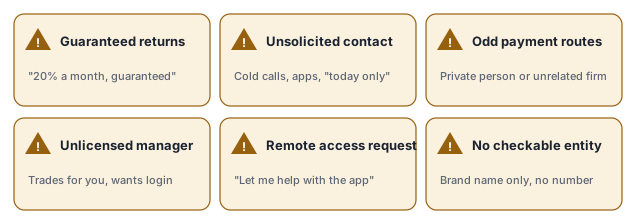
Any one of these signs is a reason to stop and verify:
- Guaranteed or unusually high returns. Leveraged forex trading carries a high risk of loss, and most retail CFD accounts lose money: is forex trading profitable. Promises such as “20% a month, guaranteed” are a major warning sign.
- Unsolicited contact and pressure. Cold calls, messages on social media or dating apps, and offers that are only available “today”.
- Unverifiable payment routes. Funding instructions should be verifiable as belonging to, or officially authorised by, the regulated entity; requests to pay a private person or an unrelated company are a serious warning sign.
- Offers to trade on your behalf without clear authorisation. An “account manager” or “analyst” who wants to open trades for you or asks for your login details, without a licence for managing client money or a documented mandate.
- Requests to install remote access software on a computer or phone to “help” with the account (a remote access scam).
- Only winning trades shown, with no independently verifiable performance record. Screenshots of profits and a luxury lifestyle on social media.
- No clear legal entity. Only a brand name, a foreign address or contact through messaging apps, with no registration number that can be checked.
How to confirm the legal entity behind a regulated forex broker: how to choose a forex broker.
What are the most common types of forex scams?
Fake forex brokers and trading platforms
A professional-looking website or app shows trades and a growing balance, but the displayed trades may be fabricated and no genuine execution or brokerage activity may occur. The aim is to encourage larger deposits; the problems start when the client tries to withdraw.
Relationship investment scams
A contact met online, often through a dating app, social media or a “wrong number” message, builds trust over weeks and then describes large profits from trading crypto, precious metals or foreign currency. The victim is directed to a fraudulent platform, sees the balance grow, and is pressed to deposit more. The CFTC calls these relationship investment scams; they are also widely known as “pig butchering” scams.
Forex signal scams and trading bot scams
Signal service scams, “managed account” offers and forex robot scams are promoted with claims of guaranteed returns or near-perfect win rates. Claims that AI or algorithms can guarantee future trading returns are not credible; the CFTC cites a bot scheme that promised at least 10% a month and was in fact a Ponzi scheme that took more than $1.7 billion from its customers.
Not every signal service or expert advisor is a scam. The key issues are unverifiable performance claims, guaranteed returns, and money management offered without authorisation.
Clone firms
A clone firm copies the name, logo, registration number and address of an authorised firm, often with a slightly different web address or phone number. The UK FCA advises using only the contact details shown on its Firm Checker, not those supplied by the caller.
Forex recovery scams
People who have already lost money are contacted with an offer to recover it, usually for a fee paid in advance. The FCA notes that recovery fraudsters may pose as regulators, government agencies, the police or law firms, and the CFTC describes recovery offers as a typical follow-on fraud after a trading scam.
Why can’t I withdraw money from my forex broker?
Withdrawals can be delayed for legitimate reasons, such as identity checks or a payment method that has to match the deposit method; these are usually explained in the client agreement. A typical sign of fraud is a request to pay first before a withdrawal is released, described as a “tax”, “commission”, “account activation”, “anti-money laundering check” or “insurance”. In scam cases, paying additional release fees often leads to further demands rather than a withdrawal. Keeping correspondence, account statements and payment receipts helps with any later complaint.
Can you get money back from a forex scam?
Recovery depends on the case and is often difficult, but acting quickly can help. Commonly recommended steps:
- Stop sending money and remove any remote access software.
- Secure your accounts: change banking, email and trading passwords from a device you know is clean, and turn on two-factor authentication.
- Keep evidence: messages, call logs, website addresses, screenshots, receipts and the details of the accounts money was sent to.
- Contact your bank or card provider promptly and ask what can be done with the payments; timing can matter.
- Report to the authorities. In the US, the CFTC and the FBI’s Internet Crime Complaint Center (IC3) accept reports; in the UK, the FCA and Report Fraud. Other countries have their own regulator and police reporting channels.
- Treat recovery offers with caution. Unsolicited recovery offers that guarantee success or demand fees before verifying the case are a common follow-on scam pattern.
A lawyer can advise on legal options in your country.

How can you avoid forex trading scams?
- Confirm the exact legal entity on the official register of a regulator that authorises it to serve your country: forex regulation. In the US, the CFTC also publishes a RED list of foreign entities that appear to need CFTC registration but are not registered.
- Do not share account logins, passwords or remote access to your devices, and use two-factor authentication where available.
- Keep online relationships and investments separate; be cautious with any new contact who introduces a trading opportunity.
- Learn the basics before depositing money: how to start forex trading.
Free email course
Forex Risk Management in 5 Days
A free five-day email course: risk per trade, stop losses, position sizing, risk-reward and drawdowns, with a worked example each day.
Frequently asked questions
How can you tell if a forex broker is a scam?
Check whether the exact legal entity appears on the official register of a regulator that authorises it to serve your country, and look for the warning signs listed in the article.
Can I get my money back from a forex scam?
It depends on the case and is often difficult. Acting quickly through your bank and the authorities can help; the steps are in the article.
Are forex signal groups scams?
Not all of them. Selling educational content or trade ideas differs from managing other people's money, which generally requires authorisation; guaranteed returns, unverifiable results or requests to hand over account access are warning signs.
What is a forex recovery scam?
A scam aimed at people who have already lost money, offering to recover it in exchange for an upfront fee. The FCA notes that recovery fraudsters may pose as regulators, government agencies, the police or law firms.
What is a clone firm?
A scam that copies the name, registration number or website details of a genuinely authorised firm. Checking the contact details on the regulator's own register, not those given by the caller or website, helps to tell them apart.
Where do you report a forex scam?
It depends on the country. In the US, the CFTC and the FBI's IC3 accept reports; in the UK, the FCA and Report Fraud.
Sources
- Customer Advisory: Eight Things You Should Know Before Trading Forex, Commodity Futures Trading Commission
- Customer Advisory: AI Won't Turn Trading Bots into Money Machines, Commodity Futures Trading Commission
- Help Warn Others About Relationship Investment Scams, Commodity Futures Trading Commission
- CFTC Warns Customers to Watch for Follow-on Frauds (30 July 2024), Commodity Futures Trading Commission
- Registration Deficient (RED) List, Commodity Futures Trading Commission
- Protect yourself from scams, Financial Conduct Authority
- Recovery room scams, Financial Conduct Authority
Related articles
- How to Choose a Forex Broker: A Checklist
How to choose a forex broker: regulation, client money protection, total trading costs, order execution, platforms and withdrawal terms, with a checklist.
- Is Forex Trading Profitable? What the Evidence Says
Is forex trading profitable? What regulators' data says about how many retail traders lose money, what contributes to losses and how expectancy works.
- How to Start Forex Trading: A Step-by-Step Guide for Beginners
How to start forex trading safely: check the rules where you live, learn the basics, choose a regulated broker, practise on demo and size every trade.
Glossary terms
- Clone firm
A clone firm is a fraudulent operation that copies the name, registration number, address or other details of a genuine authorised firm to make itself look legitimate.
- Expert Advisor
An Expert Advisor (EA) is a program for MetaTrader that can analyse prices and open, manage and close trades automatically according to rules written in MQL4 or MQL5.
- Market maker
A market maker broker, also called a dealing desk broker, quotes its own bid and ask prices and acts as the counterparty to client trades instead of passing every order to outside liquidity providers.
First published 2 October 2026. Last fact-checked 4 October 2026.This article is for educational purposes only and is not investment advice.