Forex Regulation: Regulators and Rules by Country
Forex regulation is the set of licensing and conduct rules that national financial regulators apply to firms offering forex and CFD trading to the public, such as the CFTC and NFA in the US, the FCA in the UK and ASIC in Australia. Rules differ by country and cover who may serve retail clients, maximum leverage, client money handling, negative balance protection and complaint routes.
Key takeaways
- Forex is regulated nationally; there is no single global forex regulator.
- A broker licence applies to a specific legal entity and to the clients that entity is permitted to serve.
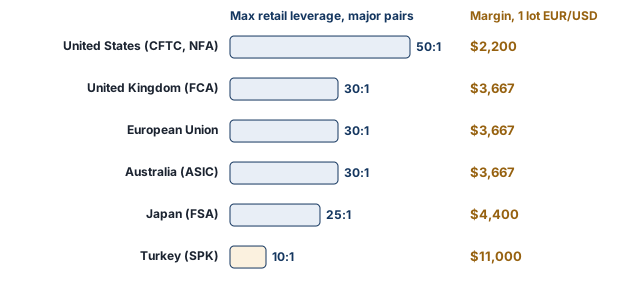
- As of October 2026, retail leverage caps on major currencies include 50:1 in the US, 30:1 in the UK, EU and Australia, 25:1 in Japan and 10:1 in Turkey.
- Protections can differ materially across jurisdictions, particularly in areas such as leverage limits, client money rules, negative balance protection and complaint mechanisms.
At a glance
- Global forex regulator
- None
- A licence covers
- One legal entity
- Max retail leverage, majors
- UK, EU, Australia 30:1 (Oct 2026)
- Max retail leverage, US
- 50:1 majors (Oct 2026)
What does forex regulation cover?
Retail forex is usually traded over the counter, with the broker as the client’s counterparty or intermediary, so the rules that protect clients come from the regulator that licenses the broker. Forex regulation typically covers:
- Authorisation: which firms may offer leveraged forex to retail clients in a country, and the capital, reporting and conduct standards they must meet.
- Leverage limits: the maximum leverage, or minimum margin, for retail clients: what is leverage in forex.
- Client money: whether client funds must be held separately from the firm’s own money: segregated client funds.
- Loss protections: margin close-out rules and negative balance protection.
- Marketing and conduct: risk warnings, restrictions on bonuses and other incentives, and complaint handling.
There is no single global forex regulator. Each licence applies to a specific legal entity and to the clients that entity is permitted to serve, which is why a regulated forex broker in one country may not be authorised to serve residents of another: how to choose a forex broker.
Forex regulators and leverage limits by country
The table compares the main regulators and the retail leverage cap on major currencies, as of October 2026. Rules change, and caps for other instruments are usually lower.
| Country or region | Main regulator(s) | Retail leverage cap, major currencies | Notes |
|---|---|---|---|
| United States | CFTC, NFA | 50:1 on specified major currencies (2% minimum security deposit) | 5% minimum security deposit (20:1) on other currencies; FIFO rule for offsetting positions |
| United Kingdom | FCA | 30:1 for CFDs sold to retail clients | Margin close-out at 50%, negative balance protection, incentives restricted |
| European Union | National competent authorities, e.g. CySEC (Cyprus), BaFin (Germany) | 30:1 for CFDs sold to retail clients | ESMA introduced the measures in 2018; national competent authorities subsequently adopted permanent measures |
| Australia | ASIC | 30:1 for CFDs sold to retail clients | Product intervention order currently due to expire on 23 May 2027 unless remade |
| Japan | FSA, with FFAJ rules | 25:1 for individual customers (4% minimum margin) | In force since 1 August 2011; different rules apply to corporate customers |
| Turkey | SPK (Capital Markets Board) | 10:1 at position opening | Minimum initial deposit of 50,000 Turkish lira or equivalent; only SPK-authorised firms may serve Turkish residents |
Margin for the same position under different caps (illustrative only)
Assumption: the broker applies the maximum retail leverage the regulator allows. A regulator’s cap is an upper limit; a broker may offer lower leverage. Other assumptions: EUR/USD, 1 standard lot (100,000 euros), price 1.1000, so the position is worth $110,000; USD account.
- 50:1 (US): $110,000 ÷ 50 = $2,200
- 30:1 (UK, EU, Australia): $110,000 ÷ 30 = about $3,667
- 25:1 (Japan): $110,000 ÷ 25 = $4,400
- 10:1 (Turkey): $110,000 ÷ 10 = $11,000
For the same position size, the leverage cap changes the margin needed to open the position, not the profit or loss per pip, which is about $10 per standard lot in each case.
How is forex regulated in the US (CFTC and NFA)?
Under CFTC forex regulation, only certain regulated entities may act as the counterparty to retail forex trades, mainly a retail foreign exchange dealer (RFED) or a futures commission merchant (FCM). Both must be NFA members approved for forex, and the CFTC advises checking registration before opening an account.
NFA rules set minimum security deposits of 2% of notional value on specified major currencies and 5% on others. Separately, a forex dealer member may not carry offsetting positions in a customer account and must offset them on a first-in, first-out (FIFO) basis. In practice, this means opposite long and short positions in the same pair cannot be held open side by side in one account in the way many platforms outside the US allow: hedging.
How is forex regulated in the UK (FCA)?
Under FCA forex regulation, CFDs sold to retail clients, including rolling spot forex, are subject to leverage limits from 30:1 to 2:1 depending on the underlying, margin close-out at 50% of required margin, negative balance protection, a ban on cash and other incentives to trade, and standardised risk warnings showing the percentage of the firm’s retail accounts that lose money. The rules apply to retail clients; clients classified as professional are treated differently.
How is forex regulated in the EU?
In the EU, ESMA introduced temporary product intervention measures on CFDs for retail clients in 2018, including a 30:1 cap on major currency pairs, margin close-out at 50% and negative balance protection. After those measures expired in 2019, national competent authorities such as CySEC in Cyprus and BaFin in Germany adopted their own permanent measures, so the details are set country by country.
How is forex regulated in Australia and Japan?
Under ASIC forex regulation, a product intervention order in force since 29 March 2021 limits retail CFD leverage to 30:1 on major currency pairs and adds margin close-out, negative balance protection and restrictions on inducements; the order is currently due to expire on 23 May 2027 unless remade. In Japan, FFAJ rules require a minimum margin of 4% of the trading amount for individual customers, which caps their leverage at 25:1.
What is an offshore forex broker?
An offshore forex broker is an entity licensed in a jurisdiction other than the client’s own. Many broker groups run several entities in different jurisdictions, and jurisdictions may differ in capital requirements, leverage limits, client money rules, complaint mechanisms and compensation arrangements. An offshore entity may offer higher leverage and may provide different or more limited protections depending on the jurisdiction. Some firms are not regulated at all and only claim to be; the warning signs are covered in forex scams, and impersonation of authorised firms in clone firm.
For Turkey, retail leveraged trading is reserved for SPK-authorised firms; the Turkish rules are explained in SPK forex leverage limit (in Turkish).
How do you check if a forex broker is regulated by a specific regulator?
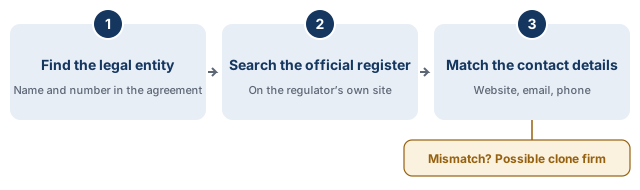
A broker licence check uses the regulator register itself: search for the exact legal name or registration number of the entity on the regulator’s official register, and check that the website and contact details match the register entry. For a forex broker regulation check in the US, NFA BASIC shows registration and disciplinary history, and the CFTC’s RED list names foreign entities that appear to need CFTC registration but are not registered. Whether trading forex is permitted for residents of a given country is a separate question: is forex trading legal.
Free email course
Forex Risk Management in 5 Days
A free five-day email course: risk per trade, stop losses, position sizing, risk-reward and drawdowns, with a worked example each day.
Frequently asked questions
Who regulates forex?
National financial regulators, for example the CFTC and NFA in the US, the FCA in the UK, national regulators such as CySEC and BaFin in the EU, and ASIC in Australia.
Is forex regulated in every country?
Many jurisdictions regulate firms that offer leveraged forex to retail clients, but the framework varies widely and some countries restrict or prohibit certain forms of retail forex trading.
What is the difference between the CFTC and the NFA?
The CFTC is the US federal regulator for derivatives markets, including retail forex. The NFA is the industry's self-regulatory organisation; firms acting as counterparty to US retail forex customers must be NFA members approved for forex.
What is the maximum forex leverage in the US?
50:1 on specified major currencies (a 2% minimum security deposit) and 20:1 on other currencies (5%), under NFA rules, as of October 2026.
What is the best forex regulator?
There is no official ranking. What matters for a client is whether the entity is authorised to serve their country and which protections apply to their account.
What does offshore regulation mean for a forex broker?
It usually means the entity is licensed outside the client's country, where requirements and protections may differ; details are in the article.
Sources
- Forex Transactions: Regulatory Guide, National Futures Association
- Retail Foreign Exchange Dealer (RFED) Registration, National Futures Association
- Customer Advisory: Eight Things You Should Know Before Trading Forex, Commodity Futures Trading Commission
- PS19/18: Restricting contract for difference products sold to retail clients, Financial Conduct Authority
- ESMA adopts final product intervention measures on CFDs and binary options, European Securities and Markets Authority
- Product Intervention, European Securities and Markets Authority
- 22-082MR ASIC's CFD product intervention order extended for five years, Australian Securities and Investments Commission
- Regulations on Leverage, The Financial Futures Association of Japan
- Yatırım Hizmetleri ve Faaliyetleri ile Yan Hizmetlere İlişkin Esaslar Hakkında Tebliğ (III-37.1), Mevzuat Bilgi Sistemi (Republic of Türkiye)
Related articles
- How to Choose a Forex Broker: A Checklist
How to choose a forex broker: regulation, client money protection, total trading costs, order execution, platforms and withdrawal terms, with a checklist.
- Forex Scams: How to Spot Them and What to Do
How forex scams work, the warning signs, signal and trading bot scams, clone firms, withdrawal blocks, recovery scams and what to do after losing money.
- What Is Leverage in Forex? How It Works, Ratios and Limits
What is leverage in forex? How leverage ratios such as 1:30, 1:100 and 1:500 work, how margin is calculated, effective leverage and retail limits.
Glossary terms
- Retail foreign exchange dealer (RFED)
A retail foreign exchange dealer (RFED) is a US registration category for firms that act, or offer to act, as the counterparty to leveraged off-exchange forex transactions with retail customers.
- Futures commission merchant (FCM)
A futures commission merchant (FCM) is a US firm that solicits or accepts orders for futures and related instruments and accepts money or other assets from customers to margin or secure those trades.
- Negative balance protection
Negative balance protection is a rule or broker policy under which a client cannot lose more than the funds in their trading account; if a loss pushes the balance below zero, the negative amount is not claimed from the client.
- Segregated client funds
Segregated client funds are client money that a broker holds in accounts kept separate from its own operating money, so that it is identified as belonging to clients rather than to the firm.
- Clone firm
A clone firm is a fraudulent operation that copies the name, registration number, address or other details of a genuine authorised firm to make itself look legitimate.
- Hedging
Hedging is reducing the currency risk of a position or an asset with an opposite position; on forex platforms the term also describes holding opposite positions on the same pair at the same time.
First published 2 October 2026. Last fact-checked 4 October 2026.This article is for educational purposes only and is not investment advice.