Is Forex Trading Legal? Rules by Country
In many jurisdictions, individuals may trade forex subject to local rules on authorised providers, permitted products and trading venues, for example through a CFTC-registered dealer in the US or an FCA-authorised firm in the UK. Some countries limit retail forex much more narrowly; in India, residents may trade forex only for permitted purposes on RBI-authorised platforms or recognised stock exchanges.
Key takeaways
- Whether forex trading is legal depends on the country of residence and on the provider used.
- In the US, UK, EU, Australia, Japan and Turkey, leveraged retail forex products are permitted through locally authorised providers, under local leverage limits; the product structure differs by country.
- India restricts residents to permitted forex transactions with authorised persons, on RBI-authorised platforms or recognised stock exchanges.
- A provider being licensed somewhere does not make it legal or protected for residents of every country.
- Legal is not the same as safe or profitable; regulation sets rules but does not remove trading risk.
At a glance
- Depends on
- Your country and the provider
- A licence elsewhere
- Not automatically valid for your country
- UK, EU, Australia
- Licensed firms; retail max 30:1 on majors (Oct 2026)
- India
- Restricted (Oct 2026)
Where is forex trading legal?
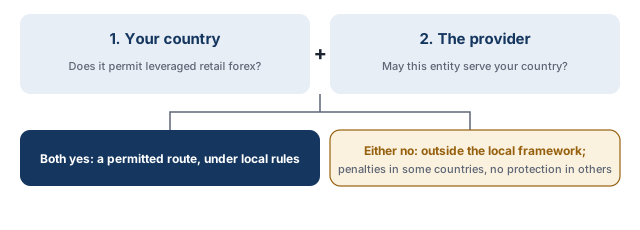
Exchanging currencies is a normal part of international trade and travel. For an individual trader asking “is forex legal?” or “is forex trading legal in my country?”, the question is narrower: whether leveraged retail forex products, including off-exchange forex and forex CFDs depending on the jurisdiction, are permitted, and through which providers. The answer depends on two things:
- The country of residence: some countries permit leveraged retail forex through authorised providers, while others limit it to specific products, purposes or venues.
- The provider: a provider licensed in one country is not automatically permitted to serve residents of another: forex regulation by country.
Is forex trading legal by country?
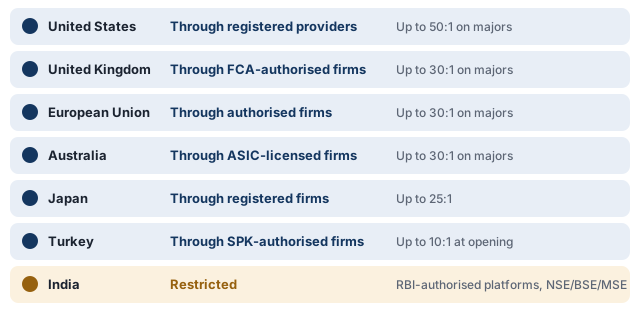
The table summarises forex legality by country for selected jurisdictions, as of October 2026. It is general information, not legal advice, and rules change. The product structure differs: in the UK, EU and Australia, retail forex is mostly offered as CFDs; in the US, as off-exchange retail forex with registered dealers; in India, through exchange-traded currency derivatives and authorised platforms.
| Country or region | Is retail forex trading permitted? | Main conditions |
|---|---|---|
| United States | Yes, through registered providers | Counterparty must be a CFTC-registered RFED or FCM that is an NFA member approved for forex; minimum security deposit of 2% on specified major currencies (leverage up to 50:1) |
| United Kingdom | Yes, through FCA-authorised firms | Forex CFDs for retail clients: leverage up to 30:1 on major pairs, negative balance protection |
| European Union | Yes, through authorised firms | Forex CFDs for retail clients: national measures based on ESMA’s 2018 CFD restrictions; leverage up to 30:1 on major pairs |
| Australia | Yes, through ASIC-licensed providers | Forex CFDs for retail clients: ASIC product intervention order, leverage up to 30:1 on major pairs |
| Japan | Yes, through registered firms | Minimum margin of 4% for individual customers (leverage up to 25:1) |
| India | Restricted | Only permitted forex transactions with authorised persons, on RBI-authorised platforms or recognised stock exchanges (NSE, BSE, MSE) |
| Turkey | Yes, through SPK-authorised firms | Leverage up to 10:1 at position opening; minimum initial deposit of 50,000 Turkish lira or equivalent; offering leveraged trading to Turkish residents without SPK authorisation is unauthorised activity |
Is it legal to trade forex with an offshore broker?
Offshore forex broker legality depends on the country. In some countries, residents dealing with an unauthorised platform can themselves face penalties; the RBI, for example, states that residents undertaking forex transactions for non-permitted purposes or on unauthorised platforms are liable for penal action under India’s Foreign Exchange Management Act (FEMA). In some jurisdictions, the principal regulatory restriction falls on the provider rather than expressly criminalising the client’s conduct. Even then, an account with an entity that is not authorised for the client’s country may fall outside local regulatory protections and complaint mechanisms, such as negative balance protection and client money rules: how to choose a forex broker.
Is forex trading legal in the US and the UK?
In the US, forex trading is legal through providers registered with the CFTC that are NFA members approved for forex, mainly retail foreign exchange dealers and futures commission merchants. In the UK, it is legal through FCA-authorised firms, and forex CFDs sold to retail clients are subject to FCA leverage limits, margin close-out, negative balance protection and standardised risk warnings.
Is forex trading legal in India?
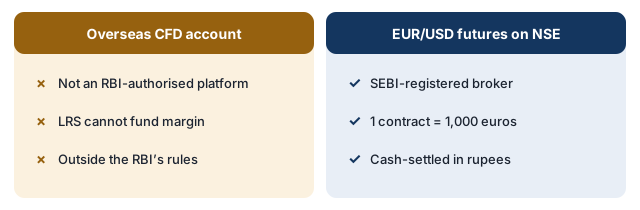
Under FEMA forex rules, resident individuals may undertake forex transactions only with authorised persons and for permitted purposes. Electronic forex trading is permitted only on RBI authorised forex platforms or on recognised stock exchanges (NSE, BSE and MSE). On exchanges, foreign currency-Indian rupee derivatives are permitted for hedging exchange rate risk, while foreign currency-foreign currency derivatives have no purpose restriction, subject to the permitted product and venue framework. Remittances under the Liberalised Remittance Scheme (LRS) cannot be used to send margin to overseas platforms, and the RBI publishes an Alert List of entities that are not authorised. The full rules and the legal exchange route: is forex trading legal in India; for Pakistan, see is forex trading legal in Pakistan.
Two ways an Indian resident might trade EUR/USD (illustrative scenario)
Assumptions: an individual resident in India, rules as described by the RBI as of October 2026.
- Route A: an online advert offers a EUR/USD trading account with an overseas platform, funded by an international transfer. The platform is not RBI-authorised, and margin remittances under the LRS are not permitted, so this route is not permitted for the resident.
- Route B: the resident trades EUR/USD futures on a recognised Indian stock exchange through a registered broker. This route can be permitted under the RBI framework, subject to exchange and intermediary rules.
Is forex legal in Turkey?
Leveraged forex trading is legal in Turkey through SPK authorised forex brokers and banks. Under SPK rules, leverage is limited to 10:1 at position opening, and a minimum initial deposit of 50,000 Turkish lira or the equivalent in foreign currency is required to start leveraged trading. The SPK treats leveraged trading offered to Turkish residents by firms without its authorisation as unauthorised activity and has warned about unauthorised offers made by phone. The full Turkish rules: is forex legal in Turkey (in Turkish).
Is legal forex trading safe?
Legal and regulated do not mean safe or profitable. Regulation sets rules on how providers operate, such as leverage limits, client money handling and risk warnings, but leveraged trading still carries a high risk of loss. Regulatory risk warnings in CFD markets show that a majority of retail CFD accounts lose money: is forex trading profitable. Scams often claim to be regulated, so registration should be checked on the regulator’s own register: forex scams.
Free email course
Forex Risk Management in 5 Days
A free five-day email course: risk per trade, stop losses, position sizing, risk-reward and drawdowns, with a worked example each day.
Frequently asked questions
Is forex trading legal in the US?
Yes, through firms registered with the CFTC that are NFA members approved for forex, such as retail foreign exchange dealers (RFEDs) and futures commission merchants.
Is forex trading legal in the UK?
Yes, through FCA-authorised firms; forex CFDs sold to retail clients are subject to FCA leverage limits and other protections.
Is forex trading legal in India?
Only for permitted purposes with authorised persons, on RBI-authorised platforms or recognised stock exchanges; the RBI publishes an Alert List of unauthorised platforms.
Is forex trading legal in Turkey?
Yes, through SPK-authorised brokers and banks. As of October 2026, SPK rules limit leverage to 10:1 at position opening and require a minimum initial deposit of 50,000 Turkish lira or the equivalent for leveraged trading.
Is forex trading legal in the EU?
Yes, through authorised firms. Forex CFDs for retail clients are subject to national measures based on ESMA's 2018 restrictions, including leverage of up to 30:1 on major pairs.
Is it illegal to use an offshore forex broker?
The legal effect varies by jurisdiction; in some cases the client may simply lack local protections, while in others, such as India, the transaction itself may be restricted.
Sources
- Customer Advisory: Eight Things You Should Know Before Trading Forex, Commodity Futures Trading Commission
- Forex Transactions: Regulatory Guide, National Futures Association
- PS19/18: Restricting contract for difference products sold to retail clients, Financial Conduct Authority
- Product Intervention, European Securities and Markets Authority
- 22-082MR ASIC's CFD product intervention order extended for five years, Australian Securities and Investments Commission
- Regulations on Leverage, The Financial Futures Association of Japan
- Foreign Exchange (Forex) Transactions, FAQs, Reserve Bank of India
- RBI Cautions against unauthorised forex trading platforms (3 February 2022), Reserve Bank of India
- Aracı Kurum Faaliyet İzinleri, Sermaye Piyasası Kurulu (Capital Markets Board of Türkiye)
- Yatırım Hizmetleri ve Faaliyetleri ile Yan Hizmetlere İlişkin Esaslar Hakkında Tebliğ (III-37.1), Mevzuat Bilgi Sistemi (Republic of Türkiye)
- İzinsiz Kaldıraçlı İşlemlere İlişkin Basın Duyurusu (23.02.2023), Sermaye Piyasası Kurulu (Capital Markets Board of Türkiye)
Related articles
- Is Forex Trading Legal in India? RBI Rules Explained
Is forex trading legal in India? What the RBI and FEMA allow, the RBI Alert List, why LRS cannot fund overseas margin, and the legal route on NSE and BSE.
- Is Forex Trading Legal in Pakistan? SBP and SECP Rules
Is forex trading legal in Pakistan? What the State Bank says about offshore forex and CFD platforms under FERA, SECP warnings, and the regulated route via PMEX.
- Forex Regulation: Regulators and Rules by Country
How forex regulation works, the main forex regulators by country, retail leverage limits, client protections and what offshore regulation means.
- How to Choose a Forex Broker: A Checklist
How to choose a forex broker: regulation, client money protection, total trading costs, order execution, platforms and withdrawal terms, with a checklist.
- Forex Scams: How to Spot Them and What to Do
How forex scams work, the warning signs, signal and trading bot scams, clone firms, withdrawal blocks, recovery scams and what to do after losing money.
- Is Forex Trading Profitable? What the Evidence Says
Is forex trading profitable? What regulators' data says about how many retail traders lose money, what contributes to losses and how expectancy works.
- What Is a CFD? Contracts for Difference Explained
What is a CFD and how does CFD trading work? Leverage and margin, costs, CFDs vs forex and shares, and the retail CFD rules in the UK, EU and Turkey.
Glossary terms
- Retail foreign exchange dealer (RFED)
A retail foreign exchange dealer (RFED) is a US registration category for firms that act, or offer to act, as the counterparty to leveraged off-exchange forex transactions with retail customers.
- Futures commission merchant (FCM)
A futures commission merchant (FCM) is a US firm that solicits or accepts orders for futures and related instruments and accepts money or other assets from customers to margin or secure those trades.
- Clone firm
A clone firm is a fraudulent operation that copies the name, registration number, address or other details of a genuine authorised firm to make itself look legitimate.
First published 2 October 2026. Last fact-checked 4 October 2026.This article is for educational purposes only and is not investment advice.