Is Forex Trading Legal in India? RBI Rules Explained
Forex trading is legal in India only within RBI rules: residents may deal in forex only with authorised persons, for permitted purposes, on RBI-authorised platforms or recognised exchanges (NSE, BSE, MSE). LRS money cannot be sent abroad as trading margin, and the RBI says residents who trade on unauthorised platforms are liable for penal action under FEMA.
Key takeaways
- The RBI allows residents to deal in forex only with authorised persons, for permitted purposes, on RBI-authorised platforms or recognised exchanges.
- Remittances under the Liberalised Remittance Scheme cannot be used for margin or for trading foreign exchange abroad.
- The RBI says residents trading on unauthorised platforms are liable for penal action under FEMA, and publishes a non-exhaustive Alert List.
- The legal route for individuals is exchange-traded currency derivatives on NSE, BSE or MSE through a SEBI-registered broker.
- Rupee pairs on Indian exchanges are for hedging a real exposure; cross-currency pairs such as EUR/USD have no purpose restriction.
At a glance
- Rules
- RBI, under FEMA
- Overseas CFD brokers
- Outside the RBI rules
- Legal route
- Exchange currency derivatives
- Rupee pairs
- Need an underlying exposure (since May 2024)
Is forex trading legal in India?
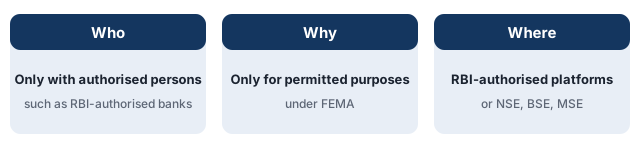
Forex trading is legal in India only inside the framework set by the Reserve Bank of India (RBI) under the Foreign Exchange Management Act, 1999 (FEMA). The RBI’s rules, as of October 2026, come down to three conditions for residents:
- Who: forex may be dealt in only with authorised persons, such as banks authorised by the RBI.
- Why: only for permitted purposes.
- Where: electronic forex trading only on electronic trading platforms (ETPs) authorised by the RBI or on the recognised stock exchanges: the National Stock Exchange (NSE), BSE and the Metropolitan Stock Exchange (MSE).
The RBI’s forex FAQ states that residents who undertake forex transactions for non-permitted purposes or on unauthorised platforms are “liable for penal action under FEMA”. This is general information, not legal advice; rules change, so check the RBI’s own pages before acting.
Can Indian residents trade forex with overseas brokers?
Not within the RBI’s rules. The RBI’s list of authorised non-bank ETP operators (Clearcorp Dealing Systems, ICAP, 360T, Refinitiv and Bloomberg, checked October 2026) includes no retail forex or CFD broker. Two further rules close the usual routes to overseas accounts:
- No LRS money for margin: the Liberalised Remittance Scheme (LRS) lets residents send money abroad for many purposes, but the RBI lists remittances “for margins or margin calls to overseas exchanges / overseas counterparty” and “for trading in foreign exchange abroad” as not permitted.
- Banks must report: in April 2024 the RBI told banks to report accounts used to collect money for unauthorised forex trading to the Directorate of Enforcement, and to advise customers to deal only with authorised persons and platforms.
Many international brokers accept clients from India through entities licensed outside India. A licence elsewhere does not make an entity authorised by the RBI, and an Indian resident who opens such an account takes on the legal risk the RBI describes, as well as losing access to Indian complaint and investor protection channels: how to choose a forex broker. Brokers and prop firms that take clients from India, and the entities that serve them: forex brokers that accept clients from India, prop firms for traders in India.
What is the RBI Alert List?
The RBI publishes an Alert List of entities that are neither authorised to deal in forex under FEMA nor authorised to operate forex trading platforms, including entities that promote them through advertisements or “training” and “advisory” services. The current version is dated 19 November 2025. The RBI states that the list is not exhaustive: an entity missing from it should not be assumed to be authorised.
Warning signs the RBI describes include promises of disproportionate returns, collection of money through bank accounts opened by local agents in the names of individuals or firms, and promotion through social media and search engine adverts: forex scams.
What is the legal route for forex in India?
The legal route for an individual is exchange-traded currency derivatives: futures and options on a recognised Indian exchange, opened through a broker registered with the Securities and Exchange Board of India (SEBI) in the currency derivatives segment. SEBI publishes the register of these brokers.
| Rupee pairs | Cross-currency pairs | |
|---|---|---|
| Pairs permitted by the RBI | USD/INR, EUR/INR, GBP/INR, JPY/INR | EUR/USD, GBP/USD, USD/JPY |
| Purpose | Hedging a contracted exchange rate exposure | No purpose restriction |
| Contract size on NSE (futures) | 1,000 USD, EUR or GBP; 100,000 JPY | 1,000 EUR, GBP or USD |
| Settlement | Cash, in rupees | Cash, in rupees |
Figures as published by the RBI and NSE, checked October 2026. Rupee-pair contracts on NSE trade from 9:00 to 17:00 IST, Monday to Friday; the NSE pages show different closing times for cross-currency contracts, so check the exchange’s current timings. Global forex session times in IST: forex market hours in India.
Can you speculate on USD/INR?
Not under the current framework. Since 3 May 2024, the RBI requires users of rupee-pair exchange contracts to have a valid underlying exposure that is not hedged elsewhere. Positions up to USD 100 million equivalent across all rupee pairs and exchanges need no documents, but the exposure must still exist. Cross-currency pairs such as EUR/USD carry no such purpose restriction.
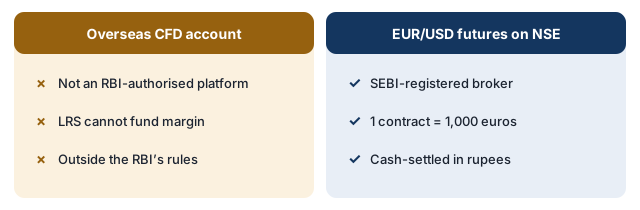
Two ways an Indian resident might trade EUR/USD (illustrative)
Assumptions: an individual resident in India, RBI rules as of October 2026.
- Overseas CFD account: funded by an international transfer or card payment to a broker outside India. The broker is not an RBI-authorised platform and LRS cannot be used for margin, so this route is outside the RBI’s rules.
- EUR/USD futures on NSE: one contract is 1,000 euros, opened through a SEBI-registered broker and settled in rupees. This route is within the RBI framework, subject to exchange and broker rules.
Is legal forex trading in India safe?
Legal does not mean safe or profitable. Currency derivatives use margin, so a small move in the exchange rate can cause a loss larger than the margin posted: what is leverage. Size each position so a stop loss costs only a planned amount of the account: position sizing.
Free email course
Forex Risk Management in 5 Days
A free five-day email course: risk per trade, stop losses, position sizing, risk-reward and drawdowns, with a worked example each day.
Frequently asked questions
Is forex trading legal in India?
Only within RBI rules. Residents may deal in forex only with authorised persons and for permitted purposes, and trade electronically only on RBI-authorised platforms or on NSE, BSE and MSE.
Is it illegal to trade forex with an overseas broker from India?
The RBI says residents who undertake forex transactions on unauthorised platforms or for non-permitted purposes are liable for penal action under FEMA, and that LRS remittances cannot be used for margin abroad.
What is the RBI Alert List?
A list the RBI publishes of entities that are not authorised to deal in forex or to operate forex trading platforms. The RBI says it is not exhaustive: a name missing from it does not mean the entity is authorised.
Can I trade EUR/USD legally in India?
Yes, as an exchange-traded currency derivative (futures or options) on a recognised Indian exchange through a SEBI-registered broker. The RBI sets no purpose restriction on cross-currency pairs.
Can I trade USD/INR futures to speculate?
Under the RBI framework in force since 3 May 2024, rupee pairs on exchanges are for hedging a contracted exposure. Positions up to USD 100 million need no documents, but the exposure must exist.
Can I use LRS to fund a forex trading account abroad?
No. The RBI's LRS rules list remittances for margins or margin calls to overseas exchanges or counterparties, and remittances for trading foreign exchange abroad, as not permitted.
Sources
- Foreign Exchange (Forex) Transactions, FAQs (updated 28 August 2024), Reserve Bank of India
- RBI Cautions against unauthorised forex trading platforms (3 February 2022), Reserve Bank of India
- Alert List of unauthorised forex trading platforms (updated 19 November 2025), Reserve Bank of India
- Electronic trading platforms authorised by the RBI (non-bank operators), Reserve Bank of India
- A.P. (DIR Series) Circular No. 02: Unauthorised foreign exchange transactions (24 April 2024), Reserve Bank of India
- Master Direction, Liberalised Remittance Scheme (updated 6 September 2024), Reserve Bank of India
- Liberalised Remittance Scheme, FAQs (updated 6 April 2023), Reserve Bank of India
- Master Direction, Risk Management and Inter-Bank Dealings (updated 1 October 2026), Reserve Bank of India
- Exchange Traded Currency Derivatives (4 April 2024), Reserve Bank of India
- Currency derivatives contract specifications (INR pairs), National Stock Exchange of India
- Currency derivatives contract specifications (cross currency), National Stock Exchange of India
- Registered stock brokers in the currency derivative segment, Securities and Exchange Board of India
Related articles
- Is Forex Trading Legal? Rules by Country
Is forex trading legal? Where retail forex trading is permitted, the conditions in the US, UK, EU, Australia, Japan, India and Turkey, and offshore brokers.
- Forex Regulation: Regulators and Rules by Country
How forex regulation works, the main forex regulators by country, retail leverage limits, client protections and what offshore regulation means.
- Forex Scams: How to Spot Them and What to Do
How forex scams work, the warning signs, signal and trading bot scams, clone firms, withdrawal blocks, recovery scams and what to do after losing money.
- How to Choose a Forex Broker: A Checklist
How to choose a forex broker: regulation, client money protection, total trading costs, order execution, platforms and withdrawal terms, with a checklist.
Glossary terms
- Leverage
Leverage lets you control a trading position larger than the money you put up. It is the ratio between the position size and the margin required: at 30:1, $1 of margin controls $30.
- Margin
Margin is the money a broker sets aside from your account to keep a leveraged position open. It is collateral, not a fee, and the blocked amount is released when the position closes.
First published 10 October 2026. Last fact-checked 10 October 2026.This article is for educational purposes only and is not investment advice.