How to Choose a Forex Broker: A Checklist
When choosing a forex broker, the first criterion is regulation: whether the specific legal entity that would open your account is authorised to serve residents of your country. After that, compare how client money is protected, the total cost of trading (spread, commission and swap), order execution, the trading platform, and deposit and withdrawal terms. Advertising and bonuses are not selection criteria.
Key takeaways
- Regulation comes first; check the exact legal entity that would hold your account, not only the brand name.
- Client money protection, negative balance protection and complaint routes depend on the regulator and the entity.
- Compare the total cost of trading (spread, commission, swap and other fees), not the spread alone.
- Order execution, the platform and withdrawal terms matter as much as costs.
- Bonuses and promotions are not selection criteria; in the UK and EU, incentives to retail clients are restricted.
At a glance
- Check first
- The regulated legal entity
- Compare
- Total cost per trade
- Execution
- Model, slippage, stop out
- Before funding big
- Demo and a small withdrawal test
What should you check before choosing a forex broker?
A broker holds client money, executes orders and sets many of the trading costs, so broker selection directly affects custody, execution, costs and complaint routes. Regulatory authorisation is the first criterion to verify before comparing commercial features such as spreads, platforms or account types.
FX Handbook’s educational articles are neutral and do not recommend specific brokers. Broker reviews and comparisons are kept on separate pages, scored with a published methodology, and any commercial relationship is disclosed there: forex broker reviews. How we are funded: affiliate disclosure.
How do you check if a forex broker is regulated?
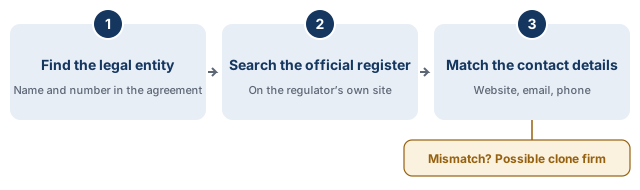
Many broker brands operate through several legal entities, each authorised by a different regulator, and the entity that opens an account depends on where the client lives. A forex broker regulation check therefore asks whether that entity is authorised to serve residents of your country, not only whether the brand holds a licence somewhere. A broker licence check usually takes three steps:
- Find the exact legal name and registration number of the entity in the client agreement or the website footer.
- Verify it directly on the regulator’s official register rather than relying only on links supplied by the broker. Examples: the FCA Firm Checker in the UK and NFA BASIC in the US.
- Check that the website address, email and phone number match the register entry. Scam websites sometimes copy the name and registration number of an authorised firm (a clone firm).
In the US, the CFTC advises that dealers offering retail forex to US customers must be registered with the CFTC and be NFA members. What counts as a regulated forex broker, and which regulators oversee retail forex, differs by country: forex regulation.
Can you use a forex broker regulated in another country?
It depends on your country’s rules and on whether the specific entity is permitted to serve residents of your country. A licence in one country does not by itself authorise a firm to serve clients elsewhere. An account with an entity that is not authorised for your country usually falls outside your local regulator’s protections and complaint routes, and in some countries offering retail forex without a local authorisation is prohibited.
How is client money protected at a forex broker?
After regulation, check what happens to client money if something goes wrong. The answers depend on the regulator and the entity:
- Segregated client funds: whether client money is held separately from the broker’s own money: segregated client funds.
- Negative balance protection: under the applicable UK and EU regimes, eligible retail CFD clients generally benefit from protection that limits losses to the funds in their trading account. It is not available in every country or at every entity: negative balance protection.
- Leverage limits and margin close-out: as of October 2026, UK and EU rules cap retail leverage on major currency pairs at 30:1 and require positions to be closed when equity falls to 50% of the required margin: what is leverage in forex.
- Compensation scheme and ombudsman: whether an investor compensation scheme or a financial ombudsman covers the account, and where a dispute can be taken. Coverage depends on the country and the entity.
How do you compare forex broker costs?
The total trading cost of a position is the spread plus commission plus swap plus any other fees. Comparing brokers on total trading cost, rather than on the lowest advertised spread alone, shows what a trade actually costs:
| Cost | What to check |
|---|---|
| Spread | Typical spread on the pairs and at the hours you trade; how far it widens around news |
| Commission | Per lot, per side or per round turn; which account types charge it |
| Swap | Long and short swap rates on positions held overnight |
| Other fees | Account, inactivity, deposit and withdrawal fees; currency conversion |
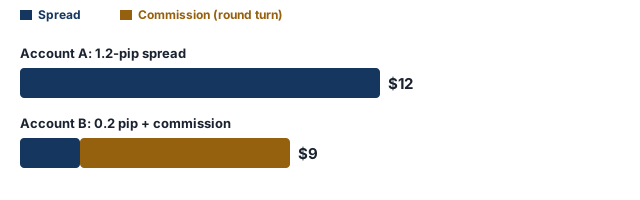
Total trading cost: spread-only vs commission account, $7 round-turn commission (illustrative only)
Assumptions: EUR/USD, 1 standard lot, USD account, pip value about $10, position opened and closed on the same day (no swap). Account B’s $7 commission is per round turn, meaning it covers opening and closing the position together.
- Account A: 1.2 pip spread, no commission. Total: 1.2 × $10 = $12
- Account B: 0.2 pip spread, $7 commission per round turn. Total: 0.2 × $10 + $7 = $9
The figures are illustrative, not quotes from any broker. Actual spreads vary with market conditions, and slippage is not included.
How raw spread and commission-free accounts compare: what is a spread in forex. Overnight costs: what is a swap in forex.
How do you evaluate a forex broker’s execution quality?
Two brokers with the same spread can produce different results depending on how orders are executed:
- Execution model: whether the broker acts as a market maker (dealing desk) or passes orders to liquidity providers as an STP broker or ECN broker, as described in its order execution policy. These labels can be used loosely in marketing, and some brokers combine models. No model is automatically better; transparency and execution quality matter more than the label.
- Slippage and requotes: how often, and by how much, orders are filled at a different price in fast markets: slippage, requote.
- Margin call and stop out levels: the margin level at which positions are closed is set out in the client agreement: stop out, what is a margin call.
How do you compare platforms, deposits and withdrawals?
- Trading platform: MetaTrader 4, MetaTrader 5 or the broker’s own platform; whether it offers the order types and tools you need: MT4 vs MT5.
- Products: the pairs, gold and other instruments available, with their leverage and cost terms.
- Deposits and withdrawals: available methods, processing times and fees. Verify that the payment destination is officially disclosed by the regulated entity and matches its funding instructions.
- Customer support: availability, languages and how disputes are handled.
- Demo account: a way to test the platform and pricing without risking money: forex demo account.
Forex broker red flags: warning signs to check
- Guaranteed returns, or persistent unsolicited calls and messages.
- Requests to fund through personal accounts or wallets, unrelated entities, or payment routes that cannot be verified against the regulated firm.
- An “account manager” offering to trade on the client’s behalf.
- Requests for an extra payment before a withdrawal is released.
- Deposit or volume-linked bonuses. In the UK and EU, incentives to trade CFDs are restricted for retail clients, and bonus terms can include trading volume or withdrawal conditions.
The full list of red flags: forex scams.
Forex broker checklist
- Identify the legal entity that would hold the account and confirm it on the regulator’s official register.
- Read the client agreement, fee schedule and order execution policy of each shortlisted broker.
- Compare the total trading cost on the pairs and at the hours you trade.
- Test the platform and pricing on a demo account.
- A small initial funding and withdrawal test can be used to observe processing times, fees and procedures.
Free email course
Forex Risk Management in 5 Days
A free five-day email course: risk per trade, stop losses, position sizing, risk-reward and drawdowns, with a worked example each day.
Frequently asked questions
How do I know if a forex broker is regulated?
Search the regulator's own register for the exact legal name of the entity named in your client agreement, and check that the website and contact details match the register entry. Details are in the article.
What is the most important factor when choosing a forex broker?
Regulation of the specific legal entity that would open the account, and whether it is authorised to serve residents of your country. Costs, execution and platforms are compared after that.
Is a low minimum deposit a sign of a good broker?
No. A low minimum deposit makes it cheaper to open an account but says nothing about regulation, client money protection, execution or total trading costs.
What is the best forex broker?
There is no single best broker for everyone; regulation in your country, client money protection, total trading cost and execution quality are assessed together.
Is a forex broker bonus a good sign?
A bonus is not a selection criterion. Bonus terms can include trading volume or withdrawal conditions, and in the UK and EU, incentives to trade CFDs are restricted for retail clients.
Can I use a broker regulated in another country?
It depends on your country's rules and on whether that entity is permitted to serve you; details are in the article.
Sources
- Customer Advisory: Eight Things You Should Know Before Trading Forex, Commodity Futures Trading Commission
- BASIC (Background Affiliation Status Information Center), National Futures Association
- FCA Firm Checker, Financial Conduct Authority
- Protect yourself from scams, Financial Conduct Authority
- PS19/18: Restricting contract for difference products sold to retail clients, Financial Conduct Authority
- ESMA adopts final product intervention measures on CFDs and binary options, European Securities and Markets Authority
Related articles
- What Is a Spread in Forex? How Spreads Work and What They Cost
What is a spread in forex? The gap between bid and ask, how to calculate spread cost per lot, fixed vs variable spreads, commission and why spreads widen.
- What Is a Swap in Forex? Rollover and Overnight Fees Explained
What is a swap in forex? The overnight rollover charge or credit, why swaps can be negative, how to calculate them, triple swap and swap-free accounts.
- MT4 vs MT5: Differences and Which to Use
MT4 vs MT5 compared: timeframes, indicators, order types, hedging and netting, programming language and products, and which situations each suits.
- Forex Demo Account: What It Is and How to Use It Properly
What is a forex demo account? How demo trading works, how to use a demo account properly, demo vs live differences and when to move to a live account.
Glossary terms
- Negative balance protection
Negative balance protection is a rule or broker policy under which a client cannot lose more than the funds in their trading account; if a loss pushes the balance below zero, the negative amount is not claimed from the client.
- Segregated client funds
Segregated client funds are client money that a broker holds in accounts kept separate from its own operating money, so that it is identified as belonging to clients rather than to the firm.
- ECN broker
An ECN (electronic communication network) broker routes client orders to an electronic network where prices from several liquidity providers and participants meet, typically charging raw spreads plus a separate commission.
- Market maker
A market maker broker, also called a dealing desk broker, quotes its own bid and ask prices and acts as the counterparty to client trades instead of passing every order to outside liquidity providers.
- STP broker
An STP (straight through processing) broker passes client orders to one or more external liquidity providers, such as banks, instead of taking the other side of the trades itself.
- Clone firm
A clone firm is a fraudulent operation that copies the name, registration number, address or other details of a genuine authorised firm to make itself look legitimate.
- Spread
The spread is the difference between the bid (sell) price and the ask (buy) price of a currency pair. It is one of the main trading costs and is usually measured in pips.
First published 2 October 2026. Last fact-checked 4 October 2026.This article is for educational purposes only and is not investment advice.