What Is a CFD? Contracts for Difference Explained
A CFD (contract for difference) is a leveraged derivative that pays the difference between an asset's price when a position is opened and when it is closed, without owning the asset. CFDs are offered on currencies, gold, indices, commodities and shares. Regulators restrict them for retail clients: in the UK and EU, leverage caps from 30:1 to 2:1 depending on the asset.
Key takeaways
- With a CFD you do not own the asset; profit or loss is the difference between the opening and closing price.
- CFDs are leveraged, so a small price move can be a large gain or loss relative to the margin.
- Retail forex is offered as CFDs in many countries, and as rolling spot contracts in others, such as by US retail forex dealers.
- In the UK and EU, retail CFD leverage is capped by asset class, with margin close-out at 50% and negative balance protection (as of October 2026).
- Costs are the spread, any commission and an overnight financing charge (swap) on positions held past the rollover.
At a glance
- Own the asset?
- No
- Max retail leverage, UK and EU
- 30:1 to 2:1 by asset (Oct 2026)
- Costs
- Spread, any commission, swap
- UK and EU retail close-out
- 50% of required margin (Oct 2026)
What is a CFD?
A CFD (contract for difference) is a derivative contract on the price of an asset. The buyer of a CFD does not own the asset: the position gains or loses the difference between the price when it is opened and the price when it is closed. The UK’s Financial Conduct Authority describes CFDs as “complex, leveraged derivatives”.
CFDs are offered on many underlying assets: currency pairs, gold and other metals, stock indices, commodities and individual shares. Depending on the country, retail forex is offered as CFDs on currency pairs or as rolling spot contracts, for example by US retail forex dealers: how forex trading works.
How does CFD trading work?
You buy (go long) if you expect the price to rise and sell (go short) if you expect it to fall. You deposit margin for only part of the position’s value, so CFDs are leveraged: what is margin in forex.
An index CFD (illustrative figures)
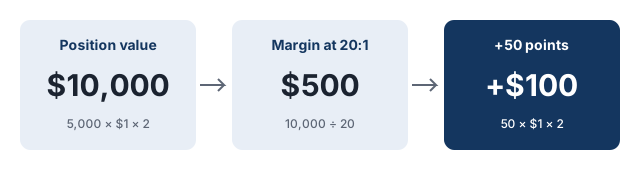
Assumptions: $15,000 account, an index CFD worth $1 per point per contract, 2 contracts bought at 5,000, leverage 20:1 (the UK and EU cap for major indices), costs excluded.
- Position value: 5,000 × 1 × 2 = $10,000. Margin required: 10,000 ÷ 20 = $500.
- The index rises to 5,050 and the position is closed: 50 points × 1 × 2 = $100 profit.
- If it falls to 4,950 instead: $100 loss, 20% of the margin and about 0.67% of the account.
The position runs at about 0.67:1 effective leverage on the account; using the full 20:1 would mean a $300,000 position.
Contract size and point value differ between brokers; check the symbol specification: gold and indices lot size calculator.
What does CFD trading cost?
- Spread: the gap between buy and sell prices, paid on every trade: what is a spread in forex.
- Commission: charged per trade on some account types and on many share CFDs.
- Swap (overnight financing): charged or credited on positions open at the daily rollover; over weeks it can become a large cost: what is a swap, swap calculator.
CFDs vs forex vs shares
| Currency pair CFD (forex) | Buying shares | Share CFD | |
|---|---|---|---|
| Do you own the asset? | No | Yes, you own part of the company | No |
| Leverage | Yes | No (unless using a margin account) | Yes |
| Profiting from a fall | By going short | By short selling, under rules | By going short |
| Dividends | None | Paid to shareholders | Brokers may make a dividend adjustment |
| Overnight cost | Swap | None | Swap |
How forex compares with buying shares on an exchange: forex vs stocks.
CFD rules for retail clients
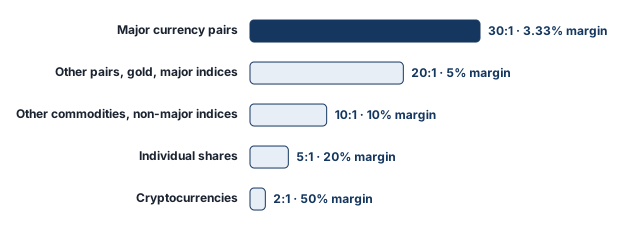
UK and EU. In 2018 the European Securities and Markets Authority (ESMA) limited retail CFD leverage to 30:1 for major currency pairs; 20:1 for other pairs, gold and major indices; 10:1 for other commodities and non-major indices; 5:1 for individual shares; and 2:1 for cryptocurrencies. It also required positions to be closed when equity falls to 50% of the required margin, negative balance protection per account and a standard risk warning. ESMA’s own measures expired on 31 July 2019; ESMA said most national regulators had by then adopted permanent measures at least as strict, and details can differ by country. The FCA confirmed permanent restrictions for UK retail clients in July 2019. Rules as described here are as of October 2026.
Turkey. Under the SPK’s communiqué III-37.1, over-the-counter CFDs offered by firms authorised by the SPK are treated as derivatives subject to the rules for leveraged trading: leverage of at most 10:1 at position opening and a minimum initial deposit of 50,000 Turkish lira, as of October 2026: is forex trading legal.
Elsewhere. Rules differ by country and by the entity a broker uses for each client; an offshore entity may offer much higher leverage with fewer protections: forex regulation.
Risks of CFD trading
- Leverage magnifies losses: a small adverse move can use up most of the margin: what is leverage.
- Margin calls and stop-outs: positions can be closed when the margin level falls: what is a margin call.
- Counterparty: in an over-the-counter CFD the broker is your counterparty; its licence and regulator decide which protections apply: how to choose a forex broker.
- Slippage and gaps: in fast markets orders can fill at worse prices than requested.
Free email course
Forex Risk Management in 5 Days
A free five-day email course: risk per trade, stop losses, position sizing, risk-reward and drawdowns, with a worked example each day.
Frequently asked questions
What is a CFD?
A CFD (contract for difference) is a leveraged derivative on the price of an asset. You do not buy the asset; you gain or lose the difference between the price when you open the position and when you close it.
What is the difference between CFDs and forex?
Forex is the market (currencies); a CFD is a product type. In many countries retail forex trading is offered as CFDs on currency pairs. CFDs also cover gold, indices, commodities and shares.
What is the difference between a CFD and buying shares?
Buying shares makes you a part-owner of the company, with dividends and voting rights. A share CFD gives no ownership: you trade the price difference with leverage, and pay an overnight financing charge if you hold it past the rollover.
How is retail forex offered in the US?
As off-exchange retail forex through firms registered with the CFTC that are NFA members approved for forex, such as retail foreign exchange dealers, rather than as the currency CFDs common in the UK and the EU. Check what a US-registered firm offers before opening an account.
What leverage is allowed on CFDs?
In the UK and EU, retail clients get at most 30:1 on major currency pairs, 20:1 on other pairs, gold and major indices, 10:1 on other commodities and indices, 5:1 on individual shares and 2:1 on cryptocurrencies. In Turkey, over-the-counter CFDs follow the SPK's 10:1 rule (October 2026).
Do CFDs have overnight fees?
Yes. A CFD position still open at the daily rollover is charged or credited a swap (financing) amount, set by the broker for each instrument and direction.
Sources
- PS19/18: Restricting contract for difference products sold to retail clients, Financial Conduct Authority
- FCA confirms permanent restrictions on the sale of CFDs and CFD-like options to retail consumers (1 July 2019), Financial Conduct Authority
- ESMA agrees to prohibit binary options and restrict CFDs to protect retail investors (27 March 2018), European Securities and Markets Authority
- ESMA ceases renewal of product intervention measures relating to contracts for differences (31 July 2019), European Securities and Markets Authority
- Customer Advisory: Eight Things You Should Know Before Trading Forex, Commodity Futures Trading Commission
- Yatırım Hizmetleri ve Faaliyetleri ile Yan Hizmetlere İlişkin Esaslar Hakkında Tebliğ (III-37.1), consolidated text, Mevzuat Bilgi Sistemi (Republic of Türkiye)
Related articles
- What Is Forex? The Foreign Exchange Market Explained
What is forex? The foreign exchange market explained: how it works, how big it is, who trades it, how pairs are quoted and what moves rates.
- How Does Forex Trading Work? A Step-by-Step Explanation
How does forex trading work? Buying and selling currency pairs step by step, how profit and loss are calculated, brokers, leverage, margin and costs.
- What Is Leverage in Forex? How It Works, Ratios and Limits
What is leverage in forex? How leverage ratios such as 1:30, 1:100 and 1:500 work, how margin is calculated, effective leverage and retail limits.
- What Is Margin in Forex? Used, Free Margin and Margin Level
What is margin in forex? How required margin is calculated, used margin, free margin, equity and margin level explained with formulas and worked examples.
- What Is a Swap in Forex? Rollover and Overnight Fees Explained
What is a swap in forex? The overnight rollover charge or credit, why swaps can be negative, how to calculate them, triple swap and swap-free accounts.
- Forex vs Stocks: Key Differences for Beginners
Forex vs stocks compared: what you trade, market hours, leverage, short selling, settlement, costs and ownership, with US and UK examples and no recommendation.
- XAU/USD Explained: How Gold Trading Works in Forex
XAU/USD explained: what the gold symbol means, troy ounces, lot and contract size, how to calculate profit on gold, the LBMA price, costs and leverage rules.
Glossary terms
- Leverage
Leverage lets you control a trading position larger than the money you put up. It is the ratio between the position size and the margin required: at 30:1, $1 of margin controls $30.
- Margin
Margin is the money a broker sets aside from your account to keep a leveraged position open. It is collateral, not a fee, and the blocked amount is released when the position closes.
- Spread
The spread is the difference between the bid (sell) price and the ask (buy) price of a currency pair. It is one of the main trading costs and is usually measured in pips.
- Swap
A swap is the overnight fee or credit for keeping a forex position open past the broker’s daily cut-off. It is based on the interest-rate differential between the two currencies as priced in the market, plus broker adjustments.
First published 18 October 2026. Last fact-checked 18 October 2026.This article is for educational purposes only and is not investment advice.