Forex vs Stocks: Key Differences for Beginners
Forex is trading one currency against another, mostly over the counter; stocks are shares of companies traded on exchanges. Forex trades 24 hours on weekdays, is usually leveraged and makes going short as easy as going long. Stocks trade in set sessions and give part-ownership, and buying them with borrowed money needs a margin account.
Key takeaways
- A share is part-ownership of a company; a forex position is a bet on one currency against another, without ownership.
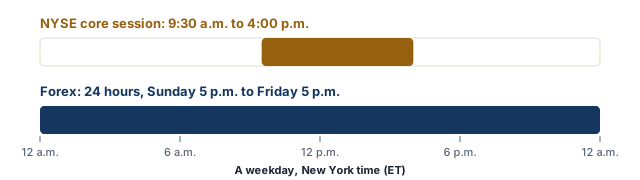
- The core NYSE session runs 9:30 a.m. to 4:00 p.m. New York time; the forex market runs from around 5 p.m. on Sunday to 5 p.m. on Friday New York time.
- Retail forex is usually leveraged; buying shares with borrowed money needs a margin account.
- Going short is built into forex; short selling shares is possible but follows extra rules.
- Neither is safer by default: risk depends on leverage, position size and the asset's volatility.
At a glance
- Ownership
- Shares yes, forex no
- Hours (New York time)
- NYSE 9:30 a.m. to 4 p.m.; forex 24h on weekdays
- Leverage
- Usually built into retail forex
- US stock settlement
- T+1 since May 2024
Forex vs stocks: the core difference
Stocks (shares) are units of ownership in a company. Buying one makes you a part-owner, usually with a right to dividends and a vote. Shares trade on exchanges such as the New York Stock Exchange or the London Stock Exchange, during set hours, through regulated brokers.
Forex is the trading of one currency against another, such as EUR/USD. Retail forex is traded mostly over the counter through a broker, as CFDs or rolling spot contracts, and usually with leverage. A forex position gives no ownership; it gains or loses as the exchange rate moves: what is forex, what is a CFD.
Forex vs stocks comparison table
| Stocks (shares on an exchange) | Forex (retail, over the counter) | |
|---|---|---|
| What you trade | Company shares | Currency pairs |
| Ownership | Yes | No |
| Where | Exchange | Broker’s platform, over the counter |
| Hours | Set sessions (NYSE core 9:30 a.m. to 4:00 p.m. ET) | 24 hours, from around Sunday 5 p.m. to Friday 5 p.m. ET |
| Leverage | Only through a margin account | Usually built in, capped by local rules |
| Going short | Short selling, under extra rules | As easy as going long |
| Settlement | US: one business day (T+1) for most trades | Daily rollover while open |
| Overnight cost | None (interest on margin loans) | Swap |
| Income | Dividends | None (swap can be a credit) |
US examples from the NYSE and SEC; other markets have their own hours and rules. As of October 2026.
Market hours
The NYSE’s core trading session runs from 9:30 a.m. to 4:00 p.m. New York time on business days; some NYSE markets add early sessions from 4:00 or 7:00 a.m. and late sessions to 8:00 p.m. Other exchanges have their own sessions and holidays.
The forex market opens on Sunday at 5:00 p.m. New York time and closes on Friday at 5:00 p.m., trading around the clock in between as the Sydney, Tokyo, London and New York sessions hand over: forex market hours.
Leverage and going short
Retail forex is usually leveraged: a deposit of margin controls a much larger position. Leverage caps depend on the country, for example 30:1 on major pairs for retail clients in the UK and EU, and 50:1 on major currencies in the US (CFTC): what is leverage in forex. Going short is a normal order: long and short positions.
With stocks, you normally pay the full price. Buying with borrowed money needs a margin account, in which the broker lends cash against the account; the SEC’s investor site notes that margin increases buying power but also exposes investors to larger losses. Short selling means borrowing shares to sell, and follows extra rules set by regulators and brokers.
The same 1% move with and without leverage
Assumptions: two accounts of $1,000 each, costs excluded.
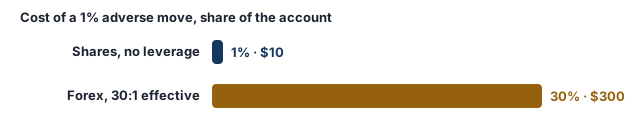
- Shares, no leverage: $1,000 of shares fall 1%: a $10 loss, 1% of the account.
- Forex at 30:1 effective leverage: a $30,000 EUR/USD position (0.30 lots at about 1.0000, USD account) moves 1% against you: a $300 loss, 30% of the account.
The price move is the same; the leverage decides how much of the account it costs.
Settlement and costs
In the US, most broker-dealer securities trades have settled one business day after the trade date (T+1) since 28 May 2024, after an SEC rule change. Stock trading costs are mainly broker commissions and the bid-ask spread.
Forex positions do not settle in that sense: while open they are rolled over each day, with a swap charged or credited, and costs are the spread, any commission and swaps: what is a spread, what is a swap.
Forex or stocks for beginners: which suits you?
Neither is better for everyone, and this page does not recommend one. Shares bought without leverage are a part-ownership that can be held for years, and the loss is limited to the amount invested. Retail forex is often used for short-term, leveraged trading, and leverage magnifies both gains and losses: is forex trading profitable. Before choosing, decide what you want from the money, how long you can leave it and how much you can afford to lose: the 1% rule.
Free email course
Forex Risk Management in 5 Days
A free five-day email course: risk per trade, stop losses, position sizing, risk-reward and drawdowns, with a worked example each day.
Frequently asked questions
What is the difference between forex and stocks?
Stocks are shares of companies, traded on exchanges in set hours; owning one makes you a part-owner. Forex is currency trading, mostly over the counter and open 24 hours on weekdays; retail forex is usually leveraged and gives no ownership.
Is forex or stocks better for beginners?
Neither is better for everyone. Shares bought without leverage cannot lose more than the amount invested; leveraged forex can lose money much faster. The right choice depends on your goals, time horizon and how much you can afford to lose. This page compares them and does not recommend one.
Is forex riskier than stocks?
Not by nature: the risk depends mostly on leverage and position size. Retail forex is usually traded with leverage, and leverage is what makes losses larger and faster.
Can you trade forex and stocks 24 hours a day?
Forex, yes, from Sunday evening to Friday evening New York time. Stock exchanges have set sessions; the NYSE core session is 9:30 a.m. to 4:00 p.m. New York time, and some NYSE markets add early and late sessions.
How long does it take for a stock trade to settle?
In the US, most broker-dealer securities trades settle one business day after the trade (T+1), since 28 May 2024. Forex positions are rolled over each day while they are open, with a swap charged or paid.
Sources
- Holidays and trading hours, New York Stock Exchange
- SEC Finalizes Rules to Reduce Risks in Clearance and Settlement (15 February 2023), U.S. Securities and Exchange Commission
- Margin account, Investor.gov (U.S. Securities and Exchange Commission)
- ESMA agrees to prohibit binary options and restrict CFDs to protect retail investors (27 March 2018), European Securities and Markets Authority
- Final Rule Regarding Retail Foreign Exchange Transactions (fact sheet), U.S. Commodity Futures Trading Commission
- PS19/18: Restricting contract for difference products sold to retail clients, Financial Conduct Authority
Related articles
- What Is Forex? The Foreign Exchange Market Explained
What is forex? The foreign exchange market explained: how it works, how big it is, who trades it, how pairs are quoted and what moves rates.
- What Is a CFD? Contracts for Difference Explained
What is a CFD and how does CFD trading work? Leverage and margin, costs, CFDs vs forex and shares, and the retail CFD rules in the UK, EU and Turkey.
- Long and Short in Forex: Buying vs Selling a Currency Pair
What does long and short mean in forex? Going long vs going short, which price each opens and closes at, worked examples, closing positions and swaps.
- What Is Leverage in Forex? How It Works, Ratios and Limits
What is leverage in forex? How leverage ratios such as 1:30, 1:100 and 1:500 work, how margin is calculated, effective leverage and retail limits.
- Is Forex Trading Profitable? What the Evidence Says
Is forex trading profitable? What regulators' data says about how many retail traders lose money, what contributes to losses and how expectancy works.
Glossary terms
- Leverage
Leverage lets you control a trading position larger than the money you put up. It is the ratio between the position size and the margin required: at 30:1, $1 of margin controls $30.
- Pip
A pip is the standard unit for measuring price changes in a currency pair: 0.0001 for most pairs and 0.01 for pairs quoted in Japanese yen.
- Spread
The spread is the difference between the bid (sell) price and the ask (buy) price of a currency pair. It is one of the main trading costs and is usually measured in pips.
First published 18 October 2026. Last fact-checked 18 October 2026.This article is for educational purposes only and is not investment advice.