XAU/USD Explained: How Gold Trading Works in Forex
XAU/USD is the price of one troy ounce of gold in US dollars, shown on trading platforms like a currency pair; XAU is gold's code in the ISO 4217 currency list. A troy ounce is exactly 31.1034768 grams. Brokers commonly offer gold as a CFD or spot contract, often with 1 lot = 100 ounces, but contract sizes differ. Profit or loss is the price change × ounces held.
Key takeaways
- XAU/USD is the US dollar price of one troy ounce of gold; XAU is gold's code in the ISO 4217 currency list.
- A troy ounce is exactly 31.1034768 grams, not the everyday ounce of about 28.35 grams.
- Many brokers define 1 lot of XAU/USD as 100 ounces, so 0.01 lots is 1 ounce, but contract sizes differ; check the symbol specification.
- Profit or loss = price change × ounces held; a $1 move on 1 ounce is $1.
- In the UK and EU, retail leverage on gold CFDs is capped at 20:1 (October 2026); positions held overnight pay or receive a swap.
At a glance
- Troy ounce
- ≈ 31.1035 grams
- Common lot size
- 100 oz (varies)
- $1 move on 1 oz
- $1
- Max retail leverage, UK and EU
- 20:1 (Oct 2026)
What is XAU/USD?
XAU/USD is the price of one troy ounce of gold in US dollars. The international gold market quotes prices in dollars per ounce, and trading platforms show that price as XAU/USD. XAU is gold’s code in the ISO 4217 list of currency codes, which is why gold is written and traded like a currency pair: how to read currency pairs.
At XAU/USD 2,400 (an illustrative price, not a current one, used in all examples on this page), one troy ounce of gold costs $2,400. If the price rises, gold has gained value against the dollar.
How many grams is a troy ounce?
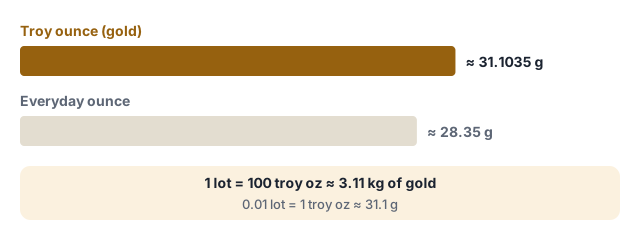
The troy ounce used for precious metals is exactly 31.1034768 grams. The everyday (avoirdupois) ounce, about 28.35 grams, is not used for gold prices. To convert a price per ounce to a price per gram, divide by 31.1034768: at $2,400 an ounce, gold costs about $77.16 a gram.
How does gold trading work on a forex platform?
On most forex platforms XAU/USD is a CFD or a spot contract on the gold price: you do not take delivery of gold, you gain or lose the price difference between opening and closing the position: what is a CFD. You can go long if you expect the price to rise and short if you expect it to fall: long and short positions.
Contract size. The number of ounces in 1 lot is set by the broker. Many use 1 lot = 100 ounces, so 0.10 lots is 10 ounces and 0.01 lots is 1 ounce, but some use other sizes. Check the contract size in the symbol specification: contract size.
P/L ($) = (closing price − opening price) × ounces held · ounces held = lots × contract size (reverse the sign for a short position)
A 0.10-lot gold trade
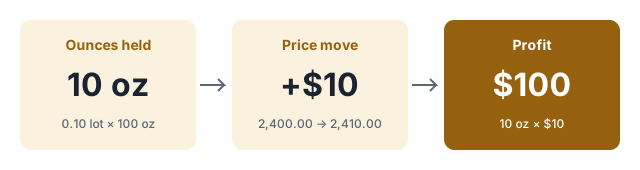
Assumptions: US dollar account; contract size 100 ounces per lot (it differs between brokers); 0.10 lots (10 ounces) bought at 2,400.00 and closed at 2,410.00; spread, commission and swap excluded.
- Price change: 2,410.00 − 2,400.00 = $10 per ounce.
- Profit: $10 × 10 ounces = $100.
- If the price had fallen to 2,390.00 instead, the loss would have been the same $100.
To size a gold trade from the amount you are willing to risk: gold and indices lot size calculator; profit on gold and indices: profit calculator.
Pips and points. Gold is usually quoted to two decimal places, and there is no single convention for what a “pip” is: brokers and platforms variously call $0.01 or $0.10 a pip or a point. Working in dollars per ounce, as in the example, avoids the confusion.
What is the LBMA Gold Price?
One of the main international benchmark prices is the LBMA Gold Price, set in US dollars twice each London business day in electronic auctions starting at 10:30 and 15:00 London time and run by ICE Benchmark Administration (IBA). It is used as a reference in contracts and valuations; the XAU/USD price on a trading platform changes continuously during the trading day.
XAU/USD costs, leverage and risks
- Spread: the gap between bid and ask can widen around major data releases, at the daily open and when liquidity is thin: what is a spread in forex.
- Swap: positions held past the daily rollover are charged or credited a swap set by the broker: what is a swap in forex, swap calculator.
- Leverage: in the UK and EU, retail leverage on gold CFDs is capped at 20:1; elsewhere caps depend on the country and on the broker entity serving you, and offshore entities may offer much more (October 2026): what is leverage in forex.
- Volatility: the gold price can move sharply around major economic data and in periods of global uncertainty, and stops can fill at worse prices in fast markets. Size each trade from the stop distance: position sizing, volatility.
- Trading hours: gold trades almost 24 hours a day on weekdays, but platform hours, including a short daily break, differ between brokers: forex market hours.
Free email course
Forex Risk Management in 5 Days
A free five-day email course: risk per trade, stop losses, position sizing, risk-reward and drawdowns, with a worked example each day.
Frequently asked questions
What does XAU/USD mean?
It is the price of one troy ounce of gold in US dollars. XAU is the ISO 4217 code for gold and USD the code for the US dollar. At XAU/USD 2,400 (an illustrative price), one ounce costs $2,400.
How many ounces is 1 lot of gold?
It depends on the broker. Many define 1 lot of XAU/USD as 100 troy ounces, so 0.01 lots is 1 ounce, but some use other sizes. Check the contract size in the symbol specification before trading.
How do I calculate profit on XAU/USD?
Multiply the price change by the number of ounces. With 1 lot = 100 ounces, 0.10 lots is 10 ounces: a $10 rise from 2,400 to 2,410 gives 10 × 10 = $100 before costs.
What is a pip in gold?
There is no single convention. Gold is usually quoted to two decimals, and brokers and platforms variously call $0.01 or $0.10 a pip or a point. Working in dollars per ounce avoids the confusion: a $1 move on 1 ounce is $1.
Is XAU/USD a currency pair?
Gold is not a currency, but it has a code (XAU) in the ISO 4217 list and is shown and traded on forex platforms in the same way as a pair.
Is trading XAU/USD the same as buying gold?
No. A XAU/USD position on a forex platform is usually a leveraged contract on the price, with no gold delivered and a swap on positions held overnight. Buying physical gold, or a fund backed by it, means owning the metal or a share of it.
Sources
Regulatory and official sources
- NIST Handbook 44 (2026), Appendix C, General Tables of Units of Measurement, National Institute of Standards and Technology
- ISO 4217 currency code list (List One), SIX (ISO 4217 Maintenance Agency)
- LBMA Gold Price, LBMA
- PS19/18: Restricting contract for difference products sold to retail clients, Financial Conduct Authority
- ESMA adopts final product intervention measures on CFDs and binary options, European Securities and Markets Authority
Related articles
- How to Read Currency Pairs: Base and Quote Currency Explained
How to read currency pairs in forex: base and quote currency, what EUR/USD 1.0850 means, what a rising pair means, bid and ask, cross rates, with examples.
- What Is a CFD? Contracts for Difference Explained
What is a CFD and how does CFD trading work? Leverage and margin, costs, CFDs vs forex and shares, and the retail CFD rules in the UK, EU and Turkey.
- What Is Leverage in Forex? How It Works, Ratios and Limits
What is leverage in forex? How leverage ratios such as 1:30, 1:100 and 1:500 work, how margin is calculated, effective leverage and retail limits.
- What Is a Swap in Forex? Rollover and Overnight Fees Explained
What is a swap in forex? The overnight rollover charge or credit, why swaps can be negative, how to calculate them, triple swap and swap-free accounts.
- What Is a Lot in Forex? Standard, Mini and Micro Lots
What is a lot in forex? Standard, mini, micro and nano lot sizes, what 0.01 lot means, pip value and margin per lot, and how to calculate lot size.
- Position Sizing in Forex: How Many Lots Should You Trade?
How to calculate position size in forex from your risk amount, stop loss distance and pip value, with worked examples for EUR/USD and USD/JPY.
Glossary terms
- Contract size
Contract size is the number of units of the base currency in one lot. For a standard forex lot it is commonly 100,000 units.
- Volatility
Volatility is how much and how quickly a currency pair’s price moves over a period. Higher volatility means larger price swings and, for the same position size, greater risk.
- Leverage
Leverage lets you control a trading position larger than the money you put up. It is the ratio between the position size and the margin required: at 30:1, $1 of margin controls $30.
- Swap
A swap is the overnight fee or credit for keeping a forex position open past the broker’s daily cut-off. It is based on the interest-rate differential between the two currencies as priced in the market, plus broker adjustments.
First published 18 October 2026. Last fact-checked 18 October 2026.This article is for educational purposes only and is not investment advice.