How to Read Currency Pairs: Base and Quote Currency Explained
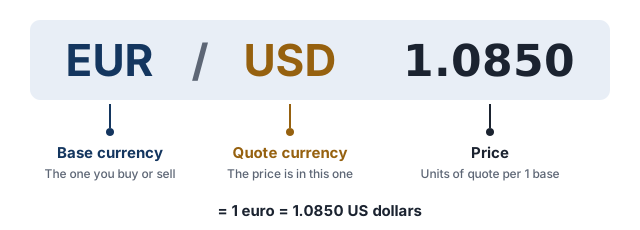
A currency pair is the price of one currency in terms of another, written like EUR/USD. The currency on the left is the base currency and the one on the right is the quote currency; the price shows how many units of the quote currency one unit of the base currency buys. EUR/USD at 1.0850 means one euro costs 1.0850 US dollars. If the pair rises, the base currency has strengthened.
Key takeaways
- The first currency in a pair is the base currency and the second is the quote currency; the price is how many units of the quote currency one unit of the base buys.
- EUR/USD at 1.0850 means one euro costs 1.0850 US dollars.
- If a pair rises, the base currency has gained against the quote currency; if it falls, the base currency has lost value.
- Every pair has two prices, the bid (sell) and the ask (buy); the gap between them is the spread.
- Buying a pair (going long) means buying the base currency and selling the quote currency; selling (going short) is the reverse.
At a glance
- Base currency
- Left: EUR in EUR/USD
- Quote currency
- Right: USD in EUR/USD
- The price
- Quote units per 1 base
- Pair rises
- Base currency stronger
How to read a currency pair
A currency pair is the price of one currency in terms of another. It is written as two three-letter currency codes separated by a slash: EUR/USD, GBP/USD, USD/JPY. Two rules are enough to read any pair:
- The currency on the left is the base currency; the one on the right is the quote currency (also called the counter currency).
- The price is how many units of the quote currency one unit of the base currency buys.
| Pair | Example price | How to read it |
|---|---|---|
| EUR/USD | 1.0850 | 1 euro = 1.0850 US dollars |
| GBP/USD | 1.2700 | 1 British pound = 1.2700 US dollars |
| USD/JPY | 150.00 | 1 US dollar = 150.00 Japanese yen |
| USD/CAD | 1.3600 | 1 US dollar = 1.3600 Canadian dollars |
The prices in the table are illustrative; real rates change constantly.
What does EUR/USD mean?
EUR/USD is the price of the euro in US dollars. The euro is the base currency and the dollar is the quote currency. At EUR/USD 1.0850, one euro costs 1.0850 dollars, so 1,000 euros cost about $1,085. The European Central Bank publishes its euro reference rates the same way: how many units of each foreign currency one euro buys. More on the pair itself: EUR/USD.
What happens when a pair rises or falls?
Read the move from the base currency’s point of view:
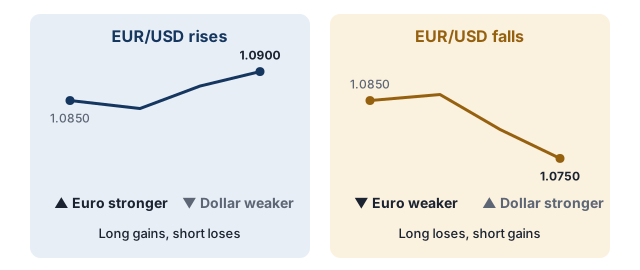
- The pair rises: the base currency has gained value against the quote currency. If EUR/USD moves from 1.0850 to 1.0900, the euro has strengthened against the dollar.
- The pair falls: the base currency has lost value. If USD/JPY falls from 150.00 to 148.00, the dollar has weakened against the yen, and the yen has strengthened.
The same move reads the other way round for the quote currency: when EUR/USD rises, the dollar weakens against the euro.
EUR/USD rises 50 pips
Assumptions: EUR/USD moves from 1.0850 to 1.0900, a 50-pip rise (one pip is 0.0001); the account is in US dollars; spread, commission and swap are excluded.
- 10,000 euros were worth $10,850 and are now worth $10,900.
- A long position of 1 standard lot (100,000 euros) gains about 50 pips × $10 = $500.
- A short position of the same size loses $500.
How pips convert into money: what is a pip, pip value calculator.
How to read bid and ask prices
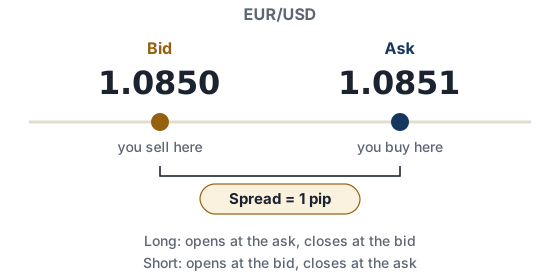
Trading platforms show two prices for every pair. The bid is the price at which you can sell the pair; the ask is the price at which you can buy it. The gap between them is the spread, the basic cost of a trade. If EUR/USD shows 1.0850 / 1.0851, the bid is 1.0850, the ask is 1.0851 and the spread is 1 pip: bid and ask price.
What does buying or selling a pair mean?
Buying a pair (going long) means buying the base currency and selling the quote currency; the position gains if the pair rises. Selling a pair (going short) means selling the base currency and buying the quote currency; it gains if the pair falls. A long EUR/USD position is a view that the euro will strengthen against the dollar: long and short positions. How large a position is: what is a lot in forex.
How to calculate a cross rate
An exchange rate is set by buyers and sellers in the market; you read it from a platform rather than calculate it. What you can calculate is a third rate from two pairs you already know. This is a cross rate.
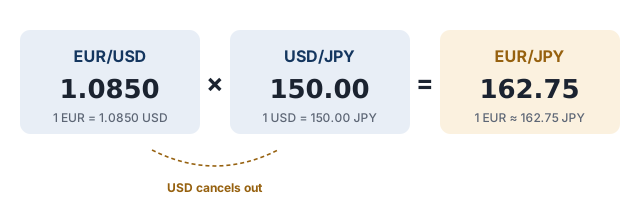
EUR/JPY ≈ EUR/USD × USD/JPY · inverse: USD/EUR ≈ 1 ÷ EUR/USD
Euro to yen cross rate
Assumptions: EUR/USD 1.0850 and USD/JPY 150.00 (illustrative rates).
- EUR/JPY = 1.0850 × 150.00 ≈ 162.75: one euro buys about 162.75 yen.
- USD/EUR = 1 ÷ 1.0850 ≈ 0.9217: one dollar buys about 0.9217 euros.
Multiply when the shared currency is the quote currency of one pair and the base currency of the other, as the US dollar is here: GBP/JPY ≈ GBP/USD × USD/JPY. When the shared currency is on the same side of both pairs, divide instead: in EUR/USD and GBP/USD the dollar is the quote currency of both, so EUR/GBP ≈ EUR/USD ÷ GBP/USD. A broker’s quoted cross rate can differ slightly from this calculation because of spreads.
Why does one currency come first?
The order of a pair follows a long-standing market convention. The euro is almost always the base currency (EUR/USD, EUR/GBP, EUR/JPY). The British pound is the base in most of its pairs other than against the euro (GBP/USD, GBP/JPY). The Australian and New Zealand dollars come first against the US dollar (AUD/USD, NZD/USD). The US dollar comes first against most other currencies, such as the yen, the Swiss franc and the Canadian dollar (USD/JPY, USD/CHF, USD/CAD). Which pairs trade the most: major currency pairs.
Free email course
Forex Risk Management in 5 Days
A free five-day email course: risk per trade, stop losses, position sizing, risk-reward and drawdowns, with a worked example each day.
Frequently asked questions
What is the base currency in a currency pair?
The currency to the left of the slash. In EUR/USD the base currency is the euro, in USD/JPY it is the US dollar. The price shows how many units of the quote currency one unit of the base currency buys.
What is the quote currency?
The currency to the right of the slash, also called the counter currency. In EUR/USD it is the US dollar, in USD/JPY the Japanese yen; the price is expressed in this currency.
What does EUR/USD 1.0850 mean?
One euro costs 1.0850 US dollars. The euro is the base currency and the dollar is the quote currency, so buying 1,000 euros at that price costs about $1,085.
What happens when a currency pair goes up?
The base currency has strengthened against the quote currency. If EUR/USD rises from 1.0850 to 1.0900, one euro buys more dollars than before: the euro has gained and the dollar has weakened against it.
Which currency comes first in a pair?
Market convention decides. The euro is almost always the base currency (EUR/USD, EUR/GBP), the British pound comes first in most of its other pairs (GBP/USD, GBP/JPY), and the US dollar comes first against currencies such as the yen, Swiss franc and Canadian dollar (USD/JPY, USD/CHF, USD/CAD).
How do you calculate a cross rate?
Multiply two pairs that share a currency. With EUR/USD at 1.0850 and USD/JPY at 150.00 (illustrative rates), EUR/JPY is about 1.0850 × 150.00 = 162.75. The inverse of a pair is 1 divided by its price: USD/EUR = 1 ÷ 1.0850 ≈ 0.9217.
Sources
Regulatory and official sources
- Euro foreign exchange reference rates, European Central Bank
Related articles
- Bid and Ask Price in Forex: What They Mean and Which You Pay
What is the bid and ask price in forex? Which price you buy and sell at, how to read a quote, the spread, the mid price and why charts show the bid.
- What Is a Pip in Forex? Meaning, Pip Value & Examples
What is a pip in forex? Pip meaning, how to count pips, pip value per lot, pips on JPY pairs, pipettes and pip vs point, with worked examples.
- Long and Short in Forex: Buying vs Selling a Currency Pair
What does long and short mean in forex? Going long vs going short, which price each opens and closes at, worked examples, closing positions and swaps.
- What Is a Spread in Forex? How Spreads Work and What They Cost
What is a spread in forex? The gap between bid and ask, how to calculate spread cost per lot, fixed vs variable spreads, commission and why spreads widen.
- Major Currency Pairs: The Most Traded Forex Pairs
What are the major currency pairs? The seven forex majors, their central banks, BIS 2025 trading volume shares, and how majors differ from minors and exotics.
- EUR/USD Explained: The Euro Dollar Pair and What Moves It
EUR/USD explained: how to read the euro dollar pair, what moves EURUSD (ECB, Fed, data), pip value per lot, trading hours and a worked example.
Glossary terms
- Pip
A pip is the standard unit for measuring price changes in a currency pair: 0.0001 for most pairs and 0.01 for pairs quoted in Japanese yen.
- Spread
The spread is the difference between the bid (sell) price and the ask (buy) price of a currency pair. It is one of the main trading costs and is usually measured in pips.
- Bid price
The bid price is the price at which you can sell a currency pair. It is normally lower than the ask price; the difference is the spread.
- Ask price
The ask price, also called the offer, is the price at which you can buy a currency pair. It is normally higher than the bid price.
First published 18 October 2026. Last fact-checked 18 October 2026.This article is for educational purposes only and is not investment advice.