EUR/USD Explained: The Euro Dollar Pair and What Moves It
EUR/USD is the price of one euro in US dollars and the most traded currency pair in the world: 21.2% of global foreign exchange turnover in the BIS survey of April 2025. Factors that commonly move it include the monetary policy of the European Central Bank and the Federal Reserve, euro area and US economic data, and global risk appetite. In a US dollar account, one pip on a standard lot is worth $10.
Key takeaways
- EUR/USD shows how many US dollars one euro buys; the euro is the base currency and the dollar the quote currency.
- In the BIS survey of April 2025, EUR/USD was the most traded pair, with 21.2% of global FX turnover.
- Factors that can move the pair include ECB and Fed interest rate policy, euro area and US data, and global risk appetite; no single factor explains it.
- One pip is 0.0001; in a US dollar account, one pip on a standard lot is worth $10.
- Liquidity is usually highest when the London and New York sessions overlap.
At a glance
- Base / quote
- Euro / US dollar
- Share of FX turnover
- 21.2% (April 2025)
- One pip
- 0.0001
- 1 pip, 1 standard lot
- $10 (USD account)
What is EUR/USD?
EUR/USD is the exchange rate between the euro and the US dollar: how many dollars one euro buys. The euro is the base currency and the dollar is the quote currency. At EUR/USD 1.0850 (an illustrative rate, used in all examples on this page), one euro costs 1.0850 dollars. When the pair rises, the euro strengthens against the dollar; when it falls, the euro weakens: how to read currency pairs.
EUR/USD is the most traded currency pair in the world and the first of the major currency pairs. In the Bank for International Settlements (BIS) survey of April 2025, it accounted for 21.2% of global foreign exchange turnover; USD/JPY was second with 14.3%. Traders often call the pair “fiber”.
How to convert euros and dollars with EUR/USD
The rate itself is set by buyers and sellers in the market. What you calculate is the conversion at that rate:
- Euros to dollars: euro amount × EUR/USD. At 1.0850, 1,000 euros = $1,085.
- Dollars to euros: dollar amount ÷ EUR/USD. $1,000 ÷ 1.0850 ≈ 921.66 euros.
A bank or card provider adds its own margin to these rates; a broker quotes a bid and an ask: bid and ask price.
What does it mean when EUR/USD falls?
A fall in EUR/USD means the euro has lost value against the dollar, which is the same as the dollar gaining against the euro. From 1.0850 to 1.0750, one euro buys 1.0750 dollars instead of 1.0850: a 100-pip move. A long EUR/USD position loses on that move and a short position gains: long and short positions.
What moves EUR/USD?
No single factor explains an exchange rate; several act on EUR/USD at the same time:
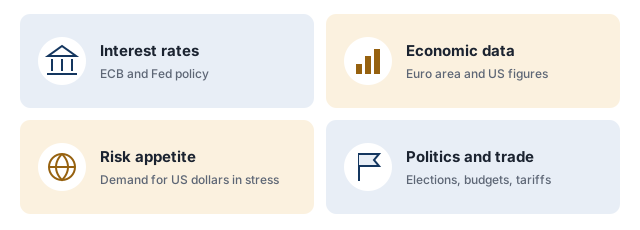
- Monetary policy: interest rate decisions and expected policy at the European Central Bank (ECB) and the Federal Reserve. Changes in the expected gap between euro and dollar interest rates can shift demand for assets in each currency.
- Economic data: inflation, growth and employment figures from the euro area and the US, such as the US jobs report and euro area inflation. Data that differ from expectations can move the price.
- Global risk appetite: in periods of market stress, demand for US dollars often changes, and the pair can move even without euro area or US news.
- Politics and trade: elections, fiscal policy and trade measures in the euro area and the US.
EUR/USD pip value
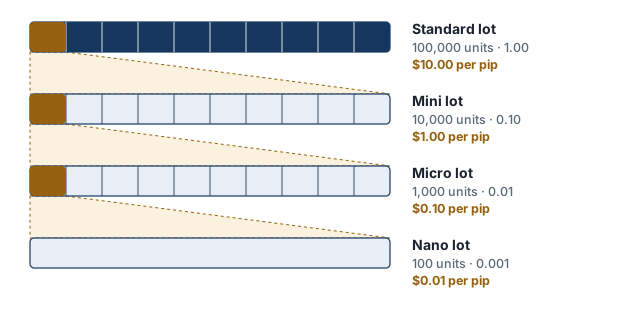
EUR/USD is quoted to four decimal places: one pip is 0.0001 (a fifth decimal, if shown, is a pipette). Because the dollar is the quote currency, the pip value in a US dollar account is fixed:
| Lot | Units | Value of 1 pip |
|---|---|---|
| Standard (1.00) | 100,000 euros | $10 |
| Mini (0.10) | 10,000 euros | $1 |
| Micro (0.01) | 1,000 euros | $0.10 |
In an account in another currency, the pip value is converted at the current rate: what is a pip, pip value calculator.
A mini lot long on EUR/USD
Assumptions: US dollar account; 0.10 lots (a mini lot) bought at 1.0850 and closed at 1.0890; spread, commission and swap excluded.
- Move: 1.0890 − 1.0850 = 40 pips.
- Profit: 40 pips × $1 = $40.
- If the price had fallen to 1.0810 instead, the loss would have been the same $40.
How lot sizes work: what is a lot in forex.
EUR/USD trading hours
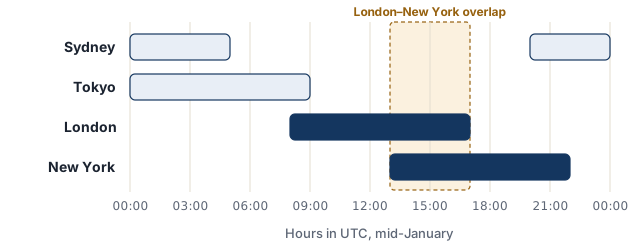
EUR/USD trades 24 hours a day on weekdays, from the Sunday open to the Friday close in New York. Turnover is usually highest during the London session and when London and New York are both open: about 8:00 AM to 12:00 PM New York time, which is 12:00 to 16:00 UTC from late March to late October and 13:00 to 17:00 UTC from early November to mid-March. For two to three weeks in March and about one week around the turn of October and November, when only one of the US and UK has changed its clocks, the overlap runs from about 8:00 AM to 1:00 PM New York time (12:00 to 17:00 UTC). Session times in your own time zone: forex market hours.
EUR/USD spread, swap and leverage
- Spread: EUR/USD usually has one of the tightest spreads of any pair, but it can widen around major data releases, central bank decisions and the daily rollover: what is a spread in forex.
- Swap: a position held past the daily rollover is charged or credited a swap, based mainly on the interest rate gap between the two currencies plus the broker’s markup: what is a swap in forex, swap calculator.
- Leverage: retail leverage on major pairs is capped in many countries, for example at 30:1 in the UK and EU and 50:1 in the US (October 2026). Deciding the risk per trade in advance can help limit losses, although gaps and slippage can exceed the planned amount: what is leverage in forex, position sizing.
Free email course
Forex Risk Management in 5 Days
A free five-day email course: risk per trade, stop losses, position sizing, risk-reward and drawdowns, with a worked example each day.
Frequently asked questions
What does EUR/USD mean?
It is the price of the euro in US dollars. At EUR/USD 1.0850 (an illustrative rate), one euro costs 1.0850 dollars; the euro is the base currency and the dollar is the quote currency.
What moves EUR/USD?
Factors include the interest rate decisions and expected policy of the European Central Bank (ECB) and the Federal Reserve, inflation, growth and jobs data from the euro area and the US, and global risk appetite. No single factor explains the exchange rate.
How much is 1 pip on EUR/USD?
One pip is 0.0001. In a US dollar account it is worth $10 on a standard lot (100,000 euros), $1 on a mini lot and $0.10 on a micro lot. In an account in another currency, the value is converted at the current rate.
What does it mean when EUR/USD goes down?
The euro has lost value against the dollar, and the dollar has gained against the euro. If EUR/USD falls from 1.0850 to 1.0750, one euro buys 1.0750 dollars instead of 1.0850. A long position loses and a short position gains, before costs.
Why is EUR/USD called fiber?
Fiber is trader slang for EUR/USD. It is commonly explained as a contrast with cable, the nickname for GBP/USD, which broker glossaries trace to the transatlantic cable that carried sterling-dollar rates; neither nickname has an official origin.
What is the best time to trade EUR/USD?
Liquidity is usually highest during the London session and the overlap of the London and New York sessions, about 8:00 AM to 12:00 PM New York time. Spreads are typically tightest then; it is not a time that makes trades more likely to win.
Sources
Regulatory and official sources
- Triennial Central Bank Survey 2025, foreign exchange turnover tables, Bank for International Settlements
- Global FX trading hits $9.6 trillion per day in April 2025 (press release, 30 September 2025), Bank for International Settlements
- Euro foreign exchange reference rates, European Central Bank
- Monetary policy decisions, European Central Bank
- ESMA adopts final product intervention measures on CFDs and binary options, European Securities and Markets Authority
- PS19/18: Restricting contract for difference products sold to retail clients, Financial Conduct Authority
- Final Rule Regarding Retail Foreign Exchange Transactions (fact sheet), U.S. Commodity Futures Trading Commission
- Federal Open Market Committee, Board of Governors of the Federal Reserve System
Related articles
- Major Currency Pairs: The Most Traded Forex Pairs
What are the major currency pairs? The seven forex majors, their central banks, BIS 2025 trading volume shares, and how majors differ from minors and exotics.
- How to Read Currency Pairs: Base and Quote Currency Explained
How to read currency pairs in forex: base and quote currency, what EUR/USD 1.0850 means, what a rising pair means, bid and ask, cross rates, with examples.
- What Is a Pip in Forex? Meaning, Pip Value & Examples
What is a pip in forex? Pip meaning, how to count pips, pip value per lot, pips on JPY pairs, pipettes and pip vs point, with worked examples.
- What Is a Spread in Forex? How Spreads Work and What They Cost
What is a spread in forex? The gap between bid and ask, how to calculate spread cost per lot, fixed vs variable spreads, commission and why spreads widen.
- What Is a Swap in Forex? Rollover and Overnight Fees Explained
What is a swap in forex? The overnight rollover charge or credit, why swaps can be negative, how to calculate them, triple swap and swap-free accounts.
- Long and Short in Forex: Buying vs Selling a Currency Pair
What does long and short mean in forex? Going long vs going short, which price each opens and closes at, worked examples, closing positions and swaps.
- GBP/USD Explained: Cable, What Moves It and Pip Value
GBP/USD explained: how to read the pound dollar pair, why it is called cable, what moves GBPUSD (Bank of England, Fed, data), pip value and a worked example.
- USD/JPY Explained: The Dollar Yen Pair, Pips and Drivers
USD/JPY explained: how to read the dollar yen pair, why a yen pip is 0.01, pip value in dollars, what moves USDJPY (Fed, Bank of Japan, carry trade).
Glossary terms
- Pip
A pip is the standard unit for measuring price changes in a currency pair: 0.0001 for most pairs and 0.01 for pairs quoted in Japanese yen.
- Spread
The spread is the difference between the bid (sell) price and the ask (buy) price of a currency pair. It is one of the main trading costs and is usually measured in pips.
- Liquidity
Liquidity is how easily a currency pair can be bought or sold without moving its price much. Highly liquid pairs tend to have tighter spreads and less slippage.
First published 18 October 2026. Last fact-checked 18 October 2026.This article is for educational purposes only and is not investment advice.