USD/JPY Explained: The Dollar Yen Pair, Pips and Drivers
USD/JPY is the price of one US dollar in Japanese yen and the second most traded currency pair: 14.3% of global foreign exchange turnover in the BIS survey of April 2025. Factors that commonly move it include the interest rate gap between the Federal Reserve and the Bank of Japan, carry trades and global risk appetite. On yen pairs one pip is 0.01, worth 1,000 yen on a standard lot.
Key takeaways
- USD/JPY shows how many yen one US dollar buys; the dollar is the base currency and the yen the quote currency.
- In the BIS survey of April 2025, USD/JPY was the second most traded pair, with 14.3% of global FX turnover.
- Factors that can move it include the Fed and Bank of Japan rate gap, carry trades and global risk appetite; no single factor explains it.
- On yen pairs one pip is 0.01; on a standard lot it is worth 1,000 yen, and its dollar value changes with the rate.
At a glance
- Share of FX turnover
- 14.3% (April 2025)
- One pip
- 0.01
- 1 pip, 1 standard lot
- 1,000 yen
- Tokyo session
- 00:00 to 09:00 UTC
What is USD/JPY?
USD/JPY is the exchange rate between the US dollar and the Japanese yen: how many yen one dollar buys. The dollar is the base currency and the yen is the quote currency. At USD/JPY 150.00 (an illustrative rate, used in all examples on this page), one dollar buys 150 yen. When the pair rises the dollar strengthens against the yen; when it falls the yen strengthens: how to read currency pairs.
In the Bank for International Settlements (BIS) survey of April 2025, USD/JPY accounted for 14.3% of global foreign exchange turnover, second only to EUR/USD: major currency pairs.
What moves USD/JPY?
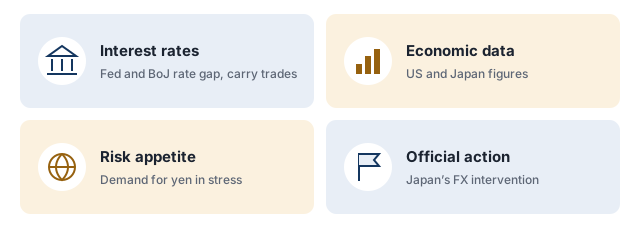
No single factor explains an exchange rate; several act on USD/JPY at the same time:
- The Fed and Bank of Japan rate gap: the difference between US and Japanese interest rates, and expectations of how it will change, is one of the most closely watched factors for the pair. It can shift demand for dollar and yen assets.
- The yen carry trade: borrowing in low-yielding yen to invest in higher-yielding assets elsewhere. Building these positions can push USD/JPY up; unwinding them quickly can push it down sharply. In forex, the overnight rate gap shows up as the swap: what is a swap in forex.
- Economic data: US and Japanese inflation, growth and employment figures.
- Risk appetite: in periods of market stress, demand for yen can change and the pair can move sharply.
- Official action: Japan’s Ministry of Finance decides on currency intervention and the Bank of Japan carries it out. Ministry of Finance data show it bought yen to support it in 2022, 2024 and, most recently, April and May 2026 (as of October 2026), and official comments about the exchange rate can also move the pair.
Why is a yen pip 0.01?
Most yen pairs are quoted to two decimal places, so one pip is 0.01 (a third decimal, if shown, is a pipette). If USD/JPY rises from 150.00 to 150.25, it has risen 25 pips: what is a pip.
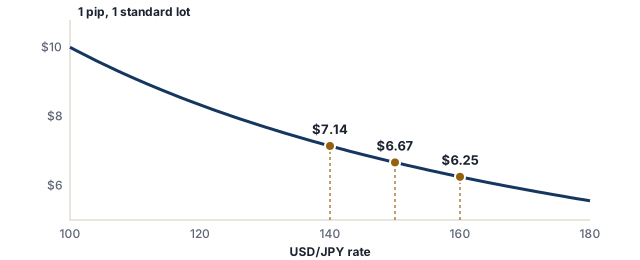
The pip value is fixed in yen: on a standard lot (100,000 dollars) one pip is 1,000 yen. Its value in dollars depends on the rate:
Pip value ($) = 1,000 yen ÷ USD/JPY rate
| USD/JPY rate | 1 pip on a standard lot |
|---|---|
| 140.00 | about $7.14 |
| 150.00 | about $6.67 |
| 160.00 | $6.25 |
A mini lot long on USD/JPY
Assumptions: US dollar account; 0.10 lots (a mini lot, 10,000 dollars) bought at 150.00 and closed at 150.60; spread, commission and swap excluded; the yen result is converted to dollars at the closing rate.
- Move: 150.60 − 150.00 = 60 pips.
- Profit: 60 pips × 100 yen = 6,000 yen, which is about $39.84 at 150.60.
- If the price had fallen to 149.40 instead, the loss would have been 6,000 yen, about $40.16 at 149.40.
The dollar value differs slightly because the yen amount is converted at the closing rate: pip value calculator.
USD/JPY trading hours, swap and sharp moves
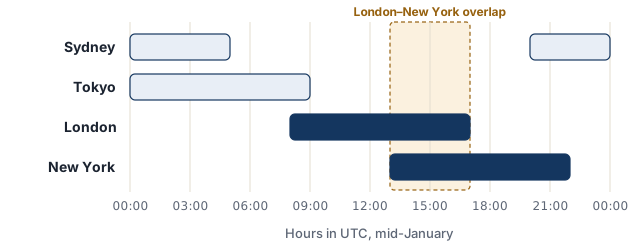
- Trading hours: USD/JPY is active in the Tokyo session (9:00 AM to 6:00 PM Tokyo time, 00:00 to 09:00 UTC; Japan does not change its clocks) as well as in London and New York: forex market hours.
- Swap: when the US and Japanese interest rate gap is wide, the overnight swap on long and short positions can differ markedly: swap calculator.
- Sharp moves: when risk appetite changes quickly or the authorities act, the price can jump, and a stop loss can fill at a worse price than set: stop loss, slippage.
Free email course
Forex Risk Management in 5 Days
A free five-day email course: risk per trade, stop losses, position sizing, risk-reward and drawdowns, with a worked example each day.
Frequently asked questions
What does USD/JPY mean?
It is the price of the US dollar in Japanese yen. At USD/JPY 150.00 (an illustrative rate), one dollar buys 150 yen; the dollar is the base currency and the yen is the quote currency.
What is a pip on USD/JPY?
On yen pairs one pip is 0.01, the second decimal place. If USD/JPY rises from 150.00 to 150.25, it has risen 25 pips.
How much is 1 pip on USD/JPY in dollars?
On a standard lot one pip is 1,000 yen. In dollars that is 1,000 divided by the USD/JPY rate: about $6.67 at 150.00, about $7.14 at 140.00 and $6.25 at 160.00.
Why does USD/JPY go up?
It rises when the dollar strengthens against the yen. Factors that can push it up include expectations that US interest rates will rise relative to Japanese rates and the build-up of yen carry trades, in which investors borrow in low-yielding yen to buy higher-yielding assets.
Why does USD/JPY fall?
It falls when the yen strengthens against the dollar. Factors that can push it down include expectations that the rate gap will narrow, higher demand for yen in periods of market stress and the unwinding of carry trades.
Does Japan intervene in USD/JPY?
It has. Japan's Ministry of Finance decides on currency intervention and the Bank of Japan carries it out; the ministry publishes the amounts. It bought yen to support it in 2022, 2024 and 2026 (Ministry of Finance data, as of October 2026). Official comments about the exchange rate can also move the pair.
Sources
Regulatory and official sources
- Triennial Central Bank Survey 2025, foreign exchange turnover tables, Bank for International Settlements
- Foreign Exchange Intervention Operations, Ministry of Finance, Japan
- Outline of Foreign Exchange Intervention, Bank of Japan
- Federal Open Market Committee, Board of Governors of the Federal Reserve System
Related articles
- Major Currency Pairs: The Most Traded Forex Pairs
What are the major currency pairs? The seven forex majors, their central banks, BIS 2025 trading volume shares, and how majors differ from minors and exotics.
- EUR/USD Explained: The Euro Dollar Pair and What Moves It
EUR/USD explained: how to read the euro dollar pair, what moves EURUSD (ECB, Fed, data), pip value per lot, trading hours and a worked example.
- How to Read Currency Pairs: Base and Quote Currency Explained
How to read currency pairs in forex: base and quote currency, what EUR/USD 1.0850 means, what a rising pair means, bid and ask, cross rates, with examples.
- What Is a Pip in Forex? Meaning, Pip Value & Examples
What is a pip in forex? Pip meaning, how to count pips, pip value per lot, pips on JPY pairs, pipettes and pip vs point, with worked examples.
- What Is a Swap in Forex? Rollover and Overnight Fees Explained
What is a swap in forex? The overnight rollover charge or credit, why swaps can be negative, how to calculate them, triple swap and swap-free accounts.
- Stop Loss in Forex: How to Set One and Where to Place It
How a stop loss works in forex, how to set one step by step, common ways to choose the stop level, and why a stop can close at a worse price.
Glossary terms
- Pip
A pip is the standard unit for measuring price changes in a currency pair: 0.0001 for most pairs and 0.01 for pairs quoted in Japanese yen.
- Swap
A swap is the overnight fee or credit for keeping a forex position open past the broker’s daily cut-off. It is based on the interest-rate differential between the two currencies as priced in the market, plus broker adjustments.
- Slippage
Slippage is the difference between the price you expect when placing an order and the price at which it is actually filled. It can work against you (negative slippage) or in your favour (positive slippage).
First published 18 October 2026. Last fact-checked 18 October 2026.This article is for educational purposes only and is not investment advice.