Major Currency Pairs: The Most Traded Forex Pairs
The major currency pairs pair the US dollar with another major currency and are among the most traded pairs in the forex market: EUR/USD, USD/JPY, GBP/USD, USD/CHF, AUD/USD, USD/CAD and NZD/USD. In the BIS survey of April 2025, EUR/USD alone made up 21.2% of global foreign exchange turnover. Majors are highly liquid and their spreads are usually the tightest.
Key takeaways
- The major pairs pair the US dollar with another major currency; the usual list is EUR/USD, USD/JPY, GBP/USD, USD/CHF, AUD/USD, USD/CAD and NZD/USD.
- In the BIS survey of April 2025, the most traded pair was EUR/USD (21.2% of turnover), followed by USD/JPY (14.3%).
- Majors are highly liquid, and their spreads are usually tighter than on minor and exotic pairs.
- Pairs of two major currencies without the US dollar (such as EUR/GBP) are minors or crosses; pairs with an emerging-market currency (such as USD/ZAR) are exotics.
At a glance
- Major pairs
- 7, all with the US dollar
- Most traded pair
- EUR/USD, 21.2% (April 2025)
- Second most traded
- USD/JPY, 14.3% (April 2025)
- Daily FX turnover
- $9.6 trillion (April 2025)
What are the major currency pairs?
The major currency pairs, or forex majors, pair the US dollar with another major currency and are among the most traded pairs in the forex market. By the usual definition there are seven, and all of them include the dollar:
| Pair | Currencies | Central banks | Nickname |
|---|---|---|---|
| EUR/USD | Euro / US dollar | European Central Bank / Federal Reserve | Fiber |
| USD/JPY | US dollar / Japanese yen | Federal Reserve / Bank of Japan | No common nickname |
| GBP/USD | British pound / US dollar | Bank of England / Federal Reserve | Cable |
| USD/CHF | US dollar / Swiss franc | Federal Reserve / Swiss National Bank | Swissie |
| AUD/USD | Australian dollar / US dollar | Reserve Bank of Australia / Federal Reserve | Aussie |
| USD/CAD | US dollar / Canadian dollar | Federal Reserve / Bank of Canada | Loonie |
| NZD/USD | New Zealand dollar / US dollar | Reserve Bank of New Zealand / Federal Reserve | Kiwi |
The nicknames are trader slang; “cable” for GBP/USD is commonly said to come from the transatlantic cable that carried the sterling-dollar rate across the Atlantic. How to read a pair’s price: how to read currency pairs.
Most traded currency pairs: BIS 2025 data
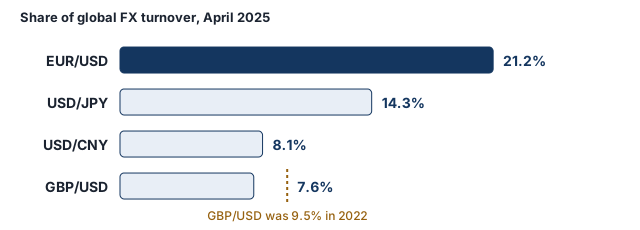
The most complete source on which pairs trade the most is the Bank for International Settlements (BIS) Triennial Central Bank Survey, run every three years with central banks around the world. In April 2025, global foreign exchange turnover averaged $9.6 trillion a day. By pair:
- EUR/USD was by far the most traded pair, with 21.2% of turnover: EUR/USD.
- USD/JPY was second with 14.3%: USD/JPY.
- USD/CNY (8.1%) moved ahead of GBP/USD in 2025. The Chinese yuan is not in the usual list of majors, but its turnover has grown quickly.
- GBP/USD was fourth with 7.6%, down from 9.5% in 2022: GBP/USD.
Shares are of global turnover in all instruments (spot, forwards, swaps and options), as reported by the BIS; they are not retail trading volumes.
What makes the majors different?
- High liquidity. With many buyers and sellers, large trades move the price less: liquidity.
- Tight spreads. The gap between bid and ask is usually smaller than on minor and exotic pairs, although it can widen around major news and at the daily rollover: what is a spread in forex.
- Plenty of information. Economic data and central bank decisions from the US, the euro area, Japan and the UK are closely followed and widely reported.
- Simple pip values. When the US dollar is the quote currency (EUR/USD, GBP/USD, AUD/USD, NZD/USD), one pip on a standard lot is $10 in a US dollar account. When the dollar is the base currency (USD/JPY, USD/CHF, USD/CAD), the pip value depends on the price: what is a pip, pip value calculator.
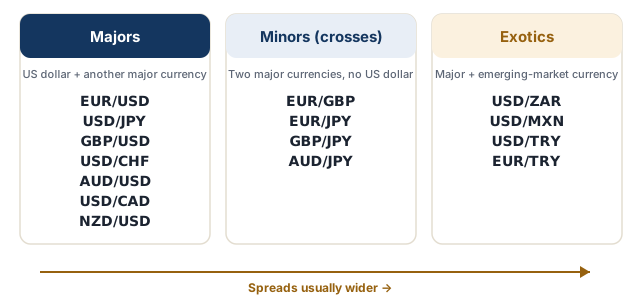
Majors, minors and exotics
| Type | Definition | Examples |
|---|---|---|
| Major pairs | US dollar + another major currency | EUR/USD, USD/JPY, GBP/USD |
| Minor pairs (crosses) | Two major currencies, no US dollar | EUR/GBP, EUR/JPY, GBP/JPY |
| Exotic pairs | A major currency + an emerging-market currency | USD/ZAR, USD/MXN, USD/TRY |
Spreads and swaps on exotic pairs are usually higher, and price moves can be sharper and gappier. Holding any pair overnight carries a swap charge or credit set by the broker: what is a swap in forex.
Free email course
Forex Risk Management in 5 Days
A free five-day email course: risk per trade, stop losses, position sizing, risk-reward and drawdowns, with a worked example each day.
Frequently asked questions
How many major currency pairs are there?
Seven, by the usual definition, and all of them include the US dollar: EUR/USD, USD/JPY, GBP/USD, USD/CHF, AUD/USD, USD/CAD and NZD/USD.
What is the most traded currency pair?
EUR/USD. In the BIS Triennial Survey of April 2025 it accounted for 21.2% of global foreign exchange turnover; USD/JPY was second with 14.3%.
Why is EUR/USD a major pair?
It pairs the US dollar with the euro, the second most traded currency, and it is the most traded pair in the world: 21.2% of global FX turnover in April 2025, according to the BIS.
What is the difference between major and minor pairs?
Major pairs include the US dollar. Minor pairs, also called crosses, pair two major currencies without the dollar, such as EUR/GBP or EUR/JPY. Spreads on minors are usually a little wider than on majors.
Is USD/CNY a major pair?
Not in the usual seven-pair list, although it is heavily traded: 8.1% of global turnover in April 2025 by BIS figures, more than GBP/USD. The onshore yuan (CNY) is subject to Chinese capital controls; many retail brokers offer USD/CNH, the offshore yuan, instead, or do not offer the pair at all.
Which major pair is best for beginners?
No pair makes a trade more likely to win. EUR/USD is often suggested as a first pair because it is the most liquid pair, its spread is usually among the tightest and its pip value in a US dollar account is fixed at $10 per standard lot.
Sources
Regulatory and official sources
- Triennial Central Bank Survey of foreign exchange and OTC derivatives markets in 2025, Bank for International Settlements
- Global FX trading hits $9.6 trillion per day in April 2025 (press release, 30 September 2025), Bank for International Settlements
- Triennial Survey 2025, foreign exchange turnover tables, Bank for International Settlements
Related articles
- How to Read Currency Pairs: Base and Quote Currency Explained
How to read currency pairs in forex: base and quote currency, what EUR/USD 1.0850 means, what a rising pair means, bid and ask, cross rates, with examples.
- EUR/USD Explained: The Euro Dollar Pair and What Moves It
EUR/USD explained: how to read the euro dollar pair, what moves EURUSD (ECB, Fed, data), pip value per lot, trading hours and a worked example.
- What Is a Spread in Forex? How Spreads Work and What They Cost
What is a spread in forex? The gap between bid and ask, how to calculate spread cost per lot, fixed vs variable spreads, commission and why spreads widen.
- What Is a Pip in Forex? Meaning, Pip Value & Examples
What is a pip in forex? Pip meaning, how to count pips, pip value per lot, pips on JPY pairs, pipettes and pip vs point, with worked examples.
- What Is Forex? The Foreign Exchange Market Explained
What is forex? The foreign exchange market explained: how it works, how big it is, who trades it, how pairs are quoted and what moves rates.
- GBP/USD Explained: Cable, What Moves It and Pip Value
GBP/USD explained: how to read the pound dollar pair, why it is called cable, what moves GBPUSD (Bank of England, Fed, data), pip value and a worked example.
- USD/JPY Explained: The Dollar Yen Pair, Pips and Drivers
USD/JPY explained: how to read the dollar yen pair, why a yen pip is 0.01, pip value in dollars, what moves USDJPY (Fed, Bank of Japan, carry trade).
Glossary terms
- Liquidity
Liquidity is how easily a currency pair can be bought or sold without moving its price much. Highly liquid pairs tend to have tighter spreads and less slippage.
- Spread
The spread is the difference between the bid (sell) price and the ask (buy) price of a currency pair. It is one of the main trading costs and is usually measured in pips.
- Pip
A pip is the standard unit for measuring price changes in a currency pair: 0.0001 for most pairs and 0.01 for pairs quoted in Japanese yen.
First published 18 October 2026. Last fact-checked 18 October 2026.This article is for educational purposes only and is not investment advice.