Prop Firm vs Broker: Funded Account or Your Own Account?
In the prop firm vs broker comparison, a prop firm sells a paid evaluation, often on a simulated account, and pays a share of eligible profits under its programme rules. A broker account is funded with the trader's own capital and is subject to the broker's execution and regulatory framework. In many retail prop firm models the trader's direct loss is limited to the fees paid, while a regulated broker offers client money protections.
Key takeaways
- With a prop firm, the trader pays a programme fee; with a broker, the trader deposits their own capital.
- In many retail prop firm models, the trader's direct financial loss is limited to the challenge or programme fees paid, subject to the programme terms.
- Prop firm accounts are often simulated and pay a profit split set by the programme; a broker account is a live brokerage account and the trader keeps all profits.
- Brokers serving retail clients are authorised by a financial regulator with client money rules; prop firms are generally not authorised as investment firms, depending on the jurisdiction and business model.
- Prop firms impose daily and maximum loss limits; at a broker, limits are the trader's own, plus the broker's margin call and stop out levels.
At a glance
- Capital
- Prop: the firm; broker: you
- Most you can lose
- Prop: fees, in many models; broker: deposit, or more without negative balance protection
- Profits
- Prop: a split; broker: all yours
- Money protection
- Prop fees: generally none; broker: client money rules where regulated
Prop firm vs broker: what is the difference?
The difference between a prop firm and a broker is who owns the capital and what the trader pays for. A broker account is funded with the trader’s own capital and is subject to the broker’s execution and regulatory framework; the trader keeps all profits and bears all losses: how to choose a forex broker. A prop firm sells an evaluation, often called a challenge: the trader pays a fee, trades an account owned by the firm, often a simulated account, and, after passing, receives a share of eligible profits on a funded account: what is a prop firm?
| Prop firm account | Broker account | |
|---|---|---|
| Who owns the capital? | The firm | The trader |
| Is the account simulated? | Often, for the challenge and the funded stage | No: a live brokerage account funded with the trader’s own money |
| What the trader pays | Challenge or programme fees (a service) | A deposit (the trader’s own capital) |
| Who bears trading losses? | The firm’s account; the trader loses the fee if a rule is broken | The trader |
| Most the trader can lose | The fees paid, in many models, subject to the programme terms and any additional fees | The deposit; protection against losing more depends on the regulator |
| Profits | A profit split set by the programme | All profits belong to the trader |
| Payout or withdrawal | Payouts under the firm’s payout rules | Withdrawals of the trader’s own balance |
| Trading rules | Daily and maximum loss limits, sometimes consistency, news or weekend rules | The trader’s own, plus margin call and stop out levels |
| Client money protection | Generally none: the fee is not client money | Segregated client funds and other protections where the broker is regulated |
What can you lose with a prop firm vs a broker?
Prop firm risk vs broker risk comes down to whose money is at stake. In many retail prop firm models, the trader’s direct financial loss is limited to the challenge or programme fees paid, including resets and add-ons; most firms do not ask traders to cover losses on the account, and the account is closed when a loss limit is broken. At a broker, the deposit is at risk and leverage magnifies losses. In the UK and the EU, retail clients of authorised brokers have negative balance protection, so losses cannot exceed the deposit; elsewhere it depends on the regulator: what is leverage in forex?
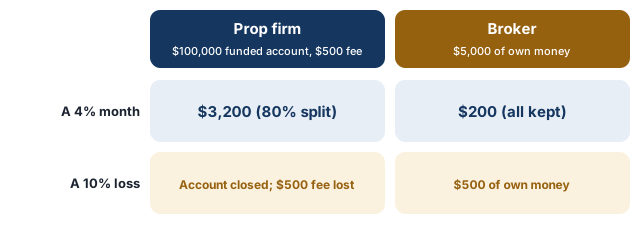
Prop Firm vs Broker Example: Same Strategy, Different Capital (illustrative only)
Assumptions: a trader makes 4% in a month on the account size used.
- Prop firm: a $100,000 funded account after a $500 challenge fee. Profit $4,000; with an 80% profit split the trader receives $3,200. A 10% loss instead would close the account, and the loss would be the $500 fee.
- Broker: a $5,000 personal trading account. Profit $200, all kept. A 10% loss would cost $500 of the trader’s own money.
The example illustrates the difference between fee-based access to a larger simulated balance and trading with personally deposited capital. A prop firm account vs a broker account also differs in what happens after a loss: one bad day can end a prop firm account, while a broker account continues as long as the trader has margin.
Are prop firms regulated like brokers?
Prop firm regulation vs broker regulation differs in most jurisdictions. A broker that serves retail clients must be authorised by a financial regulator, such as the FCA in the UK or CySEC in Cyprus, which sets rules on client money, leverage and complaints: forex regulation. Prop firms are generally not authorised as investment firms, depending on the jurisdiction and business model: FTMO states that its companies do not act as a broker and do not accept deposits, and FundedNext describes itself as not subject to conventional financial regulations. Belgium’s FSMA has warned that prop trading firms do not hold an authorisation to provide investment services there: are prop firms legit?
A regulated broker must keep client money separate from its own, as segregated client funds. A prop firm fee is a payment for a service, so these client money rules do not apply to it.
Prop Firm vs Broker: Key Trade-Offs
- Capital at risk: the programme fees at a prop firm; the trader’s own deposit at a broker.
- Trading restrictions: firm-set loss limits and rules at a prop firm; the trader’s own risk limits at a broker.
- Profit split: a share set by the programme at a prop firm; all profits at a broker.
- Regulatory protection: generally none for prop firm fees; client money rules and, in some jurisdictions, compensation schemes at a regulated broker.
- Account ownership: the firm owns the funded account; the trader owns the brokerage account.
- Execution: often simulated at a prop firm; live market execution at a broker.
- Withdrawal rights: payouts under the firm’s rules at a prop firm; withdrawals of the trader’s own balance at a broker.
The two models are not mutually exclusive and serve different purposes. Our guides to prop firm drawdown rules and to choosing a broker cover the checks for each.
Free email course
Forex Risk Management in 5 Days
A free five-day email course: risk per trade, stop losses, position sizing, risk-reward and drawdowns, with a worked example each day.
Frequently asked questions
What is the difference between a prop firm and a broker?
A prop firm sells an evaluation and pays a share of eligible profits on an account it owns, often simulated. A broker gives access to the market through a live account funded with the trader's own money, under a financial regulator's rules.
Is a prop firm a broker?
Generally no. Prop firms such as FTMO state that they do not act as a broker and do not accept deposits; they sell evaluations and pay profit shares under their own terms. Some prop firm groups also own a separate broker.
Do prop firms use brokers?
Some do. A prop firm may run its simulated accounts on a broker's or technology provider's platform, use a broker for its own trading, or belong to a group that owns a broker. The trader does not open an account with that broker.
Is a funded account the same as a brokerage account?
No. A prop firm funded account belongs to the firm, is often simulated and follows the firm's rules; a brokerage account belongs to the trader, holds the trader's own money and is protected by client money rules where the broker is regulated.
Can you lose more than the fee at a prop firm?
In many retail prop firm models the direct loss is limited to the fees paid, including resets and add-ons, and firms do not ask traders to cover account losses. At a broker the deposit is at risk, and protection against losing more depends on the regulator.
Sources
Regulatory and official sources
- Trading objectives (FTMO companies do not act as a broker), FTMO
- What capital will I trade on an FTMO account?, FTMO
- Is FundedNext regulated?, FundedNext
- The FSMA warns consumers against shadow investment game (7 March 2024), FSMA (Belgium)
- Client money and assets, Financial Conduct Authority
Related articles
- What Is a Prop Firm? How Prop Trading Firms Work
What a prop firm is and how prop trading firms work: challenge fees, prop firm evaluations, funded and simulated accounts, profit splits, rules and risks.
- How to Choose a Forex Broker: A Checklist
How to choose a forex broker: regulation, client money protection, total trading costs, order execution, platforms and withdrawal terms, with a checklist.
- Prop Firm Challenge Explained: One-Step, Two-Step and Instant Funding
How a prop firm challenge works: one-step vs two-step evaluations, instant funding, profit targets, drawdown limits, trading days, fees and refunds.
Glossary terms
- Funded account
A funded account is the prop firm account a trader receives after passing a challenge, or directly through instant funding, on which profits are shared under the firm's profit split.
- Simulated account
A simulated account is a trading account that uses fictitious capital and does not execute trades in the real market; many prop firms use simulated accounts for challenges and for funded accounts, and pay real payouts from their own revenue.
- Segregated client funds
Segregated client funds are client money that a broker holds in accounts kept separate from its own operating money, so that it is identified as belonging to clients rather than to the firm.
- Negative balance protection
Negative balance protection is a rule or broker policy under which a client cannot lose more than the funds in their trading account; if a loss pushes the balance below zero, the negative amount is not claimed from the client.
- Profit split
A profit split is the percentage of eligible profits on a funded prop firm account that the firm pays to the trader; the firm keeps the rest.
First published 4 October 2026. Last fact-checked 4 October 2026.This article is for educational purposes only and is not investment advice.