How Do Prop Firm Payouts Work? Profit Split, Timing and Rules
A prop firm payout is the trader's contractual share of eligible profits, paid after the firm checks that the account meets its payout rules. Each firm sets a waiting period, a payout frequency, a profit split and eligibility rules that vary by programme, and some programmes refund all or part of the challenge fee after a qualifying payout. On simulated funded accounts, payouts are paid from the firm's business revenue.
Key takeaways
- A prop firm payout is the trader's contractual share of eligible profits on a funded account, not a withdrawal of the trader's own money.
- Firms set a waiting period before the first payout, a payout frequency and eligibility rules that vary by programme.
- Payout rules can include minimum and maximum amounts, consistency conditions, closed positions and identity checks (KYC).
- Some programmes refund all or part of the challenge fee after a qualifying payout; others do not refund it.
- Some programmes adjust or reset the account balance or loss limit after a payout according to their payout rules.
At a glance
- A payout is
- Your share of eligible profits
- Example (illustrative)
- $3,200 + $500 refund
- Guaranteed?
- No
- Tax
- Depends on country and status
How do prop firm payouts work?
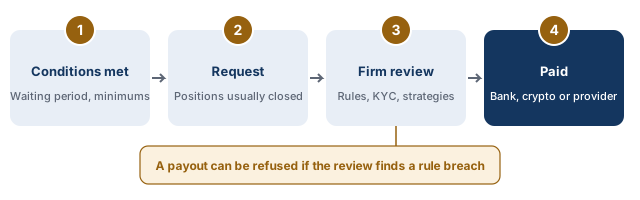
A prop firm payout is the trader’s contractual share of eligible profits, paid after the firm verifies that the account meets its payout rules. The trader requests it once the conditions are met; the firm reviews the account, calculates the trader’s share under the profit split and pays it. Because the funded account belongs to the firm and is often a simulated account, a prop firm payout is not a withdrawal of the trader’s own money: how do prop firms make money?
Prop Firm Payout Example: $100,000 Funded Account (illustrative only)
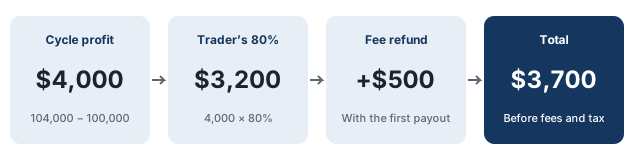
Assumptions: the account closes the payout cycle at $104,000 (a $4,000 profit), the profit split is 80%, and the programme refunds the $500 challenge fee with the first payout.
- Trader’s share: $4,000 × 80% = $3,200.
- Fee refund: $500.
- Total received: $3,700, before any withdrawal fees or taxes. What happens to the balance afterwards depends on the programme; some reset it to $100,000 for the next cycle.
When can you request a prop firm payout?
Each prop firm payout schedule has two parts: a waiting period before the first payout, and a payout frequency for later payout cycles. Processing time after a request is a separate step.
| Firm and programme | First payout | Payout frequency | Profit split | Fee refund timing |
|---|---|---|---|---|
| FTMO Challenge (2-Step) | From the 14th day after the first funded trade | Not specified in FTMO’s payout FAQ | 80%, up to 90% | With the first reward |
| FTMO Challenge (1-Step) | From the 14th day after the first funded trade | Not specified in FTMO’s payout FAQ | 90% | Not refunded |
| FundedNext Stellar 2-Step | After 21 days (default schedule) | Every 14 days; faster options at a lower split | 80%, up to 90% | With the first reward |
| FundedNext Stellar 1-Step | After 5 business days | Every 5 business days | 80%, up to 90% | With the third reward |
| The5ers High Stakes | 14 days after the funded account starts | Every 14 days | 80%, up to 100% | 70% in cash with the first payout |
Rules as published by each firm on 3 October 2026; check the current terms before buying a challenge.
Common Prop Firm Payout Rules and Conditions
- Profit split: the percentage of eligible profit paid to the trader; it varies by programme and may change under scaling plans or add-ons.
- Minimum payout: some programmes set a minimum profit for a payout, such as $500 on The5ers’ $100K High Stakes account.
- Maximum payout or payout cap: some programmes limit each payout; The5ers caps each $100K High Stakes payout at $4,000: payout cap.
- Consistency rule: some programmes require that no single day makes up more than a set share of profit before a payout: prop firm consistency rule.
- Open positions: firms usually require positions to be closed when a payout is requested.
- KYC: a first payout usually needs identity verification and a signed agreement.
- Payout eligibility: a payout can also depend on trading days, a profit buffer or the absence of prohibited strategies.
Is the Prop Firm Challenge Fee Refunded?
Some programmes refund all or part of the challenge fee after a qualifying payout; others do not. FTMO refunds the 2-Step fee with the first reward and does not refund the 1-Step fee. FundedNext refunds the Stellar 2-Step fee with the first reward and the 1-Step and Lite fees with the third. The5ers returns 10% and 20% of the High Stakes fee as credits during the challenge and 70% in cash with the first payout. E8 Markets does not refund the fee with payouts.
Prop Firm Payout Methods and Fees
Common payout methods are bank transfer, crypto payout and payment providers such as Rise. A withdrawal fee may apply: The5ers states a 3.5% fee on bank, crypto and Rise withdrawals. After a payout, some programmes adjust or reset the account balance or the loss limit according to their payout rules; FTMO’s 1-Step, for example, resets its trailing maximum loss after a reward withdrawal: prop firm drawdown rules.
Are prop firm payouts guaranteed?
No. A payout is subject to the firm’s rules, account review and ability to pay. On simulated funded accounts, payouts come from the firm’s business revenue rather than from withdrawing money from the simulated account itself. Firms can deny a payout for a breach of their rules, and firms that closed have left payouts unpaid. Payout figures published by firms are usually not independently audited: are prop firms legit?
Are prop firm payouts taxed?
Tax treatment varies by jurisdiction and by the legal status of the trader, for example whether payouts count as business income, other income or trading gains. The trader is normally responsible for declaring payouts; check with a tax adviser in your country.
Free email course
Forex Risk Management in 5 Days
A free five-day email course: risk per trade, stop losses, position sizing, risk-reward and drawdowns, with a worked example each day.
Frequently asked questions
How do prop firm payouts work?
Once a funded account meets the firm's payout rules, the trader requests a payout of their share of eligible profit, the profit split. The firm reviews the account and pays by bank transfer, crypto or a payment provider.
What is a prop firm profit split?
The percentage of eligible profit on a funded account that the firm pays to the trader. It is set by the programme and may change under a scaling plan or with paid add-ons.
When can I request my first prop firm payout?
It depends on the programme. FTMO allows a first request from the 14th day after the first funded trade, FundedNext Stellar 2-Step after 21 days on its default schedule, and FundedNext Stellar 1-Step every five business days.
How long does a prop firm payout take after approval?
Processing time is separate from the waiting period. FTMO says review takes one to two business days and payment usually one to two business days after approval; The5ers says withdrawals are typically processed within three business days.
Can a prop firm deny a payout?
Yes. A payout can be denied or reduced for a breach of the firm's rules, a prohibited trading strategy, an unmet consistency rule or payout condition, or missing identity verification (KYC).
Do prop firms pay real money from simulated accounts?
Yes, the payout itself is real money, but on a simulated funded account it is paid by the firm from its business revenue, not withdrawn from a trading balance in the market.
Sources
Regulatory and official sources
- How do I withdraw my profits?, FTMO
- Is the entry fee refunded?, FTMO
- How often will I receive my performance reward?, FundedNext
- Will I get back my registration fee?, FundedNext
- Payout policy and Hub Credit in the High Stakes program, The5ers
- Withdrawals, everything you need to know, The5ers
- Refund policy, E8 Markets
Related articles
- How Do Prop Firms Make Money? The Prop Firm Business Model
How do prop firms make money? The prop firm business model explained: challenge fees, resets, add-ons, simulated accounts, payouts and conflicts of interest.
- Prop Firm Consistency Rule: How It Works, With Examples
The prop firm consistency rule explained: how the best day percentage is calculated, what happens if you exceed it, and FTMO, FundedNext and Topstep rules.
- What Is a Prop Firm? How Prop Trading Firms Work
What a prop firm is and how prop trading firms work: challenge fees, prop firm evaluations, funded and simulated accounts, profit splits, rules and risks.
Glossary terms
- Payout
A prop firm payout is the payment of a funded trader's share of eligible profits, made by the firm under its profit split and payout rules.
- Profit split
A profit split is the percentage of eligible profits on a funded prop firm account that the firm pays to the trader; the firm keeps the rest.
- Payout cap
A payout cap is the maximum amount a prop firm pays a funded trader in a single payout or payout cycle; profit above the cap stays on the account or is paid in later cycles, depending on the programme.
- Challenge fee
A challenge fee is the price a trader pays a prop firm to take an evaluation (a challenge) with a profit target and loss limits; it pays for a service, is kept by the firm if the challenge fails, and some programmes refund it after a qualifying payout.
- Simulated account
A simulated account is a trading account that uses fictitious capital and does not execute trades in the real market; many prop firms use simulated accounts for challenges and for funded accounts, and pay real payouts from their own revenue.
- Consistency rule
A consistency rule is a prop firm condition that limits how much of a trader's total profit may come from a single day or trade, so that results are not driven by one outsized gain.
First published 4 October 2026. Last fact-checked 4 October 2026.This article is for educational purposes only and is not investment advice.