How Do Prop Firms Make Money? The Prop Firm Business Model
Challenge fees are a major revenue source for many retail prop firms: traders pay for an evaluation, and the fee is kept when a challenge is failed. Resets, add-ons and other products add to it, and some firms say they also trade their own capital. Because many firms use simulated accounts, payouts to successful traders are paid from the firm's business revenue, not from market profits on the trader's account.
Key takeaways
- Challenge fees are a major revenue source for many retail prop firms; the fee is kept when a challenge is failed.
- Resets, paid add-ons, education or tools and, at some firms, broker-related revenue or proprietary trading add to the prop firm revenue model.
- On simulated funded accounts, payouts are paid by the firm from its business revenue, not withdrawn from a trader-owned balance.
- A fee-based evaluation model creates an economic tension, because failed challenges generate revenue, while successful traders create payout obligations.
- The model depends on fee revenue and other income being sufficient to cover payouts and operating costs.
Watch: the short version
How Do Prop Firms Make Money? Where Your Challenge Fee Goes
Narration: AI voice. Educational only, not investment advice.
At a glance
- Major source
- Challenge fees, for many firms
- Also
- Resets, add-ons, tools
- Payouts on simulated accounts
- Paid from firm revenue
- Built-in tension
- Failed challenges earn fees
How do prop firms make money?
Challenge fees are a major revenue source for many retail prop firms. A trader pays a challenge fee to take an evaluation with a profit target and loss limits; the fee varies by account size and programme. If the trader breaks a rule or does not reach the target, the challenge ends and the firm keeps the fee. Belgium’s financial regulator, the FSMA, described this prop firm business model in a 2024 warning: traders often pay for several challenges before passing, and that is how these firms earn money from them: what is a prop firm?
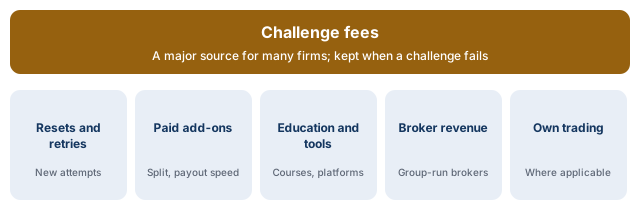
The prop firm revenue model usually combines several sources:
- Challenge fees: the price of the evaluation, kept when a challenge is failed.
- Resets and retries: a new attempt after a failed or expired challenge.
- Paid add-ons: options sold at checkout, such as a higher profit split, faster payouts or permission to use expert advisors.
- Education and tools: courses, platforms or trading tools sold by some firms or their partners.
- Broker-related revenue: some firms belong to a group that also runs a broker.
- Proprietary trading, where applicable: some firms say they trade their own capital, using data from traders’ accounts.
E8 Markets, for example, lists fees, internal use of trading data and proprietary trading by an affiliated entity as its sources of income. How prop firms earn money therefore differs by firm, and few publish the split between these sources.
Where do prop firm payouts come from?
On simulated funded accounts, payouts are paid by the prop firm from its own business revenue rather than withdrawn from a trader-owned trading balance. Many major retail prop firms use simulated challenge and funded accounts: FTMO, for example, states that all accounts it provides are demo accounts using fictitious capital. A profit on a simulated account is not earned in the market, so prop firm payout funding comes from the firm’s revenue, and a trader’s losses on that account cost the firm nothing in the market.
Some firms also say they use the trading of successful traders. FTMO states that it may trade its own capital using data from client accounts, as a separate process. FundedNext describes FNmarkets as an independent broker within the same group. Whether a given trader’s positions are copied to a real market is usually decided by the firm and not disclosed per account: how do prop firm payouts work?
Prop Firm Business Model Example: Fees vs Payouts (illustrative only)
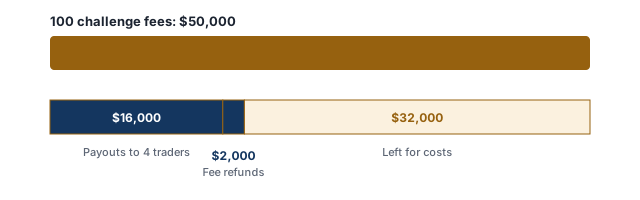
Assumptions: 100 traders each buy a $100,000 challenge for $500 (total challenge fees $50,000). Ten pass, and four of them each make a $5,000 simulated profit on the funded account, with an 80% profit split.
- Payouts: 4 × $5,000 × 80% = $16,000.
- Fee refunds to the four who were paid (if the firm refunds the fee with the first payout): 4 × $500 = $2,000.
- Left to cover platforms, data, staff, marketing and affiliate commissions: $50,000 − $16,000 − $2,000 = $32,000.
This is not an estimate of industry pass rates, payout rates or profit margins; the numbers only show how fee revenue relates to payouts in the model.
Is the prop firm business model a conflict of interest?
The question of a prop firm conflict of interest comes from how the model is built. A fee-based evaluation model can create an economic tension, because failed challenges generate revenue while successful traders create payout obligations. Rules such as tight daily loss limits, trailing drawdowns or consistency rules affect how many traders pass: prop firm drawdown rules.
Regulators have pointed to this. The FSMA called the activity a “shadow investment game” and noted that the firm alone decides the conditions and which simulated trades it copies. Italy’s Consob compared these offers to a trading “video game”. At the same time, firms compete for customers on their payout record, which is why many publish payout totals, although usually without an independent audit: are prop firms legit?
Prop Firm Business Model Risks for Traders
- The fee is the amount at risk. Prop firm challenge fees pay for a service; they are not a deposit or an investment, and they are lost if the challenge fails.
- Payouts depend on the firm’s finances. If fee revenue and other income do not cover payouts and costs, or a firm loses access to a trading platform, payouts can be delayed or the firm can close.
- Rules can change. Firms adjust rules, prices and profit splits, sometimes for new accounts only. The rules that apply are those of the account on the day of purchase.
Our prop firm reviews give the most weight to payout reliability and track record for this reason, and our guide to the prop firm challenge explains the rules that decide most evaluations.
Free email course
Forex Risk Management in 5 Days
A free five-day email course: risk per trade, stop losses, position sizing, risk-reward and drawdowns, with a worked example each day.
Frequently asked questions
How do prop firms make money?
Challenge fees are a major source of revenue for many retail prop firms, together with resets and paid add-ons. Some firms also sell education or tools, are linked to a broker, or trade their own capital using data from traders' accounts.
Do prop firms profit from failed challenges?
A failed challenge means the firm keeps the fee and owes no payout, so failed challenges are part of the revenue in a fee-based prop firm business model. How much of a firm's income they represent is rarely published.
Are prop firms profitable if traders win?
A firm can absorb payouts to winning traders if its fee revenue and other income cover them and its costs. Firm-level economics vary and are rarely published; firms that could not keep this balance have closed.
Where do prop firm payouts come from?
On simulated funded accounts, payouts are paid by the prop firm from its own business revenue rather than withdrawn from a trader-owned trading balance. Firms that copy some traders' positions to real markets may also fund payouts from those trades.
Do prop firms copy traders' trades?
Some say they may. FTMO, for example, states that it may trade its own capital using data from client accounts as a separate process. Whether a given trader's trades are copied is usually decided by the firm and not disclosed.
Sources
Regulatory and official sources
- The FSMA warns consumers against shadow investment game (7 March 2024), FSMA (Belgium)
- Beware of online trading "video games" (press release, 8 July 2024), Consob (Italy)
- How does an FTMO account work from the technical side?, FTMO
- What capital will I trade on an FTMO account?, FTMO
- What is the relationship between FundedNext and FNmarkets?, FundedNext
- Are fees your main source of income?, E8 Markets
Related articles
- What Is a Prop Firm? How Prop Trading Firms Work
What a prop firm is and how prop trading firms work: challenge fees, prop firm evaluations, funded and simulated accounts, profit splits, rules and risks.
- How Do Prop Firm Payouts Work? Profit Split, Timing and Rules
How prop firm payouts work: profit split, payout schedule, first payout timing, payout rules and caps, fee refunds, methods and fees, with firm examples.
- Are Prop Firms Legit? Regulation, Risks and How to Check
Are prop firms legit or scams? How prop firms are regulated, past industry problems, red flags and a checklist for checking whether a prop firm is legit.
Glossary terms
- Challenge fee
A challenge fee is the price a trader pays a prop firm to take an evaluation (a challenge) with a profit target and loss limits; it pays for a service, is kept by the firm if the challenge fails, and some programmes refund it after a qualifying payout.
- Simulated account
A simulated account is a trading account that uses fictitious capital and does not execute trades in the real market; many prop firms use simulated accounts for challenges and for funded accounts, and pay real payouts from their own revenue.
- Funded account
A funded account is the prop firm account a trader receives after passing a challenge, or directly through instant funding, on which profits are shared under the firm's profit split.
- Profit split
A profit split is the percentage of eligible profits on a funded prop firm account that the firm pays to the trader; the firm keeps the rest.
- Payout
A prop firm payout is the payment of a funded trader's share of eligible profits, made by the firm under its profit split and payout rules.
First published 4 October 2026. Last fact-checked 4 October 2026.This article is for educational purposes only and is not investment advice.